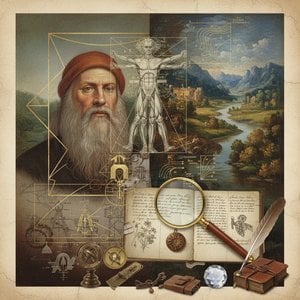
Francisco de Holanda: The Silent Genius of Renaissance Portugal
Francisco de Holanda (c. 1517 – June 19, 1585) stands as a pivotal figure in Portuguese Renaissance art and intellectual history—a man whose profound impact on his time was largely overshadowed by the brilliance of contemporaries like Michelangelo and Raphael. Born in Lisbon, Portugal, he emerged from humble beginnings to become a court painter for successive monarchs João III and Sebastião I, shaping the visual landscape of Portugal during its golden age. Yet, unlike many artists of his era who sought fame and patronage, Holanda pursued artistic excellence with an unwavering dedication that yielded masterpieces imbued with both classical ideals and deeply personal spiritual contemplation.
- Early Life and Artistic Training: Holanda’s formative years were marked by a familial tradition in illumination—his father was a skilled scribe and manuscript illuminator—a craft that instilled in him a meticulous attention to detail and an appreciation for the expressive power of color and texture. Recognizing his talent, he received instruction from Michelangelo Buonarroti during his stay in Rome between 1538 and 1547, absorbing the humanist principles and sculptural techniques championed by the Florentine master.
- The Influence of Italian Renaissance Art: Holanda’s artistic sensibilities were irrevocably shaped by his exposure to the vibrant artistic culture of Italy. He embraced the classical ideals of proportion, harmony, and idealized beauty—evident in his paintings and drawings—drawing inspiration from monumental sculptures like Michelangelo's Pietà and Raphael's frescoes in the Vatican Palace.
- A Painter’s Vision: Holanda’s distinctive style is characterized by a restrained palette dominated by muted earth tones—ochres, siennas, and umbers—which he skillfully blended to create atmospheric landscapes and portraits that convey profound emotion. His meticulous brushwork and careful rendering of light and shadow contribute to the illusionistic depth and realism of his compositions.
- Da Pintura Antigua: Holanda’s magnum opus, *De Aetatibus Mundi Imagines* ("Of The Ages Of The World"), represents a singular achievement in Iberian art. Completed in 1548, this ambitious manuscript—a lavishly illustrated sketchbook exploring biblical cosmology—demonstrates Holanda's mastery of perspective, anatomy, and decorative arts. It stands as the first treatise on painting written in Portugal, establishing him as a pioneer of humanist scholarship and artistic innovation.
- Legacy and Historical Significance: Though largely unrecognized during his lifetime, Holanda’s influence extended far beyond his immediate circle. His writings championed classical learning and aesthetic principles—a reaction against the prevailing Gothic style—promoting a more rational and harmonious vision of art and architecture. Today, Holanda's paintings reside in prestigious museums across Europe—including the Museu Nacional da Música in Lisbon and the Grão Vasco National Museum in Viseu—testament to his enduring artistic legacy and his contribution to the intellectual ferment of the Renaissance.
Holanda’s unwavering devotion to craft, combined with his profound engagement with humanist philosophy, cemented his place as one of Portugal's most important artists. His meticulous attention to detail and masterful use of color—traits that foreshadowed developments in Northern European art—established him as a visionary whose quiet genius continues to inspire admiration centuries later. He remains an artist who speaks volumes without uttering a word, embodying the spirit of Renaissance Portugal itself.