Early Life and Artistic Foundations
Francisco Galofré i Oller, born in Valls, Spain, in 1864, emerged from a region steeped in artistic tradition yet poised on the cusp of significant change. While details surrounding his earliest upbringing remain somewhat elusive, it is known that he received foundational training at the Academy of Fine Arts in Barcelona under the tutelage of Antonio Cabá. This initial exposure to academic principles would prove crucial, providing him with a solid technical base upon which to build his distinctive style. He further honed his skills at the Real Academia de San Fernando in Madrid, immersing himself in the broader Spanish artistic landscape and absorbing influences from both established masters and emerging trends.
A Commitment to Realism and Moralistic Themes
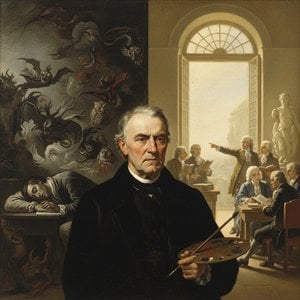
Galofré i Oller distinguished himself through a steadfast commitment to realism. In an era increasingly captivated by Impressionism and other avant-garde movements, he remained dedicated to portraying the world with meticulous accuracy and unwavering attention to detail. However, his realism was not merely observational; it served as a vehicle for exploring moralistic themes and exemplification. His paintings often depicted scenes designed to convey ethical lessons or illustrate the consequences of particular actions—a characteristic that set him apart from many of his contemporaries.
Development and Artistic Style
The artist’s development saw a gradual refinement of his realist technique, coupled with an increasing focus on narrative storytelling. He wasn't interested in fleeting moments of light or abstract forms; instead, he sought to capture the weight of human experience and the complexities of social life. His canvases often feature carefully composed scenes populated by figures engaged in everyday activities, yet imbued with symbolic significance. The use of chiaroscuro—the dramatic interplay of light and shadow—became a hallmark of his style, enhancing the emotional impact of his work and drawing viewers into the heart of each narrative.
Exhibitions, Recognition, and Legacy
Galofré i Oller actively participated in various exhibitions throughout Madrid, gaining recognition for his skillful execution and thought-provoking subject matter. He received several prizes acknowledging his talent and dedication to his craft. While he existed alongside the burgeoning Modernist movement in Barcelona, he resolutely maintained his allegiance to realism, carving out a unique niche for himself within the Spanish art world. His work, though perhaps less celebrated than that of some of his more radical peers, offers a valuable insight into the diverse artistic currents of the late 19th and early 20th centuries.
Historical Significance and Notable Works
Today, Galofré i Oller is remembered as a compelling exponent of realist painting with a strong moralistic bent. His paintings provide a fascinating glimpse into Spanish society during a period of rapid transformation. “A Model,” held in the collection of the Museu Nacional d'Art de Catalunya (MNAC), exemplifies his style and thematic concerns—a carefully rendered depiction that invites contemplation on issues of representation, class, and societal expectations. His legacy lies not only in the technical proficiency of his work but also in his unwavering commitment to using art as a means of exploring ethical questions and reflecting the complexities of the human condition. He remains an important figure for understanding the breadth and diversity of Spanish painting during this pivotal era.