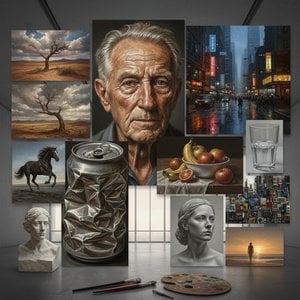
A Life Immersed in Stillness: The World of Filippo Gabrielli
Filippo Gabrielli, born in Rome in 1952, is an Italian artist whose work quietly compels attention through a masterful blend of classical technique and enigmatic subject matter. His paintings aren’t declarations; they are invitations to contemplation, still lives imbued with a subtle narrative power that unfolds slowly, rewarding patient observation. While his artistic journey has been marked by exhibitions in prestigious locations like the Palazzo Alliata in Forisportam and the Palazzo del Consiglio dei Dodici in Pisa, Gabrielli's influence extends beyond the canvas into the realm of cognitive research, revealing a mind as comfortable with intellectual inquiry as it is with aesthetic creation.
Early Influences and Artistic Development
Gabrielli’s formative years in Rome undoubtedly instilled within him an appreciation for art history and the rich visual heritage of the Italian Renaissance. This foundation is evident in his meticulous approach to composition, often echoing the traditions of Dutch still life painting while simultaneously forging a distinctly contemporary path. He earned his MFA from the School of the Museum of Fine Arts, Boston, and holds a BA in Art History from Harvard University—a testament to his dedication to understanding the historical context that informs his practice. This academic background isn’t merely theoretical; it permeates his work, manifesting as subtle allusions to past masters and a sophisticated engagement with symbolism. His early explorations weren't about replicating reality but rather about questioning it, imbuing everyday objects with layers of meaning through carefully considered arrangements and evocative lighting.
The Enigmatic Language of Objects
Gabrielli’s paintings are characterized by their unconventional pairings of seemingly disparate objects. He doesn’t depict the typical bounty of a market or the opulent displays of wealth; instead, he presents us with curious assemblages—a religious artifact alongside a scientific instrument, a piece of antique furniture juxtaposed with natural forms. This deliberate discordance isn't arbitrary. It invites viewers to construct their own narratives, prompting questions about history, memory, and the passage of time. Nel Guscio, his published work, hints at this preoccupation with interiority and hidden meanings—a shell as a metaphor for the self, containing layers of experience and untold stories. The hyper-realistic detail in his paintings further enhances this effect; each object is rendered with painstaking accuracy, demanding close scrutiny and revealing subtle textures and imperfections that contribute to their overall symbolic weight.
Beyond the Canvas: Research and Cognitive Exploration
What sets Gabrielli apart is not only his artistic talent but also his parallel career as a researcher in cognitive disorders. With 25 published works and over 210 citations on ResearchGate, he has made significant contributions to the field, notably authoring the Short Cognitive Evaluation Battery in Cognitive Disorders of the Elderly Italian Version. This dedication to understanding the complexities of the human mind seems intrinsically linked to his artistic practice. His paintings can be seen as visual explorations of memory, perception, and the subjective experience of reality—themes that resonate deeply with his research interests. The act of meticulously observing and rendering objects may be a reflection of his broader fascination with how we process information and construct meaning from the world around us.
Historical Significance and Lasting Legacy
While Gabrielli doesn’t adhere to any single artistic movement, his work occupies a unique space within contemporary realism. He is not simply recreating what he sees; he is constructing carefully orchestrated visual puzzles that challenge our perceptions and invite contemplation. His exhibitions in Rome and Pisa have established him as a notable figure in the Italian art scene, and his ongoing research continues to inform and enrich his artistic practice. His influence can be seen in the growing number of artists who are embracing a more nuanced approach to still life painting—one that prioritizes symbolism, narrative complexity, and intellectual engagement over mere technical virtuosity. The quiet power of Gabrielli’s work lies in its ability to remind us that even the most ordinary objects can hold profound meaning, waiting to be discovered by those willing to look closely enough.