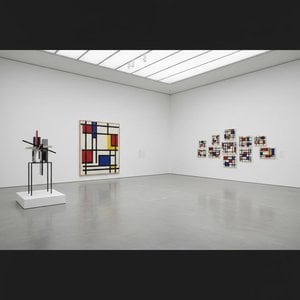
The Architect of Abstraction: The Life and Legacy of Farnese de Andrade
In the vibrant, transformative landscape of mid-20th century Brazil, few artists captured the tension between tradition and modernity as poignantly as Farnese de Andrade. Born in Rio de Janeiro in 1926, Andrade came of age during a period of profound social and political metamorphosis, a context that would inevitably seep into the fibers of his creative consciousness. His early artistic formation at the Guignard University of Art of Minas Gerais provided him with a rigorous technical foundation, yet it was his restless spirit that drove him to look beyond the academic confines of his era. While his initial forays into the world of art were marked by the dreamlike, distorted realities of Surrealism—a movement heavily influenced by the European avant-garde—Andrade soon found himself drawn toward a more structured, cerebral language of form and space.
This evolution led him to become a cornerstone of the influential Grupo Frente, a collective that sought to dismantle the remnants of academic formalism in favor of a new, radical visual vocabulary. Alongside contemporaries such as Antônio Dias and Sérly Espírito Santo, Andrade embraced the principles of Cubism and Constructivism, stripping away the unnecessary to reveal the essential. His work became a masterclass in geometric abstraction, where the canvas was no longer a window into a recognizable world, but a site for the interplay of precise lines, interlocking planes, and a deliberate, often restrained, color palette. Through this reduction, he invited viewers to engage not just with what is seen, but with the very mechanics of perception itself.
A Symphony of Form and Texture
The brilliance of Andrade’s oeuvre lies in his ability to imbue geometric rigidity with a profound sense of tactile life. His canvases often transcend mere mathematical arrangement, achieving a rhythmic vitality that feels almost organic. In works such as “Sem título,” he demonstrates an extraordinary command over the relationship between light and texture, transforming a still life into a complex exploration of depth and shadow through abstract shapes. This mastery extends to his more sculptural endeavors, where materials like wood, glass, and resin are manipulated to create three-dimensional dialogues between weight and transparency.
His artistic development was characterized by a continuous search for new visual languages, as evidenced by the diversity of his subject matter and medium:
- Geometric Precision: The use of interlocking planes and sharp contours to redefine spatial relationships.
- Material Experimentation: A transition from traditional painting to complex assemblages involving scrap wood, glass, and polychrome elements.
- Symbolic Reduction: The movement away from literal representation toward a philosophical engagement with the nature of reality.
Historical Significance and Enduring Resonance
Farnese de Andrade’s contribution to Brazilian Modernism cannot be overstated. He was not merely a participant in a movement; he was an architect of its most defining aesthetic shifts. By bridging the gap between the emotive qualities of Surrealism and the structural discipline of Constructivism, he helped forge a uniquely Brazilian identity within the global discourse of abstract art. His presence in major institutions, such as the Museum of Modern Art of São Paulo (MAM), underscores his importance to the canon of 20th-century art.
Though he passed away in 1996, the echoes of his experimentation continue to resonate within the contemporary art world. His ability to find beauty in the mathematical and meaning in the minimal remains a profound inspiration. Today, collectors and critics alike look to his work as a testament to a period when Brazilian art dared to break its own boundaries, seeking a universal truth through the language of pure form. Through his legacy, Andrade remains a luminous figure, reminding us that even within the strictest lines, there exists an infinite capacity for wonder.