Early Life and Artistic Foundations
Emilio Gola, born in Milan in 1851 into a noble family, possessed an artistic inclination nurtured from his youth. His father, though a dilettante painter himself, recognized and encouraged the burgeoning talent within his son, providing early guidance and fostering a love for visual expression. This familial support proved crucial as young Emilio embarked on a path that would eventually see him become a prominent figure in the Italian art scene of the late 19th and early 20th centuries. While initially pursuing a practical education – graduating in industrial engineering from the Polytechnic University of Milan in 1873 – Gola never fully abandoned his artistic calling. He supplemented his formal studies with private lessons under Sebastiano De Albertis, a respected artist who helped refine his technical skills and broaden his understanding of painting principles. Crucially, frequent journeys to France and the Netherlands exposed him to diverse artistic currents, laying the groundwork for his evolving style. These formative experiences instilled in Gola not only a mastery of technique but also an appreciation for the nuances of light, color, and composition that would become hallmarks of his work.The Rise of a Portraitist: Milanese Society and Naturalistic Approach
Gola’s formal debut arrived at the 1879 Exposition of Fine Arts at the Brera Academy, marking the beginning of his public career. He quickly established himself as a regular participant in national exhibitions, steadily gaining recognition for his distinctive approach to portraiture. By the 1880s, Gola had become an esteemed portraitist, sought after by women of Milanese nobility eager to capture their image on canvas. However, he wasn’t merely a recorder of likenesses; Gola infused his portraits with a vigorous naturalism that set him apart from more conventional artists of the time. He depicted his subjects not as idealized figures but as individuals possessing depth and character, capturing their fashionable, worldly dimension while simultaneously revealing an underlying sense of realism. This ability to balance elegance with authenticity proved immensely appealing, solidifying his reputation within Milanese society.Landscapes of Brianza and Stylistic Hallmarks
Alongside his success as a portraitist, Gola cultivated a rich repertoire of landscapes, particularly those depicting the countryside of Brianza – a region north of Milan known for its rolling hills and picturesque scenery. These paintings became integral to his artistic identity, showcasing a vibrant palette and a distinctive use of color that would define his stylistic hallmark. He masterfully captured the changing seasons and atmospheric conditions of Brianza, imbuing his landscapes with a sense of light and vitality. The bright colors he employed weren’t merely decorative; they served to convey emotion and create an immersive experience for the viewer. This period also saw him regularly depict views of Milan itself, further cementing his connection to the region and its aesthetic qualities.Later Years: Liguria, Venice, and Seascapes
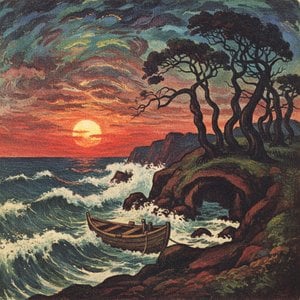
As Gola matured as an artist, his geographical focus expanded beyond Brianza and Milan. He became increasingly active in the regions of Liguria and Venice, drawn to their unique coastal landscapes and maritime atmosphere. This shift in location coincided with a renewed interest in seascapes, which would dominate his later work. These paintings were characterized by great formal synthesis and expressive intensity, reflecting a distillation of his earlier stylistic tendencies. He moved away from detailed representation towards a more evocative approach, focusing on capturing the essence of light, water, and atmosphere. His late-period seascapes demonstrate a remarkable ability to convey both the tranquility and power of the natural world. Throughout his career, Gola also dedicated himself to teaching, notably mentoring Alberto Malaspina (1853–1903), further contributing to the artistic landscape of Italy.Legacy and Historical Significance
Emilio Gola’s work represents a fascinating intersection of academic training, Impressionistic influences, and a distinctly Italian sensibility. He successfully navigated the demands of portraiture while simultaneously pursuing his passion for landscapes and seascapes, creating a body of work that is both technically accomplished and emotionally resonant. His ability to capture the spirit of Milanese society, the beauty of the Brianza countryside, and the allure of the Ligurian coast has secured his place as a key figure in Italian art history. While perhaps not as widely celebrated as some of his contemporaries, Gola’s paintings continue to captivate viewers with their vibrant colors, naturalistic approach, and evocative depictions of a bygone era. He stands as a testament to the enduring power of observation, technique, and a deep connection to one's surroundings.Otázky a odpovědi
Jak najdu všechna díla umělce Emilio Gola v určitém médiu?
Chcete-li najít všechna díla umělce Emilio Gola v určité technice, navštivte jeho stránku Podle techniky.
Kde mohu vidět díla umělce Emilio Gola v 3D galerii?
Díla umělce Emilio Gola si můžete prohlédnout v 3D galerii na jeho stránce 3D galerie.
Kde najdu díla umělce Emilio Gola uspořádaná podle tématu?
Stránka Atlas témat mapuje díla umělce Emilio Gola podle tématu.