Elmer Ellsworth Johnson: Capturing the Southwest and Beyond
Elmer Ellsworth Johnson, often simply known as Elmer Johnson, remains a quietly compelling figure in American landscape painting of the early 20th century. Born in Beardstown, Illinois, in 1884, his artistic journey led him to capture the evocative beauty of both the American Southwest and the European countryside – a duality reflected in the nuanced palettes and thoughtful compositions that define his work. While not widely celebrated during his lifetime, Johnson’s paintings offer a unique perspective on the era, blending realism with an understated romanticism.
Johnson's early life offers little documented detail, contributing to the mystique surrounding his artistic development. He spent time in Beardstown before relocating to California, where he began seriously pursuing painting. His initial training appears to have been largely self-directed, absorbing influences from the burgeoning landscape movement of the time – artists like Frederic Church and Thomas Moran, who were documenting the grandeur of the American West for a national audience. However, Johnson’s work quickly developed its own distinct character, moving beyond mere topographical representation.
A Career Bridging America and Europe
Johnson's professional career unfolded primarily during the 1910s and 1920s. He spent several years traveling extensively throughout the United States, focusing on the dramatic landscapes of Arizona, New Mexico, and Utah. These Southwestern scenes – vast mesas, towering buttes, and sun-baked canyons – became a cornerstone of his oeuvre. His paintings aren’t simply depictions; they strive to convey the feeling of being immersed in these wild spaces—the heat, the light, the sense of timelessness.
Following his time in America, Johnson embarked on a significant period of artistic exploration in Europe, particularly Spain and Italy. The Alhambra Palace in Granada, with its intricate Moorish architecture and vibrant colors, became a particular obsession. His “Room at the Alhambra” exemplifies this fascination, showcasing not just the physical structure but also the play of light and shadow within its walls—a masterful demonstration of his ability to capture atmosphere and mood. This European sojourn profoundly influenced his style, introducing him to new color palettes and compositional techniques, resulting in a richer, more layered approach to landscape painting.
Style and Technique
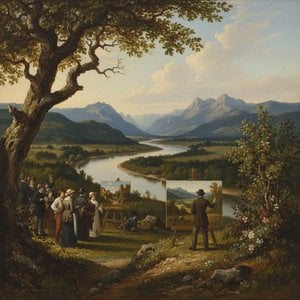
Johnson’s artistic style is characterized by a remarkable restraint. He avoided dramatic brushwork or overtly expressive gestures, instead favoring subtle gradations of tone and carefully observed details. His use of color is particularly noteworthy – often employing muted earth tones punctuated by unexpected bursts of vibrant hue. This restrained palette contributes to the paintings' sense of quiet contemplation and timelessness.
He was a meticulous observer, evident in his detailed renderings of architectural elements—from the weathered stonework of Spanish buildings to the rugged cliffs of the American West. His compositions are typically balanced and harmonious, guiding the viewer’s eye through the scene with a gentle confidence. While influenced by the landscape painters before him, Johnson developed a unique voice, prioritizing atmosphere and emotional resonance over purely representational accuracy.
Legacy and Recognition
Despite his talent and dedication, Elmer Ellsworth Johnson enjoyed relatively little recognition during his lifetime. His work was primarily exhibited in smaller galleries and private collections. However, in recent decades, there has been a growing appreciation for his quietly powerful landscapes. The Herbert F. Johnson Museum of Art in Ithaca, New York, holds a significant collection of his paintings, ensuring that his work continues to be studied and admired. The Piasecka-Johnson Collection at Princeton University also houses several examples of his art, showcasing the breadth of his artistic interests.
Furthermore, works like “School Nurse, Kindergarten Children, Nursery School at Arthurdale Project, West Virginia” demonstrate a compassionate side to Johnson’s artistry, revealing an interest in documenting everyday life and social issues. His paintings offer a valuable glimpse into a bygone era—a time when the American West was still being explored and documented, and when artists sought to capture its beauty with both skill and sensitivity. The Dr Johnson's House museum offers a fascinating parallel, highlighting the breadth of artistic interests within the Johnson family.
Johnson’s legacy lies not in grand pronouncements or revolutionary techniques, but rather in his quietly evocative landscapes—paintings that invite viewers to pause, reflect, and connect with the beauty and solitude of the natural world.