Ellsworth Woodward (1861-1939): A Pioneer of Southern Landscape Painting and Artistic Education
Ellsworth Woodward (1861–1939) stands as a pivotal figure in the artistic landscape of late 19th and early 20th century Louisiana, recognized primarily for establishing the Newcomb Pottery movement—a bold assertion of regional identity—and his distinctive approach to landscape painting that blended observation with structural considerations. Born in Seekonk, Massachusetts, he inherited an artistic lineage that instilled within him a lifelong passion for visual expression. His formative years were marked by exposure to rural surroundings and familial support for his burgeoning talent, nurtured initially through instruction at the Massachusetts School of Art.
Early Artistic Training and Influences
Woodward’s artistic journey commenced with foundational training in watercolor and oil painting at the Massachusetts School of Art, where he honed his skills under instructors who championed Impressionistic techniques—a movement profoundly impacting European art circles at the time. This influence extended beyond stylistic considerations; Woodward absorbed the ethos of valuing local materials and traditions – a cornerstone of what would become the Newcomb Pottery movement. Notably, he studied abroad briefly in Munich, engaging with the artistic sensibilities of Carl von Marr and Richard Fehr, broadening his intellectual horizons and enriching his visual vocabulary.
The Founding of Newcomb Pottery Movement
In 1876, Ellsworth and his brother William Woodward relocated to New Orleans, cementing their commitment to Southern culture and art as artists and educators. This move coincided with the burgeoning Arts and Crafts movement, which advocated for handcrafted objects imbued with aesthetic beauty and social purpose—a conviction that would shape Woodward’s artistic endeavors throughout his life. Recognizing the importance of fostering local artistry, he spearheaded the establishment of Newcomb Pottery in 1895, a collaborative venture between Tulane University and Sophie Newcomb College. This initiative aimed to elevate Southern ceramics as an art form while simultaneously grounding its production in regional resources and traditions—a deliberate rejection of mass-produced wares prevalent during the era. The movement’s success was attributed to Woodward's astute understanding of both artistic principles and social dynamics.
Woodward’s Artistic Style: Landscape Structure and Genre Painting
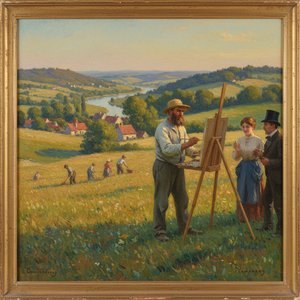
Woodward’s artistic style distinguished itself through a meticulous blend of Impressionistic brushwork and structural analysis—a technique he termed “landscape structure.” He sought not merely to depict scenes from Louisiana's natural beauty but also to convey the underlying geometric framework that governs its visual composition. This approach, exemplified in works like "Iris Field Near Newcomb Greenhouse," demonstrates his ability to capture atmospheric nuances while simultaneously emphasizing spatial relationships and compositional balance. Furthermore, Woodward excelled in genre painting—scenes depicting everyday life—often portraying Louisiana’s vibrant cultural traditions with sensitivity and detail. His portrait of William Woodward exemplifies this stylistic versatility.
Legacy and Recognition
Ellsworth Woodward's contributions extended beyond his artistic output; he served as a respected art educator at Tulane University and Newcomb College, inspiring generations of aspiring artists to embrace regional identity and explore innovative approaches to visual representation. Today, his paintings reside in prominent museums across the United States, including the Ogden Museum of Southern Art and the Historic New Orleans Collection—testaments to his enduring influence on American landscape painting and artistic pedagogy. His unwavering belief in the transformative power of art—coupled with his dedication to fostering local creativity—solidifies Ellsworth Woodward’s place as a significant figure within the history of Louisiana art and culture.