A Life Painted in Form and Feeling
Elizabeth Murray, born in Chicago in 1940 to Irish-Catholic parents, emerged as a pivotal figure in American art, reshaping modernist abstraction into a vibrant language of form brimming with personality. Her father, a lawyer, provided stability while her mother, harboring ambitions as a commercial artist, nurtured Elizabeth’s early artistic inclinations – a crucial foundation for the unique path she would forge. Murray's formal training began at the School of the Art Institute of Chicago in 1958, guided by a high school teacher who recognized her potential. This was followed by studies at Mills College in Oakland, California, where she earned her MFA in 1964. These formative years exposed her to a diverse range of influences – from the structural rigor of Cézanne and the innovative spirit of Robert Rauschenberg and Jasper Johns – all subtly informing the development of her distinctive style. However, it was the move to New York City in 1967 that truly ignited her artistic evolution, placing her at the epicenter of a rapidly changing art world.
Breaking the Frame: Innovation and Early Recognition
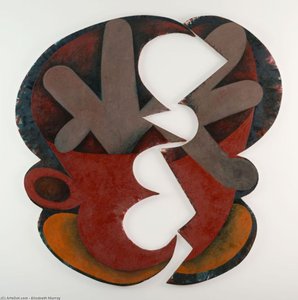
Murray’s most recognizable contribution lies in her revolutionary use of shaped canvases. Departing from the traditional rectangular format, she sculpted her paintings, giving them dynamic, often playful forms that extended beyond the confines of the frame. This wasn't merely a stylistic choice; it was a fundamental rethinking of painting itself – exploring its potential as an object and a space simultaneously. Her early exhibitions, including a breakthrough appearance at the Whitney Museum of American Art’s annual exhibition in 1971, began to garner attention for this innovative approach. *Children Meeting*, completed in 1978 and now residing in the Whitney's permanent collection, stands as an exemplary work from this period. It demonstrates her remarkable ability to convey emotion and suggest personality through non-figurative shapes, a masterful interplay of color, and dynamic lines. The painting’s title itself hints at a layered narrative – a suggestion of childhood encounters and the complexities of human relationships – rendered in bold, expressive forms that defy easy interpretation. This piece, like much of her work, reveals a deep connection to her childhood fascination with Walt Disney cartoons – a source of inspiration that infused her abstract compositions with a sense of whimsy and narrative suggestion. The use of bright, saturated colors, reminiscent of animated films, further emphasizes this playful aesthetic.
Themes, Influences, and Enduring Impact
Murray’s work consistently explored themes related to domestic life, relationships, and the very nature of painting itself. She seamlessly blended elements of Abstract Expressionism with the geometric precision of Minimalism, creating a unique visual language that was both intellectually rigorous and emotionally resonant. Her ability to reshape modernist abstraction into a high-spirited, cartoon-based aesthetic opened new avenues for artistic expression and influenced generations of artists. The influence of Cézanne is particularly evident in her use of flattened planes and multiple perspectives, while the dynamism of Rauschenberg’s combine paintings and Johns’s enigmatic subject matter provided a crucial counterpoint to the more rigid structures of Minimalism. She wasn't simply replicating these influences; she was actively transforming them, injecting her own personality and sensibility into each work. Murray’s exploration of domestic interiors – tables, chairs, cups, shoes – offered a surprisingly intimate glimpse into the everyday world, imbued with a sense of both familiarity and surrealism. The recurring motif of children, often depicted in fragmented or distorted forms, suggests themes of innocence, vulnerability, and the complexities of family dynamics.
Achievements and a Lasting Legacy
Throughout her career, Elizabeth Murray received significant recognition for her groundbreaking contributions to the art world. In 1982, she was awarded the Walter M. Campana Award from The Art Institute of Chicago, recognizing her innovative approach to painting. In 1984, she received an award from American Academy of Arts and Letters, further solidifying her position as a leading figure in contemporary art. A particularly notable moment arrived in 1993 when she was awarded the Larry Aldrich Prize in Contemporary Art – a prestigious recognition that highlighted the breadth and depth of her artistic vision. In 1999, Murray received a MacArthur Fellowship – often referred to as a “genius grant” – which provided her with the resources to pursue new ventures, including co-founding the Bowery Poetry Club with her husband, poet Bob Holman. This collaborative project demonstrated her commitment to fostering artistic dialogue and community engagement. Her work is featured in many major public collections, including the Solomon R. Guggenheim Museum, the Hirshhorn Museum and Sculpture Garden, the Pérez Art Museum Miami, the Museum of Modern Art, the Whitney Museum of American Art, the San Francisco Museum of Modern Art, the Art Institute of Chicago, the Carnegie Museum of Art, and the Wadsworth Atheneum. The retrospective at MoMA in 2006 was a watershed moment, cementing her legacy as one of the most important postmodern abstract artists of her time.
A Personal Canvas: Life and Remembrance
Elizabeth Murray’s life was enriched by strong personal connections. Her marriage to poet and poetry activist Bob Holman was a source of mutual support and creative inspiration. Together they raised three children – Sophia Murray Holman, Daisy Murray Holman, and Dakota Sunseri – weaving family life into the fabric of their artistic pursuits. The memorials held in her honor following her death – one at the Bowery Poetry Club and another at MoMA – testified to the profound impact she had on both the art world and those who knew her personally. As *The New York Times* obituary eloquently stated, she “reshaped modernist abstraction into a high-spirited, cartoon-based language of form whose subjects included domestic life, relationships and the nature of painting itself.” Elizabeth Murray’s work remains a testament to the power of artistic innovation, personal expression, and the enduring beauty of a life lived in pursuit of creative vision.