A Quiet Yet Insistent Voice: The Life of Elisabeth Vellacott
Elisabeth Jessie Vellacott, born in the early dawn of the twentieth century on January 28, 1905, was a painter whose work whispered with a profound and enduring strength. Though her name might not have commanded the headlines of the London art scene during her lifetime, her creative journey was one of remarkable depth and global vision. Raised in the intellectual and spiritual atmosphere of Cambridge—where her father, Humphrey Vellacort, transitioned from a career as a chartered accountant to a dedicated priest—Elisabeth’s upbringing provided a rich tapestry of cultural and contemplative influences. This environment, steeped in both tradition and inquiry, would later manifest in her ability to weave complex narratives into her paintings, blending the domestic with the divine.
Her formal artistic education took her from the Willesden School of Art to the prestigious Royal College of Art in London. It was within these halls that she studied under the guidance of Walter Thomas Monnington, a mentorship that grounded her technical mastery of draughtsmanship and instilled in her an enduring appreciation for the decorative arts. Yet, Vellacott’s artistry was never confined solely to the canvas; it found vibrant expression in the collaborative spirit of Cambridge life. Alongside the esteemed artist Gwen Raverat, she contributed to the visual storytelling of the University of Cambridge Musical Society, designing sets and costumes that allowed her to explore the intersection of design, movement, and drama.
A Tapestry of Global Influences and Technique
What truly distinguishes Vellacott’s oeuvre is the way she looked far beyond the borders of England to find inspiration. Her artistic vision was a sophisticated mosaic, drawing from the spiritual gravity of Russian icon painting, the intricate rhythmic patterns of Indian textiles, and the meticulous, miniature precision of Persian art. She found a harmonious dialogue with the aesthetic principles of Chinese and Japanese ceramics, integrating their sense of balance and clarity into her own compositions. This global perspective allowed her to transcend mere representation, moving toward a style that felt both ancient and intimately personal.
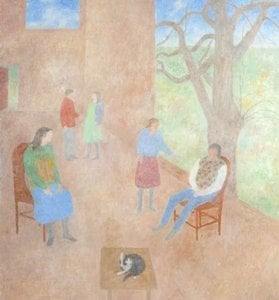
As her career matured, Vellacott’s technical approach underwent a beautiful evolution. In her later years, she moved away from traditional canvas, preferring the tactile intimacy of wooden boards. On these surfaces, she mastered a delicate technique involving a thin white wash and pale pastel tones, creating works that possessed an ethereal luminosity. Whether she was capturing the poignant melancholy of 'The Cellist with a Cat' or the soft, Impressionistic domesticity of 'Lulu', Jug and an Apple Tree', her brushwork remained sensitive to light and texture, inviting the viewer into a world of quiet contemplation.
Legacy and Artistic Significance
Vellacott’s career was characterized by a patient, persistent dedication to her craft. She did not seek immediate fame; instead, she waited until the age of 63 to hold her first solo exhibition at The Minories in Colchester. This late flowering of public recognition only served to highlight the resilience of her spirit, as she continued to produce significant work well into her nineties. Her ability to navigate between narrative landscapes and evocative figure paintings allowed her to capture the essence of human experience through a lens of subtle symbolism.
Today, the historical significance of Elisabeth Vellacott is preserved in several of the world's most esteemed institutions. Her contributions to British art are recognized through her presence in collections such as:
- The British Museum
- The Arts Council Collection
- The Fitzwilliam Museum
- Kettle's Yard
- The Glasgow Museums
Through her work, Vellacott remains a vital figure for those seeking an art that celebrates the beauty of observation and the profound connection between diverse cultural traditions. Her legacy is not merely one of paintings produced, but of a life lived through the eyes of an artist who found the extraordinary within the quietest moments.