A Life Illuminated: The Artistic Journey of Edward Penny
Born in the picturesque Cheshire countryside in 1714, Edward Penny emerged as a significant figure in the evolving landscape of British art during the 18th century. His life story is one woven with threads of privilege, rigorous training, and dedicated service to the burgeoning artistic institutions of his time. The son of a surgeon—a profession that demanded both scientific precision and an understanding of human form—and connected to landed gentry, Penny benefited from opportunities for education and cultural exposure uncommon for many aspiring artists. This foundation allowed him to pursue his innate talent, leading him initially to London as an apprentice under the esteemed portraitist Thomas Hudson. Hudson’s tutelage instilled in Penny a mastery of foundational skills – drawing, composition, and painting techniques – that would serve as the bedrock of his artistic endeavors. He diligently honed these abilities, recognizing their importance in capturing not merely likeness but also character and emotion—a hallmark of Hudson's approach to portraiture.Early Training and Artistic Influences
Hudson’s influence extended beyond mere technical instruction; he instilled in Penny a profound appreciation for classical ideals of beauty and proportion. Observing the meticulous detail with which Hudson rendered figures, Penny internalized the principles of Baroque art – dramatic lighting, dynamic poses, and opulent ornamentation—elements that would permeate his subsequent works. Furthermore, Penny's travels to Rome under Marco Benefiale proved transformative. Surrounded by the grandeur of Renaissance masterpieces, he absorbed the stylistic innovations championed by artists like Raphael and Michelangelo, broadening his artistic horizons and deepening his understanding of artistic history. This immersion in classical art instilled a desire for intellectual rigor alongside technical virtuosity—a characteristic that would define Penny’s artistic vision throughout his career. The meticulous observation of human anatomy and gesture, combined with an unwavering commitment to capturing the essence of his subjects, reflected the legacy of Hudson and Benefiale, shaping Penny's distinctive style.London Portraiture and Societal Recognition
Returning to London around 1748, Penny established himself as a professional painter specializing in portraiture—a genre that flourished during the period and catered to the tastes of the aristocracy and gentry. He quickly gained renown for his skill in portraying individuals with sensitivity and accuracy, capturing not only their physical appearance but also their inner character. His portraits were commissioned by prominent figures across British society – from statesmen and diplomats to wealthy merchants and landowners—demonstrating Penny’s ability to navigate the complexities of London's artistic circles and secure patronage from influential patrons. A pivotal moment arrived in 1762 when he joined the Incorporated Society of Artists, where he exhibited works like a striking portrait of Lady Mary Wortley Montagu – a woman celebrated for her daring correspondence with diplomats stationed in Constantinople. This association signaled Penny’s commitment to artistic innovation and collaboration—a desire to push boundaries while upholding established standards of excellence.The Royal Academy and Artistic Legacy
However, disagreements regarding the Society's direction led to a schism, prompting Penny—alongside fellow artists such as Benjamin West and Richard Wilson—to withdraw and seek alternative avenues for artistic expression. This ultimately paved the way for an even more significant chapter in his career: his nomination as one of the founding members of the Royal Academy of Arts in 1768. The establishment of the Royal Academy was a watershed moment for British art, signifying a commitment to formal training and national recognition—a mission Penny wholeheartedly embraced. As Professor of Painting at the Academy, he championed innovative teaching methods and encouraged his students to explore new artistic horizons, shaping the future trajectory of British painting. His lectures on art, though unpublished during his lifetime, were preserved by his nephew and offer invaluable insights into his artistic philosophy and pedagogical approach—a testament to Penny’s enduring influence on generations of artists.Notable Works and Artistic Style
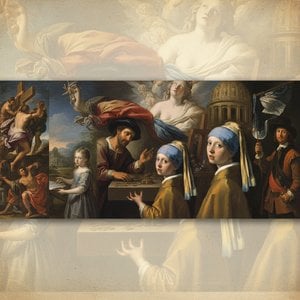
Several works stand as hallmarks of Edward Penny's artistic achievement. The Death of General Wolfe (1764), a monumental depiction of the decisive British victory at Quebec, garnered widespread acclaim and was widely disseminated through engravings by Richard Houston. This painting exemplifies Penny’s ability to portray dramatic historical events with both emotional intensity and technical skill—a masterful demonstration of Baroque principles applied to grand narrative. Equally compelling is A City Shower (1764), inspired by Jonathan Swift's satirical poem. Here, Penny demonstrates his keen observation of everyday life and urban landscapes, capturing the chaotic energy of a sudden downpour in London with remarkable detail—a testament to his ability to convey atmosphere and emotion through visual representation. The Generous Behaviour of the Chevalier Bayard (1768) showcases his interest in chivalric themes and historical narratives, while Imogen Discovered in the Cave (1770), a scene from Shakespeare’s *Cymbeline*, reveals his engagement with literary subjects—a reflection of Penny's intellectual curiosity and artistic versatility. His style is generally characterized as belonging to the Baroque tradition, reflecting the influence of both Thomas Hudson and Marco Benefiale. He possessed a remarkable technical skill and an unwavering dedication to capturing both likeness and atmosphere with finesse—leaving behind a legacy that continues to inspire admiration for its beauty and power.Otázky a odpovědi
Jak se umění umělce Edward Penny v čase vyvíjelo?
Kronika umělce Edward Penny je časová osa ovládaná skrolováním, která představuje díla umělce v chronologickém pořadí, rozdělená do kapitol podle období jeho kariéry.
V jakém historickém období působil/a Edward Penny?
Edward Penny působil v období – Raná modernita. Toto období historicky vymezuje uměleckou činnost tohoto autora.
Mohu si prohlédnout díla umělce Edward Penny podle nálady?
Stránka Pokoj nálad umělce Edward Penny umožňuje prohlížet jeho díla rozřazená podle nálady.