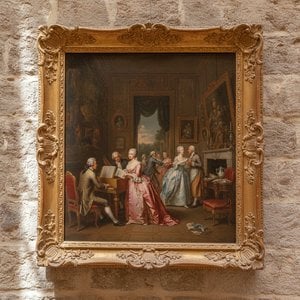
John Singleton Copley: A Bostonian Pioneer of Portraiture
John Singleton Copley, born in Boston in 1738, stands as a pivotal figure in the history of American art, bridging the gap between the nascent colonial spirit and the established traditions of European portraiture. His life was marked by both remarkable success and poignant personal tragedies, ultimately leading him to establish a distinguished career in London, where he continued to innovate within the conventions of his craft. Copley’s legacy rests primarily on his masterful portraits, which captured not only the likenesses of wealthy Bostonians but also their personalities, social standing, and the burgeoning sense of identity within the colonies.
Early Life and Artistic Training
Copley's early life was shaped by a complex family history. His father, Richard Copley, an Anglo-Irish tobacco merchant, arrived in Boston with his family in 1736, bringing with him a lineage steeped in trade and social connections. His mother, Mary Singleton Copley Pelham, descended from a prominent Irish family of Lancastrian origin. This mixed heritage provided Copley with exposure to both the practical world of commerce and the refined circles of Boston society. Initially, he received informal artistic training under his uncle, Henri-François Riesener, a painter who had served as court painter to Louis XVI. Riesener’s studio offered a valuable introduction to drawing and painting techniques, but Copley quickly surpassed his mentor's abilities, demonstrating an exceptional talent for capturing likenesses with remarkable accuracy and detail. He later studied under Robert Strange, another Boston artist, further honing his skills before embarking on his independent career.
The Rise of a Colonial Portraitist
Copley’s reputation as a portrait painter began to flourish in the 1760s and 1770s, coinciding with the rise of Boston's merchant class and their desire to document their wealth and status. He quickly became the artist of choice for prominent figures like John Hancock, Samuel Adams, and Governor Thomas Hutchinson. His portraits were not merely representations of appearance; Copley meticulously observed his subjects, capturing their expressions, gestures, and clothing with an almost photographic realism. Crucially, he went beyond simple likenesses, imbuing his paintings with a sense of character and personality—a skill that distinguished him from many of his contemporaries. Works like “Boy with an Apple” (1768) and “Josiah Quincy” (1773) exemplify this approach, revealing Copley’s ability to convey both physical appearance and inner qualities.
A Move to London and Shifting Artistic Styles
In 1774, amidst the escalating tensions leading up to the American Revolution, Copley relocated to London. This move marked a significant shift in his artistic focus. While he continued to paint portraits for wealthy English patrons, he also embraced historical painting—a genre less common in colonial America. His historical works, such as “The Death of General Wolfe” (1775), were ambitious and innovative, reflecting the grand narratives of European history while incorporating contemporary elements and a distinctly British sensibility. These paintings demonstrated his growing technical skill and willingness to experiment with new approaches to composition and subject matter.
Legacy and Historical Significance
Despite facing financial difficulties in his later years, John Singleton Copley left an indelible mark on the history of American art. He is considered one of the first true American artists, bridging the gap between colonial realism and European artistic traditions. His portraits not only documented the lives of Boston’s elite but also served as powerful symbols of wealth, status, and identity during a period of profound social and political change. Copley's influence can be seen in subsequent generations of American painters, who built upon his foundation of technical skill and psychological insight. His work remains celebrated for its realism, elegance, and the enduring quality of its portraits—testaments to the talent and vision of this remarkable Bostonian artist.
Redakce WahooArt.com
Kvíz o umění
U každé otázky je pouze jedna správná odpověď.
Otázka 1:
John Singleton Copley was born in which city?
Otázka 2:
In what year did John Singleton Copley move to London?
Otázka 3:
Copley is best known for his work in which genre during his time in England?
Otázka 4:
What was a significant characteristic of Copley's later paintings compared to his earlier work?
Otázka 5:
John Singleton Copley was the father of which notable figure?
Explore the profound beauty of genre painting. From Dutch Golden Age masters to global traditions, discover how artists capture the essence of everyday life through masterful realism and timeless storytelling.