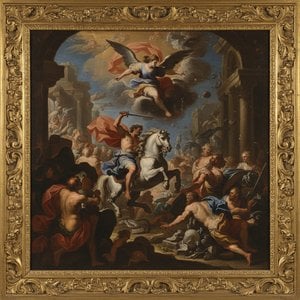
Domenico Gargiulo: A Baroque Master of Naples
Early Life and Origins
Domenico Gargiulo, also known as Micco Spadaro, was a prominent Italian painter of the Baroque period. Born in Naples, Italy around 1609-1610, he came from humble beginnings – his father was a sword maker, hence the nickname ‘Spadaro’ (meaning 'sword maker'). This background subtly influenced his life and perhaps even his artistic perspective.
Training and Influences
Gargiulo received his formal artistic training in the workshop of Aniello Falcone, a renowned battle painter. This apprenticeship profoundly shaped his early style, particularly his dramatic use of light and shadow. Beyond Falcone, Gargiulo was also influenced by the landscapes of Paul Bril, whose frescoes he likely studied in Naples, and the work of Filippo Napoletano.
Artistic Development and Style
Gargiulo’s artistic career blossomed in Naples during a period of significant cultural and political upheaval. He became known for his diverse range of subjects, including landscapes, genre scenes, and historical paintings. His style is characterized by:
- A dramatic use of chiaroscuro (light and shadow), inherited from Aniello Falcone.
- Vivid depictions of Neapolitan life and landscapes.
- An ability to capture both the grandeur and the everyday realities of his time.
Major Works and Achievements
Gargiulo’s contributions to Neapolitan art are significant, with notable works including:
- Rebecca and Eliezer at the Well: A masterful oil on canvas painting currently housed in the National Gallery of Denmark in Copenhagen. It showcases his skill in depicting biblical narratives with emotional depth.
- Representation of the Insurrection by Masaniello: This work powerfully portrays a pivotal moment in Neapolitan history – the uprising led by Masaniello against Spanish rule.
- Paintings within the Certosa di San Martino, specifically in the *coro dei conversi* and *quarto del priori*, demonstrating his versatility and skill in large-scale decorative projects.
- A depiction of the devastating Plague of 1656, reflecting the social realities of the time.
Historical Significance and Legacy
Domenico Gargiulo’s legacy lies in his ability to capture the spirit of Baroque Naples through his dynamic compositions and dramatic use of light. He was a key figure in documenting both historical events and everyday life during a turbulent period. His pupils, including Pietro Pesce and Ignazio Oliva, continued his artistic traditions, ensuring his influence extended beyond his own lifetime.
Though not as widely recognized internationally as some of his contemporaries, Gargiulo remains an important figure in the study of Neapolitan Baroque art. His works offer valuable insights into the social, political, and cultural landscape of 17th-century Italy.