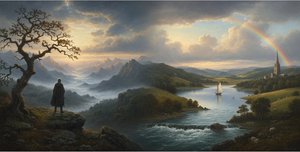
A Legacy of Light and Life: The World of David Teniers the Elder
In the heart of the 17th-century Flemish Baroque era, a period defined by dramatic movement and profound emotional depth, David Teniers the Elder emerged as a master capable of finding extraordinary beauty in the most ordinary moments. Born in Antwerp around 1582, Teniers was not merely an observer of his time but a vital participant in its artistic evolution. His life was woven into the very fabric of the Antwerp art scene, stemming from a lineage of creators that included his father, Jan Teniers I, and his brother, Juliaen. This immersion in a domestic atmosphere of pigments, brushes, and canvas provided him with a foundational mastery that would later allow him to navigate both the grandiosity of religious commissions and the intimate charm of rural landscapes.
The trajectory of Teniers’ talent was significantly shaped by the giants of his age. While his early training began under the watchful eye of his brother, his artistic soul was truly ignited in the studio of Peter Paul Rubens. To study under Rubens was to enter a crucible of innovation, where the interplay of light, shadow, and dynamic composition reigned supreme. This influence is etched into Teniers’ work through a sophisticated use of color and an expressive brushwork that breathes life into every subject. Furthermore, his travels to Rome allowed him to absorb the classical nuances of Adam Elsheimer, adding a layer of atmospheric depth and historical weight to his compositions. These diverse influences coalescent into a style that was uniquely his own—a bridge between the monumental Baroque tradition and a more grounded, humanist observation of the world.
The Art of the Everyday: Genre and Landscape
While many of his contemporaries sought glory in grand mythological or historical narratives, Teniers found his true calling in the celebration of the Flemish landscape and the spirited scenes of peasant life. He possessed a rare, empathetic eye for the genre painting, capturing the conviviality of tavern gatherings, the rustic joy of rural festivities, and the quiet dignity of the working class. His canvases often hum with a playful spirit, inviting the viewer to witness the unvarnished reality of 17th-century life through a lens of gentle humor and meticulous detail.
His landscapes are equally captivating, serving as more than mere backdrops for his figures. Instead, they are living, breathing environments characterized by:
- Atmospheric Perspective: A masterful ability to create depth, leading the eye from the textured foreground into misty, distant horizons.
- Luminous Detail: The careful rendering of light filtering through foliage or reflecting off a simple village path.
- Narrative Integration: A seamless blending of human activity with the natural world, suggesting a profound connection between man and his environment.
Even when venturing into more solemn territory, such as his religious works like "Valentine kneels to receive a rosary from the Virgin Mary," Teniers maintained his signature ability to blend realism with spiritual reverence. In these pieces, he utilized light and shadow not just for dramatic effect, but to guide the viewer’s devotion, making the divine feel tangibly present within the earthly realm.
Historical Significance and Artistic Endurance
The historical importance of David Teniers the Elder lies in his role as a pioneer of a more intimate Baroque aesthetic. He helped shift the artistic gaze from the heavens down to the earth, proving that the lives of peasants and the quietude of the countryside were worthy subjects of high art. His work provided a vital counterpoint to the grandiosity of Rubens, offering a sense of relatability and humanism that resonated deeply with the burgeoning middle class of Flanders.
His legacy is not only found in his surviving canvases but also in the continuation of the Teniers artistic dynasty. Through his descendants, including the celebrated David Teniers the Younger, his influence on Flemish genre painting persisted for decades. Today, we look back at the Elder as a painter who mastered the art of the subtle—an artist who could find the epic within the everyday and leave behind a visual record of an era defined by both its struggles and its profound, simple joys.
Otázky a odpovědi
V jakém městě a z jaké země pochází David Teniers the Elder?
David Teniers the Elder se narodil(a) ve městě Antwerp v zemi Belgium.
Kde a v jakém roce se narodil/a David Teniers the Elder?
David Teniers the Elder se narodil(a) v roce 1582 ve městě Antwerp.
Je k dispozici 3D virtuální prohlídka děl umělce David Teniers the Elder?
Díla umělce David Teniers the Elder si můžete prohlédnout v 3D galerii na jeho stránce 3D galerie.