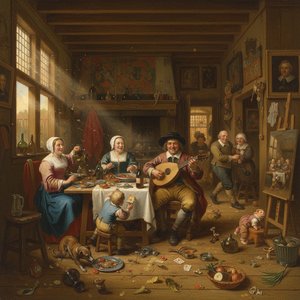
David III Teniers: The Painter of Rustic Charm and Flemish Humor
David III Teniers (1610 – 1690) stands as a pivotal figure in the artistic landscape of Antwerp during the Dutch Golden Age, renowned primarily for his captivating depictions of peasant life—scenes brimming with conviviality, earthy realism, and an unmistakable touch of humor. While overshadowed by the towering presence of Rubens and Elsheimer, Teniers carved out a distinctive niche, establishing himself as one of Flanders’ foremost genre painters and securing a lasting legacy within art history.
Born in Antwerp, David Teniers’ artistic journey commenced under the tutelage of his brother Juliaen, who served as a respected painter himself. This formative influence instilled in him an appreciation for meticulous observation and skillful execution—qualities that would characterize his entire oeuvre. Recognizing his talent, Juliaen encouraged David's pursuit of formal training, directing him towards Rubens’ studio in Antwerp, where he absorbed the master’s techniques of dramatic composition and masterful color palettes. Subsequently, Teniers traveled to Rome, immersing himself in the artistic fervor of the papal court and encountering the stylistic innovations championed by Elsheimer, broadening his artistic horizons considerably.
His guild membership in Antwerp solidified his position within the burgeoning artistic community, allowing him to hone his craft amidst a vibrant milieu of fellow artists. Despite occasional aspirations for grand historical or mythological commissions—a testament to his ambition—Teniers’ enduring fame rests upon his masterful portrayal of everyday life – scenes of bustling marketplaces, lively tavern gatherings, and idyllic rural landscapes populated by recognizable figures engaged in commonplace activities. These paintings aren't merely representations; they are imbued with a palpable sense of atmosphere and emotion, capturing the spirit of Flemish society with remarkable accuracy and wit.
A striking parallel exists between David Teniers’ artistic style and that of his son, David II Teniers (1649-1705), who continued to develop his father's distinctive aesthetic—a stylistic convergence often remarked upon by art historians. This familial connection underscores the transmission of artistic principles across generations and contributes to the enduring fascination surrounding the Teniers family’s contribution to Flemish painting.
Teniers’ output spanned a remarkable range of subjects, encompassing religious iconography alongside genre scenes. However, it was his landscapes—particularly those infused with Elsheimer's influence—that cemented his reputation as a visionary artist. Works like “Four Landscapes Painted Under Elsheimer’s Influence” exemplify Teniers’ ability to capture the subtle nuances of light and color, transforming ordinary vistas into canvases brimming with poetic beauty. Furthermore, his depictions of kermesse celebrations – festive gatherings commemorating saints' days – are celebrated for their vibrant colors and dynamic compositions, reflecting the cultural traditions of Antwerp during his lifetime.
Among Teniers’ most celebrated achievements include “A Peasant Holding a Jug And A Clay Pipe,” a quintessential example of Flemish genre painting that exemplifies his meticulous attention to detail and expressive use of color. Similarly, "Old Man And A Child" showcases his ability to convey profound emotion through simple yet powerfully rendered figures—a hallmark of his artistic sensibility. These paintings reside in prestigious institutions such as the National Gallery of Art (Washington D.C.) and St Paul’s Church (Antwerp), serving as enduring symbols of Flemish artistic excellence.
David Teniers III's legacy extends beyond his individual artworks; he played a crucial role in shaping Antwerp’s art market, establishing himself as a respected dealer and actively participating in the vibrant cultural life of his era. His presence at the St Germain Fair in Paris in 1635 underscores the significance of Antwerp as a center for artistic exchange—a testament to Teniers' entrepreneurial spirit and his contribution to fostering international artistic dialogue. Ultimately, David III Teniers remains an artist whose work continues to inspire admiration for its honesty, humor, and profound understanding of human experience – securing his place as one of the most beloved figures in Flemish art history.