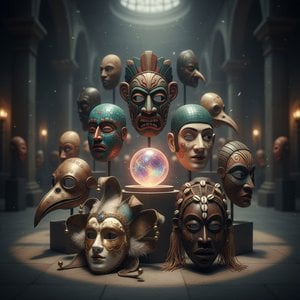
The Enduring Echoes of the Dan: A People and Their Art
Nestled within the rugged, mountainous heartland of Côte d’Ivoire and spilling over into Liberia, lies a world both ancient and vibrant – that of the Dan people. More than just an ethnic group, they are custodians of a rich cultural tapestry woven with intricate masks, profound secret societies, and a deep connection to the spirit realm. Their art isn't merely decorative; it’s a living embodiment of their history, beliefs, and social structures, offering a rare glimpse into a world largely untouched by the relentless march of modernity. This is the story of the Dan – a people whose echoes resonate with power and grace.
Origins and Migration: A Journey to the Mountains
The origins of the Dan are shrouded in the mists of time, tracing back to the western Sudan region, likely encompassing areas now part of Mali and Guinea. Centuries ago, driven by a confluence of factors – population pressures, land scarcity, and perhaps a restless spirit for adventure – they embarked on a slow, deliberate migration southward. This journey culminated in their settlement within the dramatic landscapes of the Dang and Toura mountains, a region characterized by its towering peaks, dense forests, and relative isolation. This geographical seclusion profoundly shaped their culture, fostering a strong sense of independence and preserving traditions that might have otherwise faded away.
Early accounts paint a picture of a warrior people, renowned for their fierce resistance against neighboring tribes – the Krahn, Kpelle, and Mano – who also inhabited the area. While some historians debate whether these conflicts were truly as brutal as legend suggests, they undoubtedly contributed to the Dan’s identity, forging a reputation for strength and resilience. The oral traditions surrounding this period are filled with tales of bravery, cunning, and strategic alliances, forming the bedrock of their cultural narrative.
The Masks and the Gor: Ritual, Power, and Social Order
Perhaps the most iconic aspect of Dan art is their exquisite collection of masks – a breathtaking array of intricately carved wooden figures that serve as conduits to the spirit world. These aren’t simply objects of beauty; they are integral to elaborate ritual ceremonies presided over by the *Gor* (meaning “leopard”), a powerful secret society that governs nearly every facet of Dan life. The *Gor* isn't merely a social club, but rather a complex system of governance, mediation, and spiritual guidance. Membership is earned through rigorous initiation rites, demanding both physical prowess and profound moral character.
The masks themselves are incredibly diverse, each representing a specific spirit or ancestor, embodying different roles within the community – warriors, hunters, healers, and even deities. The creation of these masks is a deeply sacred process, undertaken by skilled artisans who imbue them with their own spiritual energy. The act of wearing a mask transforms the individual into a temporary vessel for the spirit, allowing for communication with the ancestors and maintaining balance within the community. The *Gor* uses these rituals to resolve disputes, maintain social harmony, and ensure the prosperity of the Dan people.
Artistic Techniques and Symbolism: Wood as Voice
Dan wood carving is a testament to both technical skill and profound symbolic understanding. The artisans primarily work with hardwood sourced from the surrounding forests – ebony, iroko, and teak being particularly prized. The tools are simple – knives, gouges, and axes – yet the results are astonishingly detailed and expressive. Carving techniques are passed down through generations, ensuring a continuity of style and tradition.
Beyond the masks, Dan art extends to elaborate murals painted on the exterior walls of houses, depicting scenes from their mythology, historical events, and daily life. These murals serve as visual chronicles, preserving their collective memory. The use of color is particularly significant – vibrant reds, yellows, and blues are believed to possess spiritual power, warding off evil spirits and attracting good fortune. The symbolism embedded within each carving and mural is incredibly rich, reflecting a deep understanding of the natural world, ancestral beliefs, and social dynamics.
Legacy and Contemporary Relevance
Despite facing challenges from external pressures – including modernization, economic hardship, and political instability – the Dan people have managed to preserve their unique cultural identity. Their art continues to be produced, albeit often for a limited audience, and remains a vital link to their past. Today, Dan artists are increasingly seeking opportunities to share their traditions with the wider world, raising awareness of their rich heritage and advocating for its preservation.
The enduring echoes of the Dan – their masks, their rituals, their art – serve as a powerful reminder of the importance of cultural diversity and the profound connection between people and their environment. They are a testament to the resilience of a people who have faced adversity with grace and determination, ensuring that their story will continue to be told for generations to come.
Otázky a odpovědi
Mohu si prohlédnout díla umělce Dan (Gio Or Yakuba) podle klíčových slov?
Stránka Podle klíčových slov umělce Dan (Gio Or Yakuba) seskupuje jeho díla podle klíčových slov.
Mohu si prohlédnout díla umělce Dan (Gio Or Yakuba) podle použité techniky?
Díla umělce Dan (Gio Or Yakuba) si můžete prohlédnout podle použité techniky na jeho stránce Podle techniky.
Mohu si prohlédnout díla umělce Dan (Gio Or Yakuba) podle uměleckých směrů?
Umělecká směry, ve kterých Dan (Gio Or Yakuba) působil/a, si můžete prohlédnout na stránce Všechna umělecká hnutí, která seskupuje díla podle jednotlivých směrů.