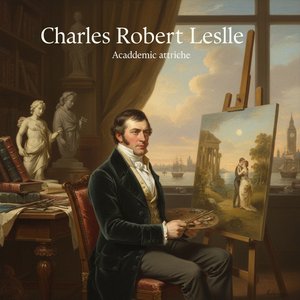
Early Life and Artistic Training
Charles Robert Leslie, a name now synonymous with charming depictions of London life in the 19th century, was born on October 19, 1794, in the heart of London to American parents. His father, Robert Charles Leslie, a clergyman, and his mother, Lydia Leslie, brought a distinctly transatlantic influence to his formative years. Just five years later, the family relocated to Philadelphia, Pennsylvania, where young Charles received his early education. This move proved pivotal, shaping not only his upbringing but also his artistic trajectory. Initially apprenticed to a bookseller – a common path for aspiring artists of the time – Leslie’s true passion quickly revealed itself: painting and theatre. He possessed an innate talent, coupled with a keen eye for detail and a remarkable ability to capture the essence of human interaction. In 1811, driven by ambition and a desire to hone his skills in the bustling artistic hub of London, Leslie embarked on a new chapter. Armed with letters of recommendation from prominent artists, he arrived in the capital, seeking opportunities within the Royal Academy Schools. These institutions provided him with invaluable training, immersing him in the techniques and traditions of British art. It was here that he began to develop his distinctive style, influenced by the works of Benjamin West and Washington Allston – both masters known for their historical paintings and dramatic compositions. Leslie’s early work reflected this influence, often exploring grand historical themes before ultimately discovering his true calling: genre painting—scenes of everyday life, portraits, and social commentary.A Flourishing Artistic Career
Leslie's artistic career quickly gained momentum in the 1820s. He swiftly established himself as a respected artist, known for his ability to capture the spirit of London’s diverse population. His paintings weren’t merely representations; they were imbued with a sense of immediacy and warmth, reflecting the vibrant energy of Victorian society. A particularly notable early work, “The Murder of Rutland by Lord Clifford,” showcased Leslie's burgeoning talent in historical painting, demonstrating his ability to recreate dramatic scenes with meticulous detail and emotional resonance. However, it was his depictions of Londoners engaged in their daily routines that truly cemented his reputation. Paintings like "Londoners Gypsying" offered a glimpse into the lives of street performers, vendors, and ordinary citizens—a refreshing departure from the formal portraits prevalent at the time. These works were characterized by their lightheartedness, humor, and keen observation of human behavior. Leslie’s skill extended beyond genre scenes; he also produced striking portraits, including a memorable depiction of Sir Walter Scott, a celebrated Scottish poet and novelist, highlighting his ability to capture the personality and character of his subjects.Museum Involvement and Legacy
Leslie's artistic contributions were recognized by the Royal Academy, where he was elected as an associate in 1821 – a significant achievement for a relatively young artist. Further solidifying his position within the art world, he received full membership in 1826. His work is now preserved and studied at the Centre d’art britannique de Yale, ensuring that his artistic legacy continues to be appreciated by future generations. Beyond his own artistic endeavors, Leslie played a significant role in the cultural landscape of London. He was a close friend of fellow artist John Constable, for whom he penned the first biography, “Memoirs of the Life of John Constable.” This biographical work offered valuable insights into Constable’s life and artistic process, contributing to a deeper understanding of his work. Leslie's career spanned several decades, during which he consistently produced works that reflected both the changing times and his own unique artistic vision. He died on May 5, 1859, leaving behind a rich body of work that continues to captivate audiences today.Key Influences and Artistic Style
Leslie’s artistic development was profoundly shaped by several key influences. Benjamin West, a prominent portraitist and historical painter, instilled in him a strong sense of composition and dramatic storytelling. Washington Allston, known for his atmospheric landscapes and romantic sensibilities, encouraged Leslie to explore the expressive potential of color and light. The Royal Academy itself—with its emphasis on classical techniques and rigorous training—provided him with a solid foundation in artistic principles. Leslie’s style was characterized by a remarkable blend of realism and sentimentality. He possessed an exceptional ability to capture the nuances of human expression, conveying emotions through subtle gestures and facial expressions. His use of light and shadow created a sense of depth and atmosphere, while his attention to detail brought scenes to life with vividness and authenticity. His genre paintings, in particular, were notable for their warmth, humor, and insightful portrayal of everyday London life.Concluding Thoughts
Charles Robert Leslie’s artistic journey is a testament to the power of talent, dedication, and inspiration. From his early apprenticeship to his recognition as a respected artist within the Royal Academy, he consistently demonstrated a remarkable ability to capture the spirit of his time. His paintings offer a valuable window into Victorian London—a vibrant, bustling metropolis teeming with life, culture, and social change. Leslie’s legacy endures through his enduring works, which continue to be admired for their beauty, artistry, and insightful portrayal of human experience.Otázky a odpovědi
Kde mohu vidět barevný profil děl umělce Charles Robert Leslie?
Stránka Genom palety umělce Charles Robert Leslie představuje barevný profil celkového díla tohoto tvůrce.
Kde najdu díla umělce Charles Robert Leslie seskupená podle techniky?
Stránka Podle techniky seskupuje díla umělce Charles Robert Leslie podle použité techniky.
Jak je kariéra umělce Charles Robert Leslie rozdělena do období?
Chronologický přehled tvorby umělce Charles Robert Leslie naleznete na jeho stránce Kronika umělce, kde jsou díla uspořádána podle jejich vzniku v jednotlivých kapitolách.