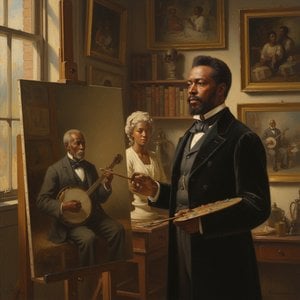
Charles Henry Alston: A Life in Art and Advocacy
Charles Henry Alston (1907-1977) was a pivotal American artist – painter, sculptor, illustrator, muralist, and educator – deeply embedded within the vibrant cultural landscape of the Harlem Renaissance. His work served as both an artistic expression and a powerful statement about Black identity and community.
Early Life and Education
Born in Charlotte, North Carolina, Alston’s family moved to New York City during his childhood. He received a solid education, graduating from DeWitt Clinton High School in 1925. His artistic talent was evident early on, leading him to study at the Harlem Art Workshop and later at Yale University School of Fine Arts, where he earned both a B.A. (1929) and an M.F.A. (1931). This formal training provided a foundation for his evolving style.
Artistic Development & Influences
Alston’s artistic journey was shaped by a diverse range of influences. He admired the work of modernist masters like Pablo Picasso and Amedeo Modigliani, drawn to their simplified forms and expressive qualities. Simultaneously, he found profound inspiration in African art, recognizing its powerful symbolism and aesthetic strength. These combined influences led him to develop a unique style characterized by flattened perspectives, bold colors, and a focus on capturing the essence of his subjects.
Work During the WPA Era
The 1930s proved crucial for Alston’s career. He became the first African American supervisor for the Federal Art Project (FAP) of the Works Progress Administration (WPA). This role was groundbreaking, allowing him to provide opportunities for numerous Black artists during a time of economic hardship and racial discrimination. He also actively created murals as part of the WPA’s efforts to beautify public spaces, notably at Harlem Hospital – these murals remain significant examples of his commitment to community art.
Major Achievements & Artistic Style
- Murals: Alston's murals, particularly those at Harlem Hospital, depict scenes of African American life and history with dignity and grace.
- Paintings: His paintings often feature portraits and figurative compositions that explore themes of identity, family, and social justice. “Portrait of a Girl” is a prime example of his sensitive portrayal of Black subjects.
- Sculpture: Alston also excelled in sculpture, most famously creating the first official sculpture of an African American displayed at the White House – a bust of Martin Luther King Jr. (1990).
Historical Significance & Legacy
Charles Henry Alston’s significance extends beyond his artistic achievements. He was a dedicated educator, teaching at various institutions including Yale University and the High School of Art and Design in New York City. He believed strongly in empowering African Americans through cultural enrichment and artistic advancement. His work challenged racial stereotypes and contributed to a more inclusive representation of Black life in American art history.
Later Life & Continued Contributions
Throughout his career, Alston continued to exhibit his work and receive recognition for his contributions. He remained committed to social justice and used his art as a platform for advocacy. His legacy continues to inspire generations of artists and activists, solidifying his place as a vital figure in American art history.
His works can be found in numerous collections including the Syracuse University Art Collection and other museums across the United States.
Otázky a odpovědi
V jakých směrech působil/a Charles Henry Alston?
Díla umělce Charles Henry Alston si můžete prohlédnout podle jednotlivých směrů na stránce Všechna umělecká hnutí daného umělce.
Existuje chronologický přehled tvorby umělce Charles Henry Alston?
Kronika umělce Charles Henry Alston je časová osa ovládaná skrolováním, která představuje díla umělce v chronologickém pořadí, rozdělená do kapitol podle období jeho kariéry.
Kde mohu vidět díla umělce Charles Henry Alston v 3D galerii?
Virtuální prohlídka je možná: stránka 3D muzeum umělce Charles Henry Alston představuje díla umělce v trojrozměrné galerii.