The Radiant Legacy of Corrado Giaquinto
In the grand tapestry of the eighteenth century, few threads shimmer with as much luminous grace as the works of Corrado Giaquinto. A master of the Rococo era, Giaquinto possessed a rare ability to bridge the heavy, dramatic grandeur of the Neapolitan Baroque with a newfound lightness and airy elegance. Born in Molfetta in 1703, his journey was one of profound transformation, moving from the disciplined shadows of traditional training into a world of brilliant color and celestial movement. While his early life might have been destined for a religious vocation, it was instead captured by the irresistible pull of the brush, leading him to escape the cloister for the studio.
His artistic foundation was built upon the rigorous techniques of Saverio Porta, whose guidance provided the essential structural understanding required for large-scale compositions. However, it was his period within the prolific Neapolitan studio of Francesco Solimena between 1719 and 1723 that truly defined his early professional identity. Under Solimena, Giaquinto mastered the monumental scale and the complex use of perspective that characterized the late Baroque. Yet, even as he absorbed this sense of gravity, a restless creative spirit began to pull him toward a more fluid and expressive way of seeing the world.
A Synthesis of Light and Motion
As Giaquinto’s career progressed, his style underwent a breathtaking evolution, driven by his encounters with the legendary Luca Giordano. While Solimena provided the structural bones of his work, Giordano offered the soul—a vibrant, kinetic energy expressed through daring color palettes and dramatic, flickering light. This synthesis allowed Giaquintio to move beyond the more restrained aesthetics of his predecessors, creating works that felt as though they were breathing with life. His time in Rome further enriched this development; collaborating with artists like Giuseppe Rossi and Nicolas Maria Rossi, he refined a visual language that was uniquely his own—one that could convey both the tragic weight of mythology and the ethereal joy of the divine.
This mastery is perhaps most evident when examining the thematic breadth of his repertoire. In works such as Medea, one can witness his ability to capture the raw, visceral intensity of myth, using bold brushstrokes to depict the harrowing consequences of vengeance. Conversely, in his religious compositions like The Nativity or The Holy Face, he employs a delicate, almost translucent touch. In these sacred scenes, the use of warm tones and gentle, diffused light creates an atmosphere of profound intimacy and spiritual tranquility, inviting the viewer into a moment of pure, unadulterated devotion.
An Itinerant Master Across Europe
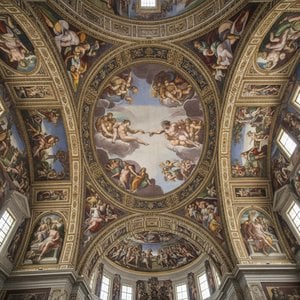
Giaquinto’s reputation was not confined to the borders of Italy; he was a true cosmopolitan of the art world. His career was a grand tour of the great cultural centers of Europe, spanning Naples, Rome, Turin, and Madrid. This nomadic existence allowed him to absorb diverse artistic traditions and adapt his technique to suit the varying tastes of royal courts and religious institutions alike. His ability to execute ambitious fresco projects, such as those in San Giovanni Calibita and Santa Croce in Gerusalemme, cemented his status as one of the premier decorators of his age.
One of his most significant achievements remains his contribution to the Cathedral of Mafra in Portugal. The altarpiece commissioned for this site serves as a definitive testament to his skill, demonstrating an unparalleled ability to synthesize emotional depth with architectural grandeur. By the time of his passing in 1765, Giaquinto had left behind a legacy that transcended mere decoration. He had successfully navigated the transition from the heavy shadows of the Baroque to the luminous, decorative splendor of the Rococo, leaving an indelible mark on the history of European painting through his unparalleled command of light, color, and human emotion.