BEZPLATNÉ UMĚLECKÉ PORADENSTVÍ

x

Stručné informace

  • Copyright status: Under copyright
  • Top 3 works:
    • Zito
    • Rockefeller Center, Collegiate Church of St. Nicholas in Foreground
    • El Second and Third Avenue Lines Bowery and Division Street, Manhattan
  • Lifespan: 93 years
  • Top-ranked work: Zito
  • Movements: documentary photography
  • Also known as: Berenice Alice Abbott
  • Typical colors: neutrální tóny
  • Nationality: Spojojené státy americké
  • Více…
  • Born: 1898, Springfield, Spojojené státy americké
  • Creative periods: mature period
  • Museums on APS:
    • Boca Raton Museum of Art
    • Boca Raton Museum of Art
    • Boca Raton Museum of Art
    • Boca Raton Museum of Art
    • Boca Raton Museum of Art
  • Art period: Modernismus
  • Color intensity: monochromní
  • Works on APS: 75
  • Died: 1991

Kvíz o umění

U každé otázky je pouze jedna správná odpověď.

Otázka 1:
V jakém městě se narodila Berenice Abbottová?
Otázka 2:
Kdo byl Berenice Abbottovou prvním asistentem v Paříži, kde získala cenné fotografické zkušenosti?
Otázka 3:
Jaký byl hlavní projekt Berenice Abbottové po návratu do New Yorku v roce 1929?
Otázka 4:
Co je charakteristické pro fotografický styl Berenice Abbottové?
Otázka 5:
Jakou roli hrála Berenice Abbottová v kariéře Eugèna Atgeta?

Early Life and Artistic Foundations

Berenice Abbott, born Berenice Alice Abbott on July 17, 1898, in Springfield, Ohio, began her life amidst a quiet yet formative period of transition. Her early years were marked by the dissolution of her parents’ marriage, an experience that instilled within her a sense of independence and a keen awareness of human relationships. Raised primarily by her mother, Lillian Alice Bunn, a woman who herself had faced hardship, Berenice developed a resilience and a deep appreciation for the complexities of family dynamics. Despite attending The Ohio State University briefly in 1918, she soon realized that the structured academic environment wasn’t aligned with her restless spirit. She yearned for a more dynamic and creative outlet, leading her to relocate to New York City in 1918 – a city brimming with artistic energy and a promise of new possibilities. Initially drawn to journalism, Berenice sought employment as a reporter, but it quickly became apparent that photography held a far stronger allure. This shift was largely influenced by her exposure to the burgeoning world of avant-garde art and the vibrant social scene of Greenwich Village, where she found herself immersed in circles frequented by artists, writers, and intellectuals. Crucially, her time in New York introduced her to Man Ray, a pivotal figure whose studio would become a crucible for her artistic development. Her early exposure to photography was not through formal training but rather through assisting Man Ray, an experience that quickly revealed her innate talent and passion for capturing the world through a lens. This apprenticeship provided her with invaluable hands-on experience in darkroom techniques and photographic processes, laying the foundation for her distinctive style.

Parisian Awakening and Photographic Development

A defining moment in Berenice Abbott’s artistic journey arrived in 1921 when she embarked on an extended sojourn to Paris – a city renowned as a global center of art and culture. This move proved transformative, propelling her into the heart of Europe's avant-garde scene and fundamentally altering the trajectory of her career. She enrolled in sculpture classes at the Académie de la Grande Chaumière, seeking to refine her artistic skills and broaden her creative horizons. However, it was her encounter with Man Ray that truly ignited her passion for photography. Working alongside him as his studio assistant, she quickly absorbed his techniques and developed a deep appreciation for the medium’s expressive potential. During this period, Abbott began to experiment with portraiture, capturing the essence of prominent artists and literary figures who frequented Paris's artistic circles – including James Joyce, Marcel Duchamp, and André Breton. Her portraits were characterized by their striking realism and an uncanny ability to capture the personality and spirit of her subjects. This early work garnered recognition, culminating in a solo exhibition at the Galerie Au Sacre du Printemps in 1926, where she showcased her captivating portraits of artistic luminaries. Furthermore, Abbott’s time in Paris coincided with her growing fascination with Eugène Atget, a largely unrecognized street photographer whose meticulous documentation of Parisian life captivated her imagination. She became deeply invested in preserving and promoting his work, recognizing its unique value and historical significance. This dedication would ultimately lead to her acquisition of his entire photographic archive – a remarkable testament to her passion and commitment.

Documenting a Changing City: New York Transformed

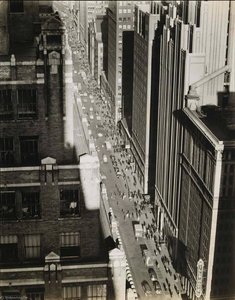
Returning to the United States in 1929, Berenice Abbott set her sights on documenting the dramatic transformation unfolding within New York City. Recognizing the city’s rapid modernization and its profound impact on urban life, she embarked on an ambitious project that would become one of her most celebrated achievements: a comprehensive photographic survey of New York's architecture and streetscapes. Supported by funding from the Works Progress Administration (WPA), Abbott meticulously documented the city’s evolving character, capturing both its iconic landmarks and its gritty underbelly. She employed innovative techniques – including “bird’s-eye” and “worm’s-eye” perspectives – to create a unique visual narrative of New York's urban landscape. These photographs weren’t merely static representations; they were dynamic portraits of a city in constant flux, reflecting the energy, diversity, and complexities of modern life. The resulting collection, titled *Changing New York*, was published in 1939 and quickly became a seminal work in documentary photography, establishing Abbott as a leading figure in the field. Her ability to capture both the grandeur and the grit of New York City cemented her reputation as a perceptive observer and a masterful storyteller through images.

Legacy and Enduring Influence

Berenice Abbott’s impact on the world of photography extends far beyond her iconic images. She was a pioneer in documentary photography, demonstrating an unparalleled ability to convey the essence of urban life through her lens. Her portraits offer intimate glimpses into the lives of influential cultural figures, while her New York City photographs serve as a valuable historical record of the city’s evolution. Crucially, Abbott played a vital role in preserving and promoting the work of Eugène Atget, bringing his artistry to wider recognition and ensuring his place in photographic history. Beyond her artistic practice, she contributed significantly to the field through her writings on photographic techniques, furthering its development as an art form. Her photographs are now held in prestigious collections worldwide – including the Smithsonian American Art Museum and the Philadelphia Museum of Art – a testament to their enduring power and significance. Berenice Abbott’s legacy continues to inspire photographers today, reminding us of the profound ability of the camera to document, interpret, and celebrate the world around us. Her work stands as a powerful reminder of the beauty and complexity of urban life, captured with remarkable skill and vision.