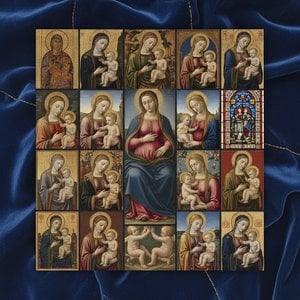
Bartolommeo Bulgarini, known variously as Bulgarino or Bologhini, emerged from the vibrant artistic ferment of fourteenth-century Siena to become one of the most profound voices of the Trecento. Born around 1300, his life was inextricably linked to the golden age of Sienese painting, a period defined by a unique tension between the celestial and the terrestrial. His formative years were shaped by the rigorous training of an apprenticeship under the legendary Pietro Lorenzetti, a connection that would anchor his style in the prestigious lineage of Sienese masters. Unlike many of his contemporaries who sought fame in distant courts, Bulgarini remained deeply rooted in his home city, dedicating his life to the altarpieces and devotional panels that would grace the chapels and cathedrals of Siena, weaving his personal legacy into the very fabric of the city's religious identity.
A Synthesis of Tradition and Innovation
The true brilliance of Bulgarini lies in his ability to act as a bridge between two worlds. He possessed a rare, intuitive grasp of how to marry the ancient, ethereal majesty of Byzantine iconography with the burgeoning humanism and spatial curiosity emerging from Florence. His technique was characterized by a meticulous attention to detail and a luminous use of color that seemed to radiate from within the gold-grounded panels. Through the careful application of tempera, he achieved a sense of weight and presence in his figures that moved beyond mere symbolism toward a more tangible reality.
In his mature works, one observes a deliberate consideration for spatial depth and a sophisticated interplay of light. This stylistic evolution is perhaps most evident in his ability to balance:
The Byzantine influence, which provided the sacred, unmoving grandeur of the divine.
The Florentine innovation, which introduced a nascent naturalism and anatomical grace.
A luminous palette that utilized gold and rich pigments to evoke a sense of heavenly splendor.
This duality allowed his art to remain deeply devotional while simultaneously participating in the progressive movement toward the Renaissance.
Enduring Devotion and Historical Legacy
Bulgarini’s career was not merely a period of artistic growth but a testament to resilience. He remained an active and influential force in the Sienese school even as the devastating Black Death of 1348 reshaped the social and cultural landscape of Italy. His monumental achievements, such as the St. Victor Altarpiece, stand as enduring landmarks of his mastery, showcasing a complex theological narrative executed with unparalleled craftsmanship. Whether through the intimate grace of his Madonna and Child compositions or the solemnity of his depictions of saints, Bulgarini’s work captures the spiritual heartbeat of an era. Today, as art historians rediscover the profound impact of his hand, his name continues to resonate as a master who successfully captured the intersection of the eternal and the earthly, leaving behind a corpus of work that remains a cornerstone of Italian medieval art.
Redakce WahooArt.com
Kvíz o umění
U každé otázky je pouze jedna správná odpověď.
Otázka 1:
Q1: Bartolommeo Bulgarini was born in:
Otázka 2:
Q2: Bulgarini’s style is characterized by:
Otázka 3:
Q3: Bulgarini is best known for his contribution to:
Otázka 4:
Q4: Bulgarini’s artistic career spanned approximately:
Embark on a visual journey through Italy's most iconic landscapes and Renaissance masterpieces. Discover the profound beauty of classical art, from Venetian altarpieces to serene countryside vistas, curated for the discerning art enthusiast and collector.
Embark on a sophisticated journey through art history with our curated guide to the most iconic Madonna and Child masterpieces. Discover the profound beauty, theological depth, and enduring legacy of these sacred Renaissance treasures.
Embark on a sophisticated journey through Italian Baroque art. Discover the dramatic interplay of light and emotion in Caravaggio’s masterpieces and explore how to bring this timeless grandeur into your collection with expert art insights.