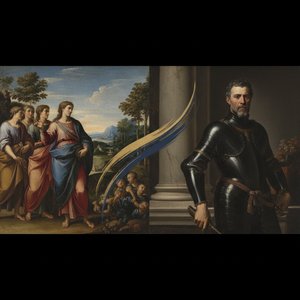
Bartolomeo Nazari: Venetian Baroque Portraitist
Bartolomeo Nazari (1693–1758) stands as a significant figure within the Venetian Baroque artistic landscape, renowned primarily for his masterful portraits that captured the elegance and grandeur of the era. Born in Clusone, near Bergamo, Italy, he embarked on an artistic journey marked by apprenticeship under Angelo Trevisani and formative encounters with Francesco Trevisani and Benedetto Luti – influential mentors who instilled foundational skills within his burgeoning talent. His keen observation of Fra Galgario, Bergamo’s celebrated portraitist, further honed his craft, establishing him as a student of established tradition.
Nazari's relocation to Venice in 1724 cemented his position at the heart of Venetian artistic life and solidified his affiliation with the Fraglia dei Pittori, the guild of Venetian painters. This association afforded him access to crucial networks and propelled his career forward. Notably, he traveled to Frankfurt in 1744, undertaking a commission to depict Emperor Charles VII and his court – an ambitious project demonstrating both technical prowess and diplomatic sensitivity. His induction into the Accademia di Belle Arti of Venice in 1756 signaled recognition of his artistic accomplishments and ensured the continuation of Venetian artistic heritage.
His legacy extends beyond individual portraits; Nazari’s son, Nazario Nazari, followed in his father's footsteps as a painter, perpetuating the family tradition. Among his notable patrons were Consul Joseph Smith and General Johann Matthias von der Schulenburg, who entrusted him with commissions reflecting the cultural tastes of their respective circles. He achieved particular acclaim for his depictions of operatic singers, notably Farinelli – capturing not merely likeness but also conveying the charisma and vocal artistry of these celebrated performers. Nazari’s final journey culminated in Genoa, where he immortalized the Doge Giovanni Giacomo Grimaldi, completing a cycle of significant commissions that solidified his reputation as Venice's premier portraitist.
Nazari’s artistic style is characterized by meticulous detail and an expressive use of chiaroscuro – dramatic contrasts between light and shadow – techniques perfected during the Baroque period. He skillfully employed oil paint on canvas to achieve luminous surfaces and nuanced tonal gradations, conveying depth and emotion with remarkable precision. His portraits often featured elaborate costumes and jewelry, reflecting the opulent tastes of Venetian aristocratic society. The artist’s compositions were carefully balanced, emphasizing idealized beauty and conveying psychological insight into his subjects.
- Notable Works: “Portrait of Doge Querini,” “Nazzari, Bartolomeo - McClintock and Strong Biblical Cyclopedia”, “Farinelli (Carlo Maria Michelangelo Nicola Broschi)”
- Influences: Angelo Trevisani, Francesco Trevisani, Benedetto Luti, Fra Galgario
- Technique: Oil paint on canvas; Chiaroscuro; Detailed observation and rendering of textures.
Nazari’s contribution to Venetian art is undeniable. He embodies the spirit of Baroque portraiture—a genre devoted to capturing not just physical appearance but also conveying character and status. His enduring fame rests upon his ability to transform individuals into symbols of power, refinement, and artistic excellence – a testament to his skill as an artist and his place within the history of Venetian art.