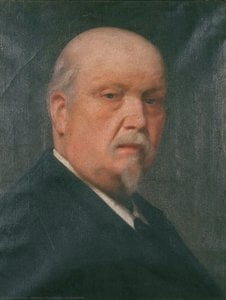
Dino Compagnoni in Mediatore della Pace tra Guelfi e Ghibellini
Born: 1822, Castel Franco, Italy
Died: 1897
Lifespan: 75 years
Antonio Puccinelli: A Tuscan Visionary Capturing Emotion Through Portraiture
Antonio Puccinelli (1822 – 1897) stands as a significant figure in Italian Romantic painting, particularly renowned for his exquisitely detailed portraits and self-portraits that delve into the psychological complexities of their subjects. Born in Castel Franco, Tuscany, Puccinelli’s artistic journey unfolded against the backdrop of a burgeoning era marked by both scientific advancements and fervent emotional expression—a confluence that profoundly shaped his distinctive style and enduring legacy.
Early Life & Artistic Training: Puccinelli received his formative artistic education at the Accademia di Belle Arti Firenze, where he honed his skills under luminaries like Giuseppe Aimone Zavattini and Giovanni Fattori. These influential mentors instilled in him a meticulous approach to observation and a dedication to capturing nuanced emotional states with remarkable accuracy.
Style & Technique: Puccinelli’s artistic hallmark was his masterful command of chiaroscuro—the dramatic interplay of light and shadow—a technique borrowed heavily from Caravaggio and utilized extensively throughout his oeuvre. He achieved this effect through painstaking layering of glazes, meticulously blending pigments to create textures that seemed to breathe with life. His portraits weren't merely representations of likeness; they were explorations of character, conveying inner feelings and psychological depth.
Notable Works: Among Puccinelli’s celebrated paintings are “Portrait of Marrocchi,” a captivating depiction of Florentine nobility showcasing his exceptional ability to convey emotion through subtle facial expressions and posture. Similarly, his self-portrait offers an intimate glimpse into the artist's contemplative gaze and conveys a palpable sense of melancholy—a characteristic that resonates deeply with viewers today. Also noteworthy is “Dino Compagnoni in Mediatore della Pace tra Guelfi e Ghibellini”, which exemplifies Puccinelli’s stylistic prowess and his commitment to portraying historical narratives with artistic sensitivity.
Influences & Artistic Context
Puccinelli's artistic sensibilities were undeniably shaped by the Romantic movement, which championed individualism, emotion, and imagination as antidotes to Enlightenment rationalism. Artists like Eugène Delacroix and Friedrich Wilhelm Heineken served as inspiration for Puccinelli, encouraging him to prioritize expressive power over mere visual realism. Furthermore, Puccinelli’s meticulous attention to detail—a trait evident in his portraits—reflects the broader fascination with scientific observation during the Victorian era, albeit filtered through an aesthetic lens prioritizing subjective experience.
Legacy & Historical Significance
Antonio Puccinelli's contribution to Italian art history extends beyond his individual masterpieces; he embodies the spirit of Romantic painting’s quest for emotional truth and psychological insight. His portraits continue to captivate audiences with their evocative realism and profound understanding of human character—a testament to his artistic genius and enduring relevance in contemporary art discourse. Puccinelli's work stands as a cornerstone of Tuscan Romanticism, securing his place among the most accomplished portrait artists of his time.
Further Exploration
For deeper insights into Antonio Puccinelli’s life and artistry, consider visiting Fundación Antonio de Nebrija in Madrid or Museo Antonio Parreiras in Rio de Janeiro to experience Neomudéjar art & design firsthand. Also, delve into “Antonio Canova: Neoclassical Sculpture & the Pursuit of Emotional Perfection” for a comparative study of sculptural and painterly approaches to conveying emotion. Finally, explore “Antonio Zeno Shindler: A Pioneer of Cross-Cultural Portraiture in Early Modernism” to appreciate Puccinelli’s artistic lineage within a broader context of evolving aesthetic ideals.
Explore the fascinating history of self-portraiture from Renaissance masters like Dürer & Rembrandt to modern interpretations. Discover the psychological insights and artistic techniques behind these iconic works. Expert analysis for art enthusiasts.
Explore the captivating world of introspective art! Discover how artists across eras – from Rembrandt to Kahlo – used self-portraiture to reveal their inner worlds and emotional depths. A journey through art history & psychology.
Prozkoumejte 10 ikonických děl 19. století – od romantismu po impresionismus! Obrazy Courbeta, Moneta a dalších mistrů s příběhy a technikami. Najděte inspiraci pro váš interiér a kvalitní reprodukce na WahooArt.com.