Anthony Gross: A Life in Print and War
Born Anthony Imre Sandor Gross in Dulwich, London, on March 19th, 1905, into a family steeped in artistic and intellectual pursuits, his life was one of constant movement and creative exploration. His father, Alexander Gross, a Hungarian cartographer, instilled a deep appreciation for visual representation and meticulous detail, while his mother, Isabelle Crowley – a suffragette and playwright – fostered a spirit of independent thought and social engagement. This unique upbringing, coupled with the influence of his artist sister Phyllis Pearsall, shaped a multifaceted personality that would profoundly impact his artistic development.
Gross’s early education at Shrewsbury House School and Repton School provided a solid foundation, but it was his time at the Slade School of Fine Art in London that truly ignited his passion for printmaking. There, under the guidance of Henry Tonks and later Stanley William Hayter, he honed his skills in etching, engraving, and intaglio techniques. This period marked a crucial shift towards a more experimental approach to art, influenced by the burgeoning avant-garde movements emerging from Paris – particularly Cubism and Futurism. He spent time studying at the École des Beaux-Arts in Paris and the Academia de San Fernando in Madrid, absorbing diverse artistic traditions and expanding his technical repertoire.
The War Artist’s Eye
World War II dramatically altered the course of Gross's career, propelling him into the role of an Official War Artist. Initially assigned to Egypt, Syria, Palestine, and Kurdistan, he captured the daily realities of military life – the camaraderie amongst soldiers, the logistical challenges, and the stark beauty of the landscapes. His work during this period moved beyond mere documentation; he sought to convey the emotional weight of conflict, portraying both its brutality and its moments of shared humanity.
His most celebrated wartime commissions led him to North Africa, Italy, and ultimately, France – culminating in his participation in the D-Day landings at Arromanches. This pivotal moment is immortalized in a series of powerful etchings that capture the chaos and determination of Allied troops as they stormed ashore. Following the invasion, Gross documented the advance through Europe, witnessing the end of the war and the subsequent occupation. His depictions of Berlin, particularly the iconic image of Soviet and American soldiers shaking hands on the Elbe River, became enduring symbols of victory and reconciliation.
Technique and Style
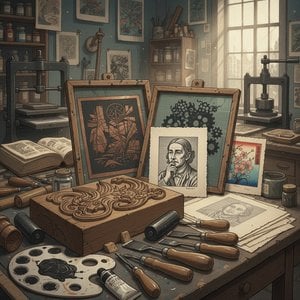
Gross’s artistic style evolved significantly throughout his career, reflecting both his technical mastery and his evolving aesthetic sensibilities. Initially influenced by traditional printmaking techniques, he gradually embraced a more expressive and gestural approach, particularly during the war years. His etchings are characterized by bold lines, dynamic compositions, and a remarkable ability to convey movement and emotion. He frequently worked in collaboration with Stanley William Hayter at Atelier 17 in Paris, experimenting with innovative printing processes such as drypoint and variable textures, pushing the boundaries of printmaking and creating works of exceptional visual impact.
Beyond his war art, Gross produced a substantial body of landscape paintings and illustrations. His depictions of the English countryside, often imbued with a sense of melancholy and nostalgia, demonstrate a deep connection to the natural world. He also explored themes of mythology and folklore in his prints, drawing inspiration from ancient stories and legends.
Legacy and Recognition
Anthony Gross’s artistic legacy extends far beyond his wartime commissions. His work is held in prestigious collections worldwide, including the British Museum, the Tate Gallery, and the National Gallery of Victoria. He was recognized with numerous accolades throughout his career, including a Commander of the Order of the British Empire (CBE) and an Associate membership of the Royal Academy. His influence on subsequent generations of printmakers is undeniable, and his powerful images continue to resonate with audiences today.
Gross’s life and work serve as a testament to the power of art to document history, capture emotion, and transcend cultural boundaries. He remains a significant figure in British art history, celebrated for his technical skill, artistic vision, and unwavering commitment to portraying the human experience in all its complexity.