Edward Calvert: A Quiet Master of the English Landscape (1799–1883)
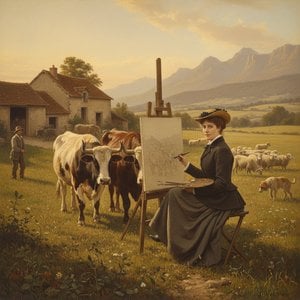
The name Edward Calvert might not immediately resonate with art history enthusiasts, yet his contribution to 19th-century British landscape painting deserves recognition. Born in September 1799 in Greenlaw, Scotland, Calvert’s life unfolded as a journey of artistic refinement and quiet dedication, culminating in a body of work characterized by meticulous detail, atmospheric perspective, and a profound appreciation for the English countryside. While he never achieved widespread fame during his lifetime, Calvert's legacy lies in his skillful depictions of rural scenes—cattle on the ridge, humble farmhouses nestled amongst rolling hills—offering intimate glimpses into a vanishing world.
Calvert’s early artistic education began at the Royal Academy in Edinburgh. This formative period exposed him to the established conventions of landscape painting and provided a foundation for his later work. However, unlike many of his contemporaries who sought recognition within the formal art establishment, Calvert largely pursued a solitary path, dedicating himself to the craft with unwavering consistency. His career spanned nearly eight decades, witnessing significant shifts in artistic styles and social landscapes. He initially worked as a printmaker, honing his observational skills and developing a keen eye for detail – a skill that would later translate seamlessly into his paintings.
Calvert’s artistic style is often described as quietly observant and remarkably precise. He eschewed dramatic compositions or overtly emotional subjects, instead focusing on capturing the subtle nuances of light, texture, and color within the natural world. His palette was restrained, favoring muted greens, browns, and blues to create a sense of atmospheric depth and realism. A key element of his technique involved painstaking layering of paint—a method that allowed him to build up textures and achieve remarkable clarity in his depictions of foliage, livestock, and architectural details. He wasn’t interested in grand vistas or heroic scenes; rather, he sought to convey the quiet dignity and enduring beauty of everyday rural life.
Key Works and Notable Paintings
- Cattle on the Ridge of a Hill (Shoreham): Perhaps his most celebrated work, this painting exemplifies Calvert’s meticulous attention to detail and his ability to capture the essence of a rural scene. The composition is deceptively simple—a herd of cattle grazing on a hillside—yet it reveals a wealth of subtle observations about light, texture, and perspective.
- The Ancients: This evocative piece showcases Calvert’s skill in depicting ancient ruins, blending them seamlessly into the surrounding landscape. It demonstrates his understanding of atmospheric perspective and his ability to create a sense of timelessness.
Calvert's artistic output is relatively modest compared to some of his contemporaries, but each painting reflects a deep connection to the land and a commitment to portraying it with honesty and respect. His work offers a valuable window into the visual culture of 19th-century England, revealing a world largely untouched by industrialization and urbanization.
Influences and Artistic Context
Calvert’s artistic development was shaped by several factors. The Romantic movement, with its emphasis on emotion and the sublime in nature, undoubtedly influenced his approach to landscape painting. However, Calvert's work differs from the more dramatic expressions of Romanticism in that it prioritizes observation and detail over subjective feeling. He also drew inspiration from earlier generations of English landscape painters, such as John Constable and J.M.W. Turner, though he avoided direct imitation, instead developing his own distinctive style.
Furthermore, Calvert’s background as a printmaker informed his painting technique. The precision required for creating detailed engravings instilled in him a meticulousness that translated directly to his brushwork. The influence of the Royal Academy's curriculum and the prevailing artistic trends of the time are also evident in his work, though he ultimately forged his own unique path.
Later Life and Legacy
Edward Calvert lived a long life, dying on July 14, 1883, at the age of 83. Throughout his later years, he continued to paint prolifically, documenting the changing landscape of England with quiet diligence. His work remained largely unknown during his lifetime, but in recent decades, Calvert’s paintings have been increasingly recognized for their understated beauty and technical skill. Today, his art is housed primarily in the Tate collection, a testament to its enduring value.
Calvert's legacy lies not in grand pronouncements or revolutionary innovations, but in his steadfast dedication to capturing the quiet dignity of the English countryside. He was a master of observation and detail, a painter who found beauty in the commonplace—a reminder that even the most humble scenes can hold profound artistic merit.