A Life Painted Across Landscapes: The Story of Amédée Joullin
Amédée Joullin, a name perhaps less heralded than some of his contemporaries, nevertheless occupies a significant place in the narrative of American Western art. Born on June 13, 1862, in the vibrant city of San Francisco to French immigrant parents, Joullin’s artistic journey was one deeply intertwined with the evolving identity of California and its indigenous peoples. His life, spanning just over five decades, was a testament to his dedication to capturing the beauty and spirit of a land undergoing rapid transformation, and a sincere attempt to portray Native American culture with respect and sensitivity—a rarity in an era often marked by romanticized or prejudiced depictions. From early studies at the Art School of San Francisco under the tutelage of Jules Tavernier, Joullin demonstrated a keen eye for detail and a burgeoning talent for landscape painting. A period of hardship followed, spent in Paris during 1884 where he experienced financial difficulties, yet this struggle likely honed his resolve and fueled his artistic vision.
From San Francisco Studios to the American Southwest
Returning to the United States in 1886, Joullin secured a position as a professor of painting and design at the San Francisco School of Design, a role he held for ten years. This period provided him with stability and allowed him to refine his technique while imparting knowledge to a new generation of artists. However, it was from 1892 onward that Joullin’s artistic focus truly crystallized. He became increasingly captivated by the lives and traditions of Native Americans, embarking on journeys to Mexico and New Mexico in pursuit of authentic subject matter. This wasn't merely an aesthetic choice; Joullin sought to understand and represent these cultures with a depth rarely seen at the time. His paintings from this era are characterized by a meticulous attention to detail in costumes, artifacts, and ceremonial practices, reflecting his commitment to accurate portrayal. He didn’t simply paint *about* Native Americans; he strived to paint *with* an understanding of their world. A notable commission during this period was the painting “Driving the Golden Spike” for the Montana State Capitol rotunda, a testament to his growing reputation and skill in large-scale historical works. The modest payment of $500 underscores the challenges faced by artists seeking recognition beyond the established art circles.
A Parisian Refinement and Artistic Marriage
Joullin’s dedication to honing his craft led him back to Paris from 1900 to 1905, where he studied at the prestigious École des Beaux-Arts and attended the Académie Julian. This period of intensive study undoubtedly refined his technique and broadened his artistic horizons, influencing the subtle tonal qualities that would become a hallmark of his work. It was in New York City on May 25, 1907, that he married fellow artist Lucille Wilcox Joullin, forging a partnership that likely provided both personal and professional support. While details about their collaborative endeavors remain scarce, it’s reasonable to assume they shared artistic insights and encouraged each other's creative pursuits. The marriage represents a significant chapter in his life, adding another layer of richness to his already complex story.
Legacy and Lasting Impression
Amédée Joullin passed away on February 3, 1917, at his home in San Francisco, leaving behind a body of work that continues to resonate with viewers today. His paintings are treasured by institutions such as the M.H. de Young Memorial Museum of San Francisco and the Crocker Art Museum in Sacramento, serving as enduring reminders of his artistic vision. Joullin’s significance lies not only in his technical skill but also in his sensitive portrayal of Native American life during a period of profound cultural change. He stands as an example of an artist who sought to bridge cultures through his work, offering a glimpse into a world often overlooked or misrepresented.
Themes and Techniques
Joullin’s artistic style is often categorized within the
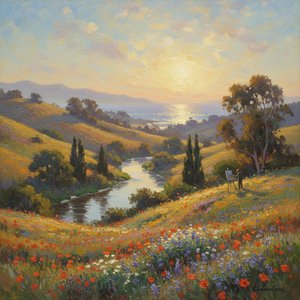
Tonalist movement, characterized by its emphasis on atmospheric effects, muted colors, and subtle gradations of light and shadow. His landscapes evoke a sense of tranquility and reverence for nature, while his depictions of Native Americans are marked by dignity and respect. He masterfully employed oil paints to create richly textured surfaces and capture the nuances of light reflecting off skin, clothing, and natural elements.
His works often feature a melancholic beauty, hinting at the fragility of both the landscape and the cultures he sought to preserve on canvas. The following are key themes present in his work:
- California Landscapes: Joullin’s early paintings focused on the dramatic scenery of California, showcasing its mountains, valleys, and coastline.
- Native American Life & Culture: His most significant works depict scenes from the daily lives and ceremonial practices of various Native American tribes in Mexico and New Mexico.
- Historical Narratives: Commissions like “Driving the Golden Spike” demonstrate his ability to capture important moments in American history with accuracy and detail.
- The Vanishing West: A subtle undercurrent of sadness permeates many of his paintings, reflecting a concern for the preservation of Native American cultures facing displacement and assimilation.
Joullin’s art serves as a valuable historical document, offering insights into a pivotal era in American history. His legacy continues to inspire artists and scholars alike, reminding us of the power of art to bridge cultural divides and preserve the beauty of a changing world.