Alexandre-Louis Leloir: A Parisian Painter of Shadows and Light
Born in the heart of Paris in 1843, Alexandre-Louis Leloir emerged from a lineage steeped in artistic tradition – his father, Auguste Leloir, was a respected painter, while his maternal grandfather, Alexandre Colin (a former student of Girodet), instilled in him an early appreciation for meticulous observation and classical technique. This familial legacy, coupled with the vibrant artistic atmosphere of his upbringing, laid the foundation for a career that would span both historical narratives and intimate genre scenes, ultimately establishing Leloir as a significant figure within the French art world of the late 19th century.
Leloir’s formal training began at the École des Beaux-Arts in Paris. He relentlessly pursued recognition through the prestigious Prix de Rome, securing second grand prizes on multiple occasions – notably in 1861 for “The Death of Priam” and again in 1864 with “Homer on the Island of Scyros.” These successes, though not culminating in a first-place victory, demonstrated his burgeoning talent and established him within the competitive circles of Parisian art. His early works showcased a dedication to academic principles, reflecting the influence of his grandfather’s teachings and the prevailing artistic standards of the time.
The Salon Years: Historical Grandeur and Genre's Intimacy
Leloir’s career truly blossomed during the *Salons* of the mid-19th century. Initially, he focused on historical subjects, producing dramatic compositions such as “Massacre of Innocents” (1863) and “The Fight of Jacob with the Angel” (1865), works that demonstrated his ability to render complex narratives with a meticulous attention to detail. These paintings, characterized by their rich colors and dynamic arrangements, garnered considerable attention and solidified his reputation as a skilled historical painter.
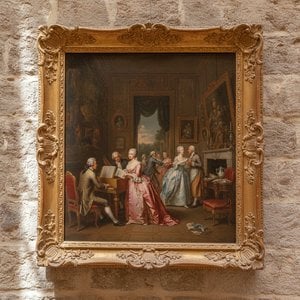
However, around 1868, Leloir underwent a significant stylistic shift. He began to gravitate towards genre scenes – depictions of everyday life, often drawing inspiration from medieval settings, the opulent interiors of the *Grand Siècle*, and exotic Orientalist landscapes. This transition marked a departure from the formal constraints of historical painting, allowing him greater freedom in exploring human emotion and social commentary. Works like “A Musical Interlude” (circa 1869) exemplify this new direction, capturing the elegance and intrigue of a private gathering with a masterful blend of color and composition.
Orientalist Visions and Artistic Circles
Leloir’s interest in Orientalism extended beyond mere picturesque landscapes. He produced evocative scenes depicting Nubian women – often presented as domestic servants or courtesans – imbued with a sense of both exotic allure and poignant vulnerability. These paintings, such as “A Musical Interlude,” reveal his ability to capture the nuances of cultural interaction and social dynamics. His artistic circle included prominent figures like Jean-Baptiste Auguste Leloir (his father), Édouard Toudouze, and others who contributed to the vibrant artistic community of Paris.
Furthermore, Leloir played a pivotal role in establishing the Société des Aquarellistes Français in 1879, a collective dedicated to promoting watercolor painting. This initiative underscored his commitment to artistic innovation and collaboration, solidifying his position as a respected figure within the Parisian art scene. He was also recognized for his contributions to illustration, notably working on editions of Molière’s plays.
Recognition and Legacy
Leloir's dedication to his craft was formally acknowledged in 1876 when he was made a Chevalier of the Legion of Honor. His work continued to be exhibited at the Salon throughout his career, earning him both critical acclaim and commercial success. Alexandre-Louis Leloir died prematurely in January 1884, at the age of 40, leaving behind a substantial body of work that reflects the diverse influences shaping French art during the late 19th century. His paintings—ranging from grand historical narratives to intimate genre scenes—remain valuable examples of his artistic skill and offer a captivating glimpse into Parisian life and culture.
Key Works
- The Death of Priam (1861)
- The Fight of Jacob with the Angel (1865)
- Massacre of Innocents (1863)
- A Musical Interlude (circa 1869)
- Homer on the Island of Scyros (1864)