A Wanderer’s Vision: The Life and Legacy of Alexander Yakovlev
Alexander Evgenievich Yakovlev (1887–1938) was an artist whose life story reads like a grand, sweeping epic of the early twentieth century. Born in the imperial grandeur of Saint Petersburg, Yakovlev’s early years were steeped in the rich traditions of Russian realism and the burgeoning influences of Impressionism. His formative training at the Imperial Academy of Fine Arts placed him under the tutative guidance of masters such as Dmitry Kardovsky, a period that instilled in him a rigorous command over draftsmanship and tonal precision. Yet, while his roots were firmly planted in the soil of Russia, his spirit was inherently nomadic. Alongside his contemporary Vasily Shukhaev, Yakovlev embarked on transformative journeys through Italy and Spain, experiences that would forever expand the palette of his imagination and infuse his work with a cosmopolitan elegance.
The trajectory of Yakovlev’s career was irrevocably altered by the seismic shifts of global politics. Following the outbreak of the First World War and the subsequent October Revolution, Yakovlev found himself an exile from his homeland. His travels took him through the far reaches of the East—Mongolia, China, and Japan—where he became a captivated observer of foreign cultures. In Peking, amidst the chaos of revolution, he began to distill the vibrant essence of Asian life into sketches and drawings that would later establish his reputation as a superb artiste-voyageur. This period of exploration was not merely about documentation; it was an emotional immersion into new light, new textures, and new human narratives, which he would eventually bring to the art salons of Europe.
The Mastery of Form and the Spirit of Travel
Settling in Paris in 1919, Yakovlev transitioned from a Russian student to a celebrated figure within the French art scene. His ability to blend the meticulous detail of his academic training with the evocative, atmospheric qualities of modernism made him a standout member of the revived Mir iskusstva (World of Art) movement. He gained significant acclaim through exhibitions that showcased his breathtaking depictions of the Far East, particularly his studies of Japanese Kabuki theater, which demonstrated an unparalleled ability to capture movement and theatrical drama through delicate line and color.
Yakovlev’s technical repertoire was as diverse as his travels. Whether working in the soft, intimate medium of graphite pencil or the rich, layered depths of oil paint, he possessed a unique gift for finding the soul within his subjects. His oeuvre is characterized by several key artistic pillars:
- The Intimacy of Portraiture: Beyond mere likeness, Yakovlev sought the psychological truth of his sitters, as seen in his hauntingly melancholic portrait of Leonid Sologub.
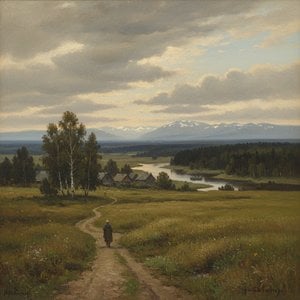
- The Grandeur of Landscape: From the serene mountains of Persian Spring to the sun-drenched vistas of Africa, his landscapes serve as windows into the diverse climates he traversed.
- The Elegance of the Human Figure: His nude studies and depictions of female heads are celebrated for their grace, blending anatomical accuracy with a mythic, almost ethereal beauty.
- Decorative Brilliance: His work on large-scale commissions, such as murals and frescoes for prominent European patrons, showcased his skill as a designer capable of transforming architectural spaces.
A Lasting Impression on the Modern Canon
The later years of Yakovlev’s life were marked by continued adventure and artistic evolution. His participation in the famous La Croisière Noire—the motorized expedition across Africa sponsored by André Citroën—provided him with a wealth of new, exotic imagery that further solidified his status as a master of ethnographic and landscape art. Even as he moved between studios in Paris and retreats in Capri, his work remained anchored by a profound commitment to observation and an unwavering pursuit of beauty.
Though he passed away in 1938, leaving behind a legacy that bridges the gap between Russian tradition and European modernism, Alexander Yakovlev’s impact remains palpable. He was more than just a painter; he was a visual chronicler of a changing world. His ability to synthesize the disparate elements of his life—the discipline of Saint Petersburg, the mysticism of the East, and the sophistication of Paris—into a cohesive artistic language ensures that his work continues to resonate with collectors and historians alike. In every brushstroke and every pencil line, one finds the heartbeat of a man who saw the world not just as it was, but as a tapestry of infinite, moving wonders.
Otázky a odpovědi
Kolik děl umělce Alexander Evgenievich Yakovlev je možné si prohlédnout?
V katalogu si můžete prohlédnout 49 děl děl autora Alexander Evgenievich Yakovlev na stránce Všechna umělecká díla.
Jak najdu díla umělce Alexander Evgenievich Yakovlev v určité barevné paletě?
Stránka Podle barevné palety seskupuje díla umělce Alexander Evgenievich Yakovlev podle jejich barevných palet.
Existuje časová osa děl umělce Alexander Evgenievich Yakovlev?
Existuje časová osa děl umělce Alexander Evgenievich Yakovlev: stránka Časová osa děl řadí díla podle data jejich vzniku.