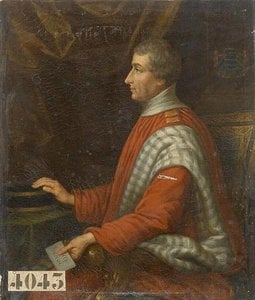
Joseph Albrier: A Parisian Portraitist of Refined Elegance
Joseph Albrier (1791-1863) was a French painter whose career unfolded during a pivotal era in European art, bridging the Neoclassical and Romantic movements. While not achieving the widespread fame of his contemporaries like David or Delacroix, Albrier carved out a distinctive niche as a portraitist, particularly renowned for capturing the refined elegance and aristocratic bearing of his subjects. His work offers a fascinating glimpse into the social fabric of 19th-century Paris, reflecting the tastes and values of the elite.
Born in Paris, Albrier’s artistic journey began under the tutelage of Jean-Baptiste Regnault, a prominent figure in the French art world and a student of Jacques-Louis David. This formative influence instilled in him a solid grounding in classical techniques and an appreciation for historical subjects – elements that would become hallmarks of his later work. Albrier’s early training emphasized meticulous draftsmanship and a careful study of anatomy, skills he skillfully applied to the creation of remarkably detailed portraits.
Albrier's artistic output spanned several decades, with his most prolific period occurring between 1819 and 1836. During this time, he exhibited regularly at the Paris Salon, a crucial venue for artists seeking recognition and patronage. His subjects were predominantly members of Parisian high society – aristocrats, nobility, and wealthy merchants – individuals who commissioned portraits to solidify their social standing and immortalize their families. Albrier’s ability to capture not just physical likeness but also an individual's character and demeanor was highly valued by his clientele.
The Language of Portraiture: Technique and Style
Albrier’s style is often described as Neoclassical with subtle Romantic influences. He meticulously rendered fabrics, jewelry, and hairstyles, employing a delicate hand and a keen eye for detail. His portraits are characterized by a restrained palette – typically consisting of muted tones of grey, brown, and ochre—which served to enhance the dignity and sophistication of his subjects. Albrier’s use of light and shadow was particularly masterful, creating a sense of depth and volume that brought his figures to life.
Unlike some of his contemporaries who embraced dramatic lighting or theatrical poses, Albrier favored a more understated approach. He sought to portray his subjects in a naturalistic manner, capturing their expressions with subtle nuances. His compositions were generally formal and symmetrical, reflecting the conventions of portraiture at the time. However, he occasionally introduced elements of asymmetry or off-center placement to create visual interest and dynamism.
Albrier’s technical skill was further demonstrated in his ability to depict textures – the velvet of a gown, the sheen of polished jewelry, the folds of a cloak—with remarkable accuracy. He achieved this through careful observation and a mastery of brushwork, utilizing short, broken strokes to build up layers of color and create a sense of tactile realism.
Notable Works and Patronage
Among Albrier’s most celebrated portraits are those of Madame la Marquise de Montesson, housed in the Musée des Beaux-Arts at Beziers, and numerous depictions of members of the Bourbon dynasty commissioned by King Louis Philippe. These works exemplify his ability to capture the dignity and grace of aristocratic subjects while also conveying a sense of their individual personalities.
Albrier’s work was highly sought after by wealthy patrons throughout France. He received commissions from prominent families, including the Rothschilds and the Ouvrards, who recognized his talent for creating portraits that reflected their social status and wealth. His paintings were displayed in private salons and public galleries, contributing to the vibrant artistic scene of Paris during the 19th century.
Legacy and Historical Context
Joseph Albrier’s legacy is perhaps less widely recognized than some of his contemporaries, but his contributions to French portraiture are nonetheless significant. He represents a crucial link between the Neoclassical tradition and the emerging Romantic style, embodying the refined elegance and social consciousness that characterized Parisian art during this period.
Albrier’s work provides valuable insights into the lives and customs of the French aristocracy in the 19th century. His portraits offer a window into the world of balls, salons, and private gatherings, revealing the fashion, etiquette, and social hierarchies that governed Parisian society. Furthermore, his meticulous attention to detail and technical skill serve as a testament to the enduring power of traditional artistic techniques.
Despite not achieving widespread fame during his lifetime, Joseph Albrier’s portraits continue to be admired for their beauty, elegance, and historical significance. They stand as a reminder of a talented artist who played a vital role in shaping the visual culture of 19th-century France.