The Art of the Encounter: The Meticulous World of Alastair Christian Adams
To step into the world of Alastair Christian Adams is to enter a space where time slows, and the simple act of looking becomes a profound investigation of the human soul. A British master of contemporary portraiture, Adams has spent decades refining a practice rooted in the belief that a portrait is far more than a mere likeness; it is a sequence of encounters, a layered dialogue between the observer and the observed. Born in 1968, his artistic journey was shaped by an early, intense fascination with the mechanics of drawing and the emotive power of paint, a passion that would eventually lead him to the prestigious halls of the Edinburgh College of Art and the Royal Academy Schools.
His technical foundation is built upon the rigorous traditions of classical oil painting, yet his approach possesses a modern, psychological urgency. Adams does not merely sit a subject in a studio; he often adopts a nomadic practice, working within the very environments his subjects inhabit. By transforming these spaces into temporary studios, he allows the specific light, atmosphere, and architecture of a sitter's life to seep into the fabric of the canvas. This method ensures that the background is never incidental, but rather an integral part of the narrative, contributing to a sense of place that grounds the figure in their own reality.
Mastery Through Layering and Light
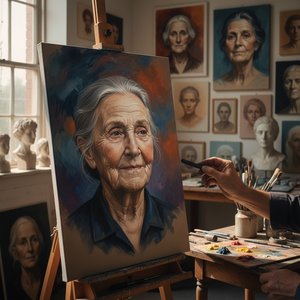
The physical creation of an Adams portrait is a feat of patience and precision. Eschewing rapid, gestural strokes for a more meditative process, he employs a sophisticated glazing technique. By applying numerous thin, translucent layers of pigment onto the canvas, he builds up tonal depth and luminosity, creating surfaces that seem to glow from within. This painstaking method allows him to render the most minute textures—the subtle grain of skin pores, the heavy weight of fabric folds, or the soft sheen of a glance—with such accuracy that the subjects appear almost palpable to the viewer.
This dedication to detail is heavily informed by his reverence for the masters of the past. One can trace the lineage of his work through the influence of Rembrandt, particularly in his ability to manipulate light and shadow to suggest inner character, and Lucian Freud, whose uncompromising honesty and anatomical scrutiny resonate in Adams’s pursuit of psychological depth. Through these influences, Adams bridges the gap between historical mastery and contemporary relevance, using old-world techniques to explore modern identities.
A Legacy of Faces and Narratives
Throughout his prolific career, Adams has navigated the delicate divide between the public image and the private self. His oeuvre is a remarkable tapestry of human experience, featuring a diverse array of subjects ranging from the highest echelons of political power to the quiet resilience of everyday heroes. His notable achievements include:
- Political and Academic Portraits: Capturing the gravity of figures such as Tony Blair for the National Portrait Gallery, as well as prominent academics like Girish Sethna and Derek Alexander Wood.
- Humanitarian and Social Narratives: Moving beyond fame to document profound personal stories, such as the eloquent intimacy found in his portrait of Sylvia Mac, a burns survivor and body positivity campaigner.
- Leadership in the Arts: Contributing to the evolution of the genre through his influential leadership within the Royal Society of Portrait Painters.
Ultimately, the significance of Alastair Christian Adams lies in his ability to evoke empathy. In an era of fleeting digital images, his work demands a return to slow, deliberate observation. He invites us to contemplate the complexities of the human condition, reminding us that every face holds a history, and every gaze is an invitation to understand the profound beauty found in the details of life.