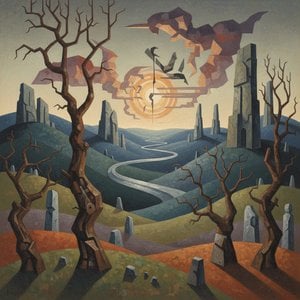
Adrian Durham Stokes (1902 – 1972): A Vision of Cornish Landscape
Adrian Durham Stokes was a British landscape painter born in Cornwall, England, in 1902. His artistic journey spanned decades, marked by unwavering dedication to capturing the essence of rural Britain and establishing himself as a respected figure within the realist movement. Though relatively unknown today compared to some contemporaries, Stokes’s paintings possess a quiet beauty and profound observation that continue to resonate with viewers interested in early 20th-century art.
Stokes's formative years were steeped in Cornish tradition. Growing up amidst the rugged coastline and windswept moorlands instilled within him an enduring fascination for the natural world – a fascination that would become central to his artistic vision. He initially pursued studies at Marlborough College, honing his drawing skills before embarking on formal training at Slade School of Fine Art in London, where he studied under Frank Auerbach and Cedric Lees. These influences shaped his approach to painting, emphasizing tonal modulation and textural richness—techniques characteristic of the British School of Painting.
His artistic output primarily focused on landscapes depicting Cornwall and its surrounding areas. Stokes’s canvases are renowned for their meticulous detail and masterful rendering of light and atmosphere. He eschewed flamboyant brushstrokes or dramatic color palettes, opting instead for subdued hues that subtly convey the mood of each scene. His method involved layering thin glazes of oil paint to build up tonal depth, creating surfaces that shimmer with reflected light—a technique he perfected during his travels in Italy where he studied under Giorgio Morandi. This Italian experience profoundly impacted Stokes’s artistic sensibilities, introducing him to a more contemplative and understated aesthetic.
Stokes's most celebrated works include “Landscape, West Penwith Moor” (1937), an oil painting that exemplifies his signature style. The canvas depicts the windswept expanse of Cornish moorland bathed in hazy sunlight. Loose brushstrokes blend seamlessly with tonal variations, conveying a sense of melancholy and capturing the timeless beauty of the landscape. Critics noted Stokes’s ability to convey emotion through subtle visual cues—a testament to his profound understanding of artistic expression.
Throughout his career, Stokes maintained an independent studio practice, prioritizing personal vision over commercial considerations. He exhibited regularly in London galleries and gained recognition for his contribution to British art history. Although he never achieved widespread fame, Stokes’s paintings remain treasured by collectors and scholars alike—a quiet legacy of a painter who dedicated himself to preserving the visual memory of rural England. His work stands as an enduring reminder of the power of observation and the beauty found in simplicity.