A Life Between Worlds: The Artistic Journey of Abel Herrero
Abel Herrero, born in Havana, Cuba, in 1971, embodies a fascinating artistic trajectory shaped by geographical displacement and a profound engagement with the socio-political currents of his time. His story isn’t simply one of an artist finding their voice; it's about a continuous negotiation between cultural roots and adopted landscapes, manifested through a powerfully abstract visual language. Herrero’s early exposure to the vibrant, yet politically charged, art scene of post-revolutionary Cuba laid the groundwork for a career deeply concerned with iconography, symbolism, and the complex relationship between humanity and nature. While details of his childhood remain somewhat private, it's clear that the island’s rich cultural tapestry and its inherent contradictions—beauty intertwined with hardship—left an indelible mark on his artistic sensibility. He began formal art studies in Cuba, honing foundational skills before a pivotal move to Milan, Italy, in 1994 would irrevocably alter the course of his creative development.
From Havana to Tuscany: A European Dialogue
The relocation to Milan at the young age of twenty-three wasn’t merely a change of scenery; it was an immersion into a different artistic ecosystem. Herrero quickly integrated himself into the Italian art world, forging connections with key figures from both established and emerging generations. This period proved crucial in his pursuit of a deeper understanding of European iconography and symbolic representation—a research that would become central to his work. He wasn’t simply adopting new techniques; he was actively engaging in a dialogue with centuries of artistic tradition, questioning its assumptions and reinterpreting its visual vocabulary. The relationships he cultivated during this time, particularly those with post-war masters like Jannis Kounellis and Claudio Parmiggiani, proved profoundly influential, shaping his aesthetic principles and intellectual approach to artmaking. This wasn’t a rejection of his Cuban heritage but rather an expansion of it—a synthesis of lived experience and scholarly inquiry.
The Language of Subtraction: Technique and Conceptual Depth
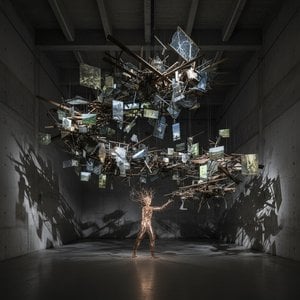
Herrero's artistic production is remarkably diverse, encompassing painting, sculpture, photography, and installation art. However, a unifying thread runs through all his work: a distinctive technique characterized by *subtraction*. He begins with canvases saturated in vibrant color—often bold, electrifying hues—and then progressively removes layers of paint using improvised tools like cloths and cardboard. This process isn’t random; it's a deliberate act of unveiling, revealing underlying compositions that blend figurative and abstract elements. The resulting works are often monochromatic, possessing an intense emotional resonance born from the tension between presence and absence. Critics have described this approach as a “powerful, essential painting,” free from rhetorical excess, where the very *time* invested in its creation becomes integral to its meaning. This emphasis on gestural abstraction is not merely stylistic; it’s deeply connected to his philosophical underpinnings, embracing Majakovsky’s thesis of economy in art—a belief that artistic expression should be distilled to its most essential form.
Osservatorio and the Human-Nature Relationship
In recent years, Herrero has focused increasingly on the concept of *Osservatorio* – observation – and its implications for understanding our relationship with the natural world. This exploration is particularly evident in his work created since 2010, when he established a studio in the Tuscan countryside. The landscapes of Tuscany became both subject matter and metaphor, prompting him to investigate themes of saturation—both visual and ecological. His canvases are not simply representations of nature; they’re meditations on its fragility, its power, and our responsibility towards it. Installations like *Black Sea Games*, with their gray canvases and black marble spheres, evoke a sense of loss and calcification, serving as stark reminders of the consequences of environmental degradation. The sea itself—a constant presence in his life, both from his Cuban upbringing and his Italian surroundings—becomes a symbol of hope and peril, embodying both freedom and vulnerability.
A Legacy of Exchange: Herrero’s Historical Significance
Abel Herrero's work transcends geographical boundaries, fostering a dialogue between cultures and generations. His participation in prestigious events like the Venice Biennale (2011) and exhibitions at institutions such as the MAXXI in Rome (2014) and the Havana Biennale (2015) have solidified his position as a significant contemporary artist. More than just an aesthetic innovator, Herrero is a cultural bridge, promoting exchange between Cuba and Italy through his art and initiatives like *Guest Thinkers*—a project he founded in 2006 that brought leading intellectuals to engage with Cuban institutions. His exhibitions, such as *Dangerous Games* at Tornabuoni Art in Paris (2024) and *Roma: Electri City* at z2o Sara Zanin Gallery (2014), demonstrate his commitment to site-specific installations that respond directly to their environment. Herrero’s legacy lies not only in the beauty of his abstract compositions but also in his ability to provoke thought, challenge assumptions, and remind us of the weight of human decisions on the world around us.