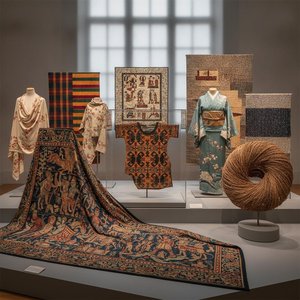
The Materiality of Memory
The impulse to manipulate fiber is perhaps the oldest form of human expression, predating the first pigments applied to cave walls. Long before the formalization of art history, humanity was engaged in the creation of soft architectures, using animal skins and plant fibers to negotiate the environment. This primal necessity—the need for protection and warmth—established a fundamental connection between the human body and the material world. Today, that connection has evolved from survival into a sophisticated language of texture and presence.
In a contemporary landscape increasingly defined by the flatness of digital screens and the ephemeral nature of pixels, there is a profound, grounding pull toward the physical. Collectors are increasingly seeking works that possess weight, warmth, and a discernible surface tension. Textile art offers a sensory connection that oil on canvas, for all its depth, cannot replicate; it invites a contemplation of texture that bridges the gap between the viewer and the maker. This modern craving for substance finds its roots in that ancient, tactile necessity, transforming a utilitarian origin into a profound aesthetic experience.
The Subversion of the Domestic
 Faith Ringgold
Explore Faith Ringgold’s narrative quilts & mixed media art! Celebrating Black American experiences through storytelling, activism, & iconic works.
For much of the nineteenth century, the act of transforming plant or animal matter into fabric was relegated to the domestic sphere, often dismissed by critics as menial labor. This categorization created a rigid divide between the "fine arts" of painting and sculpture and the "applied arts" of weaving and embroidery. Because these practices were frequently the domain of women, they were often excluded from the formal theorization of art, viewed as craft rather than intellectual expression.
The mid-twentieth century, particularly the period following World War II, saw a radical shift as artists began to reclaim these materials to challenge the status quo. Artists like Faith Ringgold and Sheila Hicks utilized fiber to express personal narratives and political identities, turning humble threads into resonant, intricate works. By moving from the home to the gallery, textile art transitioned from a functional necessity to a valid expressive medium. This movement effectively dismantled the hierarchy that once placed the needle and loom beneath the brush and chisel.
Geometry and the Radical Weave
 Chandrashekhar Bheda
Discover Chandrashekhar Bheda's vibrant textile designs! Explore intricate patterns & innovative techniques in Indian art, inspired by nature & tradition. View his artwork.
The evolution of textile art is often a tension between the rigid constraints of the loom and the fluid intentions of the artist. Traditional weaving is governed by the square grid—the intersection of warp and weft—which dictates a predictable, structural geometry. For centuries, this grid was the inescapable boundary of the medium, ensuring stability and pattern but limiting the potential for organic movement.
Innovation often arrives when an artist chooses to disrupt these foundational principles. Chandrashekhar Bheda, working from Gurgaon, India, achieved this by restructuring the Panja Durrie loom to defy traditional geometry. By altering the very mechanics of the weave, he created fabrics where the patterns no longer adhered to the expected grid, resulting in a dynamism that suggests spatial movement and curvature. This departure from the established order mirrors the broader history of art, where the most significant advancements occur when the artist learns to manipulate the tools of tradition to serve a new, non-linear vision.
The Architecture of Light and Thread
 Sudo, Reiko
Discover Sudo Reiko's innovative textile designs! Japanese artist blending tradition & sustainability, creating stunning fabrics & redefining textile heritage.
Modern textile innovation frequently exists at the intersection of ancient craftsmanship and cutting-edge technology. The ability to manipulate light through fiber allows for a sculptural quality that challenges the perception of what fabric can achieve. When light catches a single golden thread or filters through a translucent weave, the material ceases to be a mere surface and becomes an environmental presence.
This exploration of possibility is exemplified by the work of Reiko Sudo, who blends traditional Japanese techniques with modern industrial processes. Through her work with Nuno Corporation, Sudo has pushed the boundaries of how textiles interact with space, treating fabric as a medium for sculptural exploration rather than just a material for clothing. This approach echoes the avant-garde experiments of the Bauhaus, where weavers like Anni Albers integrated geometric abstraction with industrial experimentation, proving that the loom could be a tool for high-modernist inquiry.
The Narrative of the Discarded
 Maite Izquierdo
, a renowned Spanish textile artist, explores color, materiality, and existential themes through innovative fabric techniques. Her impactful works blend tradition and contemporary art, inspiring global recognition.
Texture is rarely just an aesthetic choice; it is often a vessel for history. The use of recycled textiles or salvaged materials introduces a layer of temporal depth to a work, as the fibers themselves carry the echoes of previous lives. When an artist works with remnants, they are not merely assembling shapes; they are engaging with the inherent memory embedded within the material.
Maite Izquierdo, a Chilean artist, utilizes this concept by working with discarded textiles to explore themes of identity and the ephemeral. Her practice involves the meticulous sewing, ripping, and tying of materials, acknowledging the beauty of decay and transformation. By embracing frayed edges and the imperfections of used fabric, the work becomes a tactile record of existence. This practice turns the act of creation into an act of reclamation, ensuring that the stories woven into the fibers are not lost to time but are instead recontextualized through contemporary vision.
Acquiring the Tactile Presence
For the discerning collector, the acquisition of textile art offers a unique opportunity to own works that possess both intellectual depth and an undeniable physical presence. As the distinction between "craft" and "fine art" continues to dissolve in prestigious institutions like the Museum of Modern Art, the market for high-quality, material-based art continues to expand. These works demand a space that respects their texture and their history.
WahooArt.com provides a curated gateway for those seeking to integrate this level of historical depth and material excellence into their collections. Whether through the acquisition of original works or the commissioning of a bespoke piece, our platform connects collectors with exceptional artistry. From the intricate textures of custom commissions to the tactile complexity of hand-made works, we facilitate the acquisition of art that resonates with the weight and authenticity of the human touch.