The nineteenth century in Poland was a period defined by absence; the nation itself was partitioned, existing more as a shared memory and a cultural ideal than as a political entity. In this era of shifting borders and suppressed sovereignty, the canvas became a vital site of preservation. Painters were tasked with the heavy responsibility of acting as visual custodians of a national spirit, using their brushes to document a history that was often under threat of being erased.
This duty is perhaps most poignantly felt in Jan Matejko’s 1862 work, Stańczyk. The painting presents a profound contrast between the lively, oblivious ball of the royal court in the background and the solitary, brooding figure of the court jester in the foreground. Stańczyk sits in shadow, his face etched with a sense of isolation and hopelessness that mirrored the political anxieties of the time. Through this single figure, Matejko captured the tension between the grandeur of the past and the precarious reality of the present.
The legacy of this historical urgency remains visible today in the way Polish art continues to grapple with the concept of identity. Much like the painters of the 1800s who sought to define a nation through its most dramatic moments, modern collectors often seek works that offer a sense of grounding and historical continuity within their own spaces.
Jacek Malczewski. Polish Symbolist blending folklore, mythology, and historical motifs into dreamlike allegories of national identity and existential struggle.
As the century turned, the focus shifted from the grand, epic narratives of history toward the internal, often turbulent, landscapes of the human soul. This transition found its most potent expression in the Young Poland movement, a period characterized by a surge of symbolism and a fascination with the subconscious. It was a time when the boundaries between the physical world and the realm of myth began to dissolve.
Jacek Malczewski, born in Radom in 1854, emerged as the central figure of this movement. His work did not merely depict scenes; it conjured worlds where mythological figures walked alongside contemporary Polish figures. Malczewski’s paintings often blended the heroic with the melancholic, creating a visual language that spoke to a nation yearning for self-determination. His ability to weave together folklore, personal introspection, and national longing transformed the act of painting into a form of spiritual inquiry.
This preoccupation with the unseen and the symbolic finds a parallel in the way we approach art today. We no longer look at a portrait simply to see a face, but to understand the psychological depth and the unspoken narratives that reside behind the eyes.
Leon Wyczółkowski. Polish realist and Young Poland leader known for impressionist landscapes, dramatic nudes, and rich still life painted with impasto textures.
While some artists looked toward myth, others found a different kind of intensity in the soil itself. The Polish countryside was not treated as a mere backdrop for pastoral idylls, but as a space imbued with a subtle, quiet drama. The landscape became a vessel for mood, capturing the atmospheric shifts of the seasons and the heavy stillness of the earth.
Leon Wyczółkowski was a master of this atmospheric approach. His landscapes avoided the superficiality of mere scenery, instead focusing on the interplay of light and shadow to evoke a sense of place that felt both specific and universal. There was a certain weight to his depictions, a sense that the land held memories of those who had worked it and those who had fought for it.
This reverence for the landscape echoes the way we perceive the natural world in contemporary art. There is a growing appreciation for works that do not merely show a view, but rather capture the specific, fleeting essence of a moment, allowing the viewer to feel the temperature and the silence of the scene.
Intimacy and the Psychological Portrait
The evolution of Polish art also moved toward a profound intimacy, particularly in the way the individual was captured on canvas. As the rigid structures of Academic Realism gave way to more expressive forms, the portrait became a tool for exploring the nuances of human character and the fragility of the ego.
Olga Boznańska stands as a preeminent figure in this pursuit. Her portraits are celebrated for their psychological depth, often utilizing a soft, ethereal quality that seems to dissolve the physical boundaries of the subject. She did not seek to document the external trappings of status, but rather the internal essence of the person. The result is a sense of intimacy that feels almost intrusive, as if the viewer is witnessing a private moment of reflection.
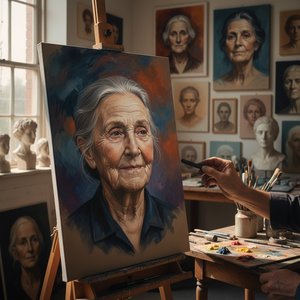
This focus on the internal life continues to drive the demand for custom portraiture. There is a desire to move beyond the literal likeness and to capture the true character of a subject, turning a simple image into a profound study of identity.
Aleksandra Ekster. Avant-garde pioneer of Cubo-Futurism and Suprematism known for dynamic, geometric abstraction and vibrant, theatrical stage designs.
The twentieth century brought a radical redrawing of the lines between tradition and the avant-garde. As the world became increasingly fragmented by war and technological change, Polish artists responded with a new, dynamic energy. The influence of Cubism, Expressionism, and Constructivism began to permeate the artistic consciousness, leading to a period of intense formal experimentation.
This era saw the rise of artists who embraced the geometric and the abstract, seeking to find a new visual language for a modern age. From the bold energy of Aleksandra Ekster to the sophisticated elegance of Tamara de Lempicka, the period was marked by a tension between the old world and the new. Art became a tool for cultural revolution, challenging the viewer to find meaning in shape, color, and rhythm rather than in recognizable figures.
Today, this spirit of experimentation lives on in the way we integrate art into modern living. The bold lines of an abstract piece or the structured composition of a geometric print can provide a striking counterpoint to the organic textures of a contemporary home.
Stanisław Wyspiański. Polish Symbolist polymath known for vibrant stained glass, organic Art Nouveau lines, and evocative pastel portraits of family and nature.
Finally, the intersection of fine art and design reached a peak during the Art Nouveau movement, known in Poland as Secesja. This was not merely a style, but a way of life that sought to harmonize art with the functional world, from the architecture of Kraków to the intricate patterns of decorative objects.
Stanisław Wyspiański was the driving force of this movement, a polymath whose influence spanned theatre, stained glass, and interior design. His work often utilized organic, flowing lines inspired by nature, yet it remained deeply rooted in a uniquely Polish sensibility. This period demonstrated that art could be both highly sophisticated and deeply integrated into the fabric of daily existence.
At WahooArt.com, we honor this legacy of craftsmanship and aesthetic harmony. Whether through our hand-painted oil reproductions that capture the tactile depth of the masters or our custom commissions that allow you to reimagine history, we provide the means to bring this profound sense of beauty and identity into your own environment. From museum-quality oils to bespoke digital mockups, our service is designed for those who value the soul of the artwork as much as its visual impact.
Redakce WahooArt.com
Jan Matejko
b. 1838 · Svobodné město Krakov, Polsko
Polský historický malíř dramatických, monumentálních scén a intenzivních psychologických příběhů, známý svým detailním antiquářským realismem.
Explore the profound psychological depth of emotional portraiture. From Expressionist masterpieces to custom oil commissions, discover how fine art captures the human soul through light, color, and masterful technique for discerning collectors.
Explore the profound psychological depth of Expressionist portraiture. From Munch to Schiele, discover how distorted forms and visceral brushstrokes unmask raw human emotion in this definitive guide for art enthusiasts and collectors.
20th-century Polish painters like Tamara de Lempicka, Sigmar Polke, and Aleksandra Ekster define an era. Find museum-quality reproductions on WahooArt.com.



 Stańczyk
 Jacek Malczewski
 Leon Wyczółkowski
 Aleksandra Ekster
 Stanisław Wyspiański