


Introduction
At the dawn of the twentieth century, a profound psychological shift swept through the cultural landscape of Germany, manifesting as a radical departure from the naturalism of the previous era. This movement sought to transcend the mere imitation of the external world, choosing instead to prioritize the internal landscape of the human psyche. Through a deliberate distortion of color and form, these artists sought to convey raw emotion, spiritual intensity, and the often-turbulent anxieties of a modernizing society. It was a rebellion against academic tradition, where the brushstroke became a vehicle for subjective experience rather than a tool for precise representation.
The movement emerged from a unique confluence of social upheaval and intellectual fervor, fueled by the tension between rapid industrialization and a deep-seated longing for primal, authentic expression. From the vibrant, rhythmic compositions of the Die Brücke group to the more structured, spiritual inquiries of Der Blaue Reiter, German expressionism redefined the boundaries of visual language. These artists did not merely paint scenes; they painted the visceral impact of those scenes, utilizing jarring palettes and jagged lines to provoke a direct, emotional response from the viewer.
Today, the legacy of this era remains vital, as its influence continues to resonate through contemporary art, graphic design, and even cinema. The courage of these painters to confront the complexities of the human condition—its loneliness, its ecstasy, and its chaos—ensures their work remains a powerful touchstone for anyone seeking art that speaks to the soul rather than just the eye. In the following sections, we examine ten seminal figures whose distinct visions helped define this transformative period of art history.
Ernst Ludwig Kirchner
 The Red Tower at Halle - Ernst Ludwig Kirchner
In The Red Tower at Halle, the viewer is thrust into a world of rhythmic energy and chromatic intensity. This 1914 masterpiece exemplifies the artist's ability to transform an urban landscape into a psychological experience, using a sharp diagonal perspective to pull the eye through a bustling street scene. Kirchner’s approach is defined by a radical simplification of form and a preference for unmixed, glowing colors that prioritize emotional truth over mere visual likeness.
As a foundational figure of German Expressionism, Kirchner was instrumental in the formation of the Die Brücke collective in 1905. Alongside fellow artists, he sought to bridge the gap between classical tradition and the raw, visceral realities of modern existence. His training in architecture in Dresden provided a disciplined understanding of composition, which he later subverted through gestural, impasto brushwork and a dramatic, high-contrast palette of deep blues, purples, and warm oranges.
His work remains a testament to the movement's core mission: the deliberate distortion of shape and color to convey the inner tension of the human condition. Through his vibrant depictions of city life and his rejection of academic rigidity, Kirchner remains a central pillar of this transformative era in German art history.
Max Beckmann
 Great Scene of Agony - Max Beckmann
Max Beckmann stands as a formidable pillar of the German Expressionist movement, a master who navigated the tension between rigorous academic training and the raw, psychological urgency of the twentieth century. Born in Leipzig in 1884, Beckmann’s early years were marked by a disciplined study of formal technique, yet his spirit was fundamentally driven to confront the complexities of the modern human condition. His work is characterized by a profound sense of confrontation, utilizing distorted forms and a heavy, tactile impasto to articulate the weight of history and the fragility of existence.
In his 1906 work, Great Scene of Agony, we witness the early stirrings of his expressive power. This piece serves as a visceral exploration of vulnerability, utilizing an unbalanced composition and a somber, muted palette to evoke a sense of profound unease. By eschewing mere likeness in favor of emotional truth, Beckmann’s practice aligns him deeply with the Expressionist ethos, where color and shape are deliberately manipulated to mirror the internal landscape of the psyche. His ability to transform the canvas into a site of psychological struggle ensures his enduring legacy among the most significant voices of German modernism."
August Macke
 Woman in a Green Jacket - August Macke
A central figure of the Der Blaue Reiter movement, August Macke (1887–1914) brought a luminous, rhythmic vitality to German Expressionism. Unlike the more aggressive distortions seen in other branches of the movement, Macke’s work is defined by a sophisticated synthesis of color and form. His approach was profoundly shaped by his encounters with French Modernism, particularly the light-drenched qualities of Impressionism and the geometric dynamism of Orphic Cubism. This unique perspective allowed him to move beyond the rigid academic training he received at the Düsseldorf Academy and under Lovis Corinth, evolving instead toward a style that prioritized the spiritual and emotional resonance of light.
One can recognize a Macke masterpiece at a glance through his use of vibrant, non-naturalistic color palettes and a sense of harmonious composition. In his 1913 work, Woman in a Green Jacket, he captures a fleeting moment of social leisure through a sophisticated interplay of shapes and hues. His brushwork is energetic yet controlled, creating a sense of movement that elevates a simple park scene into a profound exploration of modern life. By simplifying forms and emphasizing the rhythmic quality of color, Macke remains a quintessential German Expressionist, translating the essence of the external world into a vivid, internal experience.
Paula Modersohn-Becker
 Self Portrait with Camellia Branch - Paula Modersohn-Becker
In the intimate realm of early twentieth-century modernism, few works possess the haunting, quiet power of Paula Modersohn-Becker’s Self Portrait with Camellia Branch. Painted between 1906 and 1907, this masterpiece serves as a profound meditation on the intersection of femininity, mortality, and the natural world. Through her unflinching gaze, the artist invites the viewer into a space where the boundaries between the internal psyche and the external world begin to blur, embodying the very essence of the Expressionist movement.
As a pioneering figure among German Expressionist painters, Modersohn-Becker moved decisively away from the light-drenched idealism of Impressionism to embrace a more subjective, emotional truth. Her work is characterized by a deliberate flattening of perspective and simplified, almost primal forms that prioritize inner vision over objective likeness. Her signature subjects—intimate depictions of motherhood and daring, introspective self-portraits—are rendered with a heavy, palpable atmosphere. Utilizing a palette rich in deep blues and earthy greens, she achieved a sense of permanence and weight that defined her unique contribution to the movement. Her life, though tragically short, left an indelible mark on the avant-garde through her courage to explore the depths of human experience with unflinching honesty.
Frank Auerbach
 Euston Steps - Study - Frank Auerbach
Auerbach’s work is instantly recognizable through its visceral, sculptural intensity. To encounter an Auerbach is to witness the physical struggle of paint itself; he employs a heavy, tactile impasto that transforms the canvas into a relief of dense, layered pigment. His palette often leans toward somber, earthy tones, using light and shadow not merely to define form, but to excavate the psychological weight of his subjects. This profound emphasis on emotional distortion and the raw, unvarnished truth of the human condition firmly places him within the lineage of German expressionist painters, despite his long residency in Britain.
Born in Berlin in 1931, his early life was marked by the trauma of displacement during the Nazi era, a formative experience that informed his gritty, emotive style. After studying at St Martin’s and the Royal College of Art, he was deeply influenced by the teachings of David Bomberg, whose focus on direct observation helped shape his unique voice within the School of London. In his 1981 work, Euston Steps - Study, this expressionist approach is masterfully realized. The painting captures the urban landscape of London through thick, agitated brushstrokes, turning a transit hub into a dramatic, atmospheric exploration of movement and presence.
Otto Dix
 Sappenkopf - Otto Dix
The visceral intensity of Otto Dix’s work is inseparable from the trauma of his lived experience. Having served as a machine gunner on both the Eastern and Western Fronts during World War I, Dix did not merely observe the carnage; he was consumed by its mechanized brutality. This profound psychological wounding transformed his artistic gaze, driving him away from the decorative impulses of his early training at the Kunstgewerbeschule in Dresden toward a stark, unflinching realism. As a central figure in the German Expressionist movement, Dix utilized deliberate distortion and jarring emotional truths to confront the grotesque realities of a fractured era, moving beyond mere likeness to capture the raw essence of human suffering.
His 1920 masterpiece, Sappenkopf, serves as a haunting testament to this period. In this work, the somber, espresso-toned palette and clinical precision evoke the rigid, suffocating atmosphere of military life. Through sharp lines and a focus on the heavy textures of the uniform and medals, Dix captures a sense of profound isolation. His ability to translate the grit of industrial labor and the devastation of war into a powerful visual language ensures his place among the most significant German Expressionist painters.
Anselm Kiefer
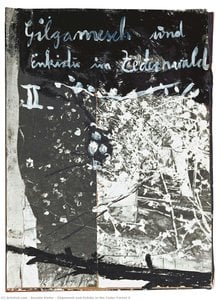 Gilgamesh and Enkidu in the Cedar Forest II - Anselm Kiefer
Anselm Kiefer stands as a monumental figure within the lineage of German expressionist painters, though his work specifically revitalized the movement through the lens of Neo-Expressionism. Born in Donaueschingen in 1945, his practice is inextricably tied to the historical weight of post-war Germany. Unlike the early 20th-century masters, Kiefer uses the expressive distortion of shape and emotion to confront the profound trauma and collective memory of his nation. His approach is deeply visceral, moving beyond mere representation to excavate the layers of history through a heavy, almost geological materiality.
His technical foundation was established through rigorous studies under Peter Dreher and Horst Antes at the Hochschule für Gestaltung Weinheim-Basel. Kiefer’s work is characterized by an alchemical use of materials—such as ash and straw—to give physical form to themes of absence and destruction. In his evocative work Gilgamesh and Enkidu in the Cedar Forest II (1981), he utilizes a dark, mythological imagery and a palette of rosy brown to explore ancient epics, demonstrating the movement's capacity to use symbolic distortion to convey deep-seated human emotion and historical gravity.
Erich Heckel
 Reclining Figure on Black Cloth - Erich Heckel
A pivotal moment in the trajectory of German expressionist painters occurred in 1905 when Erich Heckel joined forces with Ernst Ludwig Kirchner and others to form the revolutionary group Die Brücke. As the group's secretary and treasurer, Heckel was instrumental in bridging neo-romantic traditions with a raw, modern sensibility. His work is defined by the movement's core impulse: the deliberate distortion of shape and color to externalize profound internal emotions rather than mere physical likeness.
In his evocative work, Reclining Figure on Black Cloth, we witness the mastery of this expressive approach. The painting captures a moment of contemplative repose, where the human form is rendered with a grace that feels both timeless and intensely modern. Through a sophisticated use of color and composition, Heckel explores the psyche, moving away from the bright palettes of his early years toward a more melancholic, subdued intensity. His ability to infuse scenes of modern life and the nude with such psychological depth exemplifies the very essence of the Expressionist spirit, making him a foundational figure in the history of German modernism.
Max Pechstein
 Two lying Nudes - Max Pechstein
A hallmark of Max Pechstein’s oeuvre is the vibrant, rhythmic energy he brings to the canvas, often characterized by a simplified, almost primal approach to form. To recognize a Pechstein at a glance is to look for an intense, unmixed application of pigment and a palette that favors bold, emotive color over academic precision. His work frequently explores the human form, landscapes, and scenes of daily life, all rendered with a tactile, expressive brushwork that prioritizes emotional truth over photographic likeness.
As a central figure in the legendary German Expressionism, Pechstein was a founding member of the Die Brücke group. Unlike many of his contemporaries, he possessed a rigorous academic foundation from the Royal Academy of Fine Arts in Dresden, which he utilized to bridge the gap between traditional craftsmanship and the radical, visceral modernity of the early twentieth century.
In his evocative work, Two Lying Nudes, Pechstein exemplifies this movement through a masterful use of light and shadow. The painting captures a profound sense of intimacy, using color to create a psychological depth that transcends mere representation, inviting the viewer into a private, dreamlike sanctuary.
Lucian Freud
 The Big Man - Lucian Freud
Born in Berlin in 1922, Lucian Freud’s artistic lineage is deeply intertwined with the intellectual weight of his grandfather, Sigmund Freud. While his family fled Germany for London in 1933, his early creative impulses remained tethered to the emotional intensity of the Expressionist tradition. His work is defined by a profound departure from mere likeness, instead utilizing the deliberate distortion of form to convey raw, psychological truth. Freud’s connection to the movement is most evident in his early flirtations with Surrealism and the visceral, unsettling emotionality characteristic of German Expressionism, which he eventually distilled into a singular, unflinching realism.
A viewer recognizes a Freud masterpiece by its tactile, almost sculptural surface. He utilized a heavy, impastoed application of paint, creating a physical topography that mimics the vulnerability of flesh. His palette often favors muted, somber tones that amplify the dramatic tension of his subjects. In his 1977 work, The Big Man, this technique is masterfully employed. The painting serves as a profound exploration of the human condition, using thick, expressive brushstrokes to transform a solitary figure into a vessel of intense introspection and melancholic depth.
Conclusion
The legacy of German expressionism lies in its profound ability to prioritize the raw, internal landscape of the human psyche over the mere imitation of external reality. From the jagged, urban anxieties captured by Kirchner to the monumental, textured explorations of Kiefer, these artists redefined the boundaries of visual language through deliberate distortion and emotive color. Whether through the delicate, soulful portraits of Modersohn-Becker or the visceral, heavy impasto of Freud, this movement transformed the canvas into a site of intense psychological confrontation. To possess such works is to invite a powerful, emotive energy into one's environment, a sentiment echoed throughout our full collection. At WahooArt.com, we honor this heritage by offering museum-quality, hand-painted oil reproductions that capture the essential soul and tactile brushwork of these masters, allowing you to live with their profound visions every day.


