The Revolution of Perception: Breaking from Academic Tradition
To understand the magic of Impressionism, one must first envision the rigid, somber world of the nineteenth-century French Academy. For decades, the Académie des Beaux-Arts dictated that true art resided in historical grandeur, mythological perfection, and a polished, invisible brushstroke that left no trace of the artist’s hand. The canvases were often dark, heavy with studio shadows and a sense of eternal, unmoving permanence. However, a group of rebellious visionaries—led by the likes of Claude Monet, Renoir, and Pissarro—begged to look elsewhere. They sought not the frozen perfection of the past, but the vibrating reality of the present.
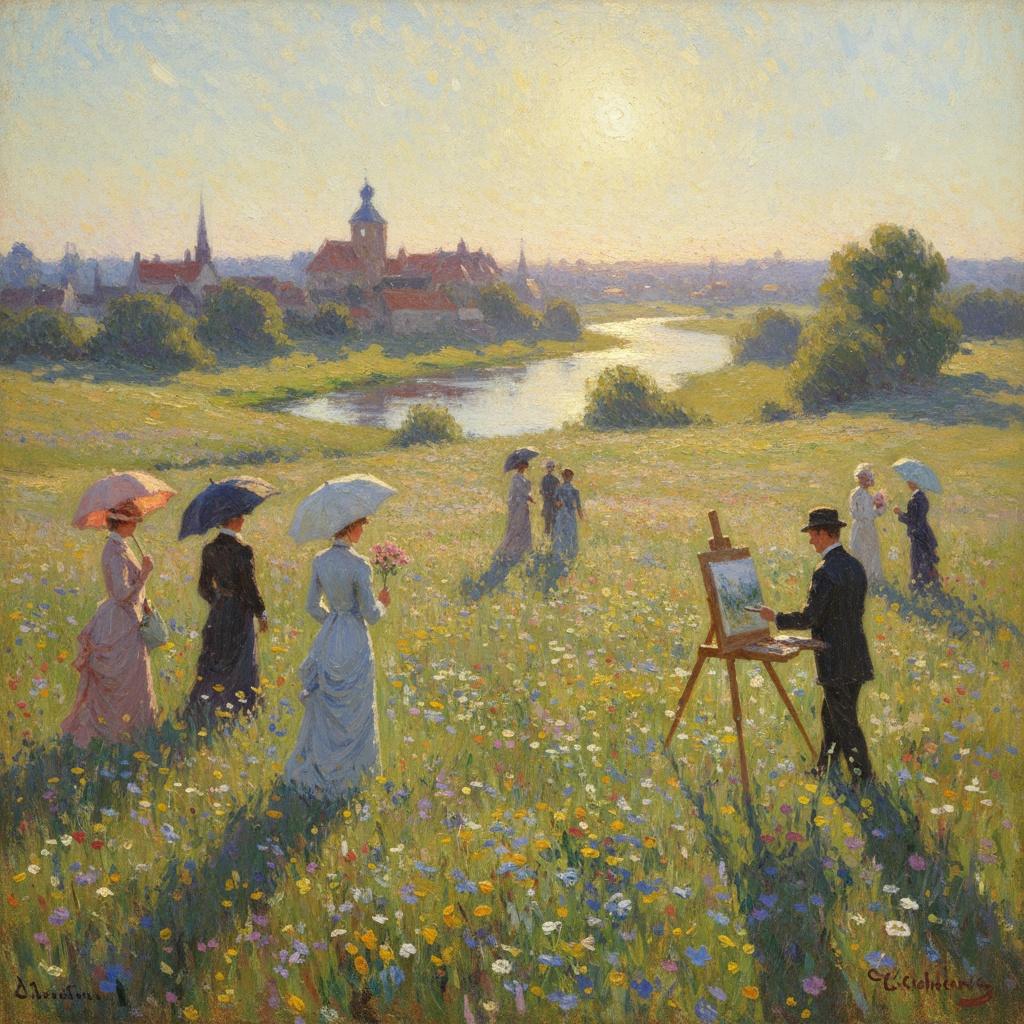
This movement was more than a stylistic shift; it was a profound revolution in human perception. These artists began to reject the controlled environment of the studio in favor of the unpredictable rhythms of life. They abandoned the heavy blacks and earth tones of the old masters, choosing instead to embrace the spectrum of visible light. By breaking away from the strictures of academic realism, they invited the viewer to experience a world that was no longer static, but fluid, breathing, and intensely alive. It was an invitation to see the beauty in the mundane, finding divinity in a sun-drenched meadow or a quiet riverbank.
Chasing the Sun: The Science of Light and Color Theory
At the heart of the Impressionist triumph lies a sophisticated understanding of optical science. These painters became amateur physicists, obsessed with how light interacts with surfaces and how the human eye perceives color under changing conditions. They discovered that shadows are rarely black or grey; rather, they are composed of deep blues, violets, and reflected hues from the surrounding environment. This realization transformed the canvas into a prism. When observing a work like Monet’s Lavacourt, one does not merely see a landscape, but witnesses the interplay of warmth and coolness as the sun traverses the sky.
The technique relied heavily on the principle of optical mixing. Instead of blending pigments smoothly on a palette to create a flat, uniform color, Impressionists applied dabs of pure, unadultered pigment side-by-side. From a distance, the viewer’s eye performs the work of the brush, blending these distinct strokes into a luminous whole. This method allows for a brilliance that traditional glazing cannot achieve. The colors appear to vibrate with an internal energy, mimicking the way light actually dances upon water or filters through the canopy of a forest, creating a sense of radiance that feels almost tactile.
En Plein Air: Capturing the Fleeting Moment in Nature
The advent of portable tin paint tubes revolutionized the movement, allowing artists to move their easels out of the dim studio and into the great outdoors. This practice, known as en plein air, was essential to the Impressionist mission. To capture the "impression" of a moment, one had and must work with incredible speed. The light changes by the minute; a cloud passing over the sun can entirely alter the color temperature of a landscape. Artists like Blanche Hoschedé Monet carried this tradition forward, documenting the serene, shifting atmospheres around Giverny with an intimacy that only direct observation can provide.
This connection to nature brought a new sense of movement to the genre. In works such as Infantry Guards Wandering Along the River, we see more than just figures in a landscape; we feel the breeze, the humidity, and the transient passage of time. The subject matter shifted from the heroic to the ephemeral—the way mist clings to a valley in the morning or how the midday sun flattens the perspective of a hayfield. By painting outdoors, the Impressionists bridged the gap between the observer and the observed, making the viewer a participant in the fleeting beauty of the natural world.
Mastering the Brushstroke: Texture, Movement, and Impasto
The physical texture of an Impressionist painting is perhaps its most emotive characteristic. The brushstroke became a signature of presence, a rhythmic pulse that guides the eye across the canvas. Many artists utilized impasto—the thick, heavy application of paint—to create a three-dimensional surface. These raised ridges of pigment catch actual light within the room, casting tiny shadows that change as you move past the painting. This creates a "living" quality, where the artwork seems to respond to its environment just as much as it depicts one.
In masterpieces like Monet’s Spring, the delicate yet vigorous brushstrokes evoke the softness of new blossoms and the vitality of growing flora. The texture is not merely decorative; it is structural. It provides the weight necessary to ground the ethereal light. Through varying the pressure and direction of the brush, the artist can simulate the roughness of bark, the fluidity of water, or the lightness of air. This tactile depth ensures that the painting remains a physical object of wonder, inviting the eye to wander through its layered topography.
The Impressionist Legacy: From Monet to Modern Interpretations
The ripples of the Impressionist movement continue to expand through the centuries, influencing everything from Post-Impressionism to the modern digital age. The movement’s emphasis on subjectivity and the emotional resonance of color paved the way for the abstractionists who would follow. Today, we see the spirit of Impressionism in our very desire to capture the essence of a moment—whether through a photograph or a custom painting. The movement taught us that truth is not found in rigid detail, but in the feeling of light and the memory of color.
For the modern collector, embracing this legacy means bringing that sense of luminous tranquility into the contemporary home. Whether through a meticulously handcrafted oil reproduction that honors every original brushstroke or a personalized reimagining of a cherished memory, the magic of Impressionism remains accessible. It serves as a timeless reminder to pause, to observe, and to find the extraordinary within the fleeting light of our own lives.
Discover the artistry for yourself at WahooArt.com. From museum-quality oil reproductions that capture the tactile soul of the masters to custom commissions that transform your personal photos into Impressionist treasures, we bring the beauty of art history into your living space with unparalleled craftsmanship and global expertise.