


The Gilded Curtain: An Introduction to the Theatrical Soul of Impressionism
 Opéra national de Paris
A Symphony of Stone and Song: Unveiling the Bibliothèque-Musée de l’Opéra National de Paris Nestled within the heart of Paris, a world away from the glittering stages of its sister opera house, lies a treasure trove often overlooked – the Bibliothèqu...
To step into the world of late 19th-century Paris is to enter a realm where the air itself seems to hum with the ghosts of legendary performances. For those of us who have spent decades wandering through the hallowed halls of the Musée d'Orsay or gazing at the soft, luminous textures of a Renoir, there is a particular magic found in the intersection of art and the stage. The Impressionist movement, while often celebrated for its sun-drenched landscapes and flickering light on water, possessed a profound fascination with the controlled drama of the theater and the ballet. It was a period where the boundaries between the observer and the observed began to blur, as artists sought to capture not just the spectacle of the performance, but the very atmosphere of the opera house.
This era was defined by a shift in gaze—from the idealized, mythological subjects of the Academy toward the vibrant, breathing pulse of modern life. The theater provided the perfect stage for this revolution. Within the velvet-lined confines of the Opéra National de Paris, artists found a symphony of stone and song, a place where light could be manipulated to create depth, mystery, and emotion. This was not merely about documenting a dance; it was about capturing the ephemeral beauty of a moment that would vanish as soon as the curtain fell. For the discerning lover of art, these works serve as a window into a vanished era of Parisian splendor, inviting us to feel the weight of the silk, the warmth of the footlights, and the quiet tension of the wings.
Beyond the Glitz: Degas and the Unfiltered Reality of the Ballet Rehearsal
 Ballet Rehearsal
A Glimpse Behind the Curtain: Degas’s ‘Ballet Rehearsal’ Edgar Degas's *Ballet Rehearsal* (1874) offers a rare and intimate look into the world of 19th-century ballet, moving beyond the glamour of performance to reveal the dedication and often mundan...
While history often nests Edgar Degas within the luminous circle of the Impressionists, to truly understand his contribution, one must look past the romanticized label. Degas was a man of fascinating contradictions—a meticulous realist who preferred the structured elegance of the studio over the unpredictable light of the open field. He did not merely paint beautiful ballerinas; he captured the grueling reality of their profession. In masterpieces such as The Ballet Relevé or The Ballet Rehearsal on Stage, we see a departure from the glamour of the performance to reveal the dedication and often mundane reality of practice.
Degas possessed an unparalleled ability to dissect the mechanics of motion, treating the human figure as a study in kinetic energy and anatomical precision. His gaze was that of a dedicated observer, finding profound narratives in the disciplined strain of a dancer mid-rehearsal or the weary slump of a limb during a break. There is a quiet tension found within his canvases—a heavy reality of human effort juxtaposed against the grace of a fleeting gesture. By peering behind the curtain, Degas allowed us to witness the authentic beauty of the dance: the sweat, the concentration, and the physical toll that precedes the effortless elegance we see under the spotlight.
A Symphony of Light and Motion: Capturing the Ephemeral Moment on Stage
 The Star (Dancer on Stage)
A Moment Frozen in Motion: Degas’s “The Star” (Dancer on Stage) Edgar Degas's "The Star," or "Dancer on Stage" as it was originally titled, is more than just a pastel portrait; it’s a meticulously observed and profoundly evocative capture of the ephe...
The true magic of stage performance in Impressionist art lies in the interplay between light and movement. Consider the way Degas utilized the diffused, often artificial light of the theater to underscore his fascination with ephemeral qualities. In works like The Star (Dancer on Stage), we encounter a moment frozen in time, yet vibrating with potential energy. The lighting is not merely a functional element; it is a character in itself, casting shadows that suggest layers of narrative complexity and highlighting the textures of silk, lace, and tulle.
This mastery of light allows for an immersive experience into the atmosphere of the performance. Through loose, expressive brushstrokes, the artist can convey the fluidity of a swirling tutu or the shimmer of light catching a satin ribbon. There is a rhythmic pulse found within these compositions, where the placement of figures—some clustered in the corps de ballet, others isolated in a moment of solitude—guides the viewer’s eye through the space. It is a dance of observation, where the artist uses color and tone to evoke the very heartbeat of the theater, making the viewer feel less like a spectator in a gallery and more like an intimate witness to the performance itself.
The Architect of Motion: Analyzing Technique, Pastel, and Composition
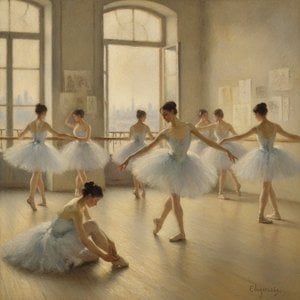 The Grace of Motion: Exploring the Timeless Masterpieces and Impressionist Brilliance of Edgar Degas
The Architect of Motion: Degas and the Essence of Movement Edgar Degas A Life Immersed in Movement Born Hilaire-Germain-Edgar De Gas in Paris, 1834, Edgar Degas was an artist of fascinating contradictions. While often grouped with the Impressionists—...
To appreciate these works at a deeper level, one must admire the technical brilliance required to render motion on a static surface. Degas, in particular, was a master of the pastel medium. Unlike oil paints, which can sometimes feel heavy or opaque, pastels offer a direct connection between the artist's hand and the canvas, allowing for incredibly nuanced gradations of tone. He built up layers of pigment with delicate strokes, creating a luminous effect that captures the subtle variations in skin tones and the translucent quality of stage costumes.
His compositions were often revolutionary, utilizing asymmetry and unexpected cropping—techniques reminiscent of the burgeoning art of photography. By cutting off figures at the edge of the frame or positioning a stagehand in the foreground, he created a sense of immediacy and depth. This unconventional approach forces the eye to move across the canvas, mimicking the restless energy of a live performance. The use of impasto and heavy textures in certain areas provides a tactile dimension, ensuring that the light does not just sit upon the surface but seems to emerge from within the very fibers of the work.
From the Studio to the Gallery: Preserving the Magic of Performance in Modern Interiors
For the modern collector, bringing the spirit of these Impressionist masterpieces into one's home is an act of preserving a cultural legacy. Whether it is a large-format mural that recreates the grandeur of a Parisian ceiling or a bespoke, hand-painted oil reproduction on 100% cotton canvas, the goal remains the same: to capture the soul of the era. A true reproduction should possess the visible brushstrokes and deep tonal range that distinguish a handmade work from a mere print, allowing the texture of the paint to catch the light just as Degas intended.
Integrating such evocative art into contemporary spaces requires an eye for balance. Much like the multi-panel trends in modern architecture, splitting a wide, sweeping scene across several canvases can create a breathtaking focal point on a staircase or a grand hall. When we choose to surround ourselves with works that celebrate movement and light, we do more than decorate a room; we invite the timeless elegance of the 19th-century stage into our daily lives, ensuring that the magic of the performance never truly fades.
Reflections on a Vanished Era: The Enduring Emotional Resonance of the Stage
 Capturing Motion: The Top 25 Masterpieces by Edgar Degas
Introduction To step into the world of Edgar Degas is to enter a realm where time seems to pause, yet movement never ceases. There is a profound, rhythmic pulse found within his canvases—a quiet tension between the grace of a fleeting gesture and the...
As we look back upon these storied collections, we realize that the enduring power of Impressionist stage scenes lies in their ability to speak to the universal human experience. We see ourselves in the concentration of the dancer, the exhaustion of the rehearsal, and the shared breath of the audience. These paintings are not mere visual records; they are emotional echoes of a time when art sought to find the monumental within the mundane.
The legacy of artists like Degas remains vibrant because they taught us that true beauty is found in the honest portrayal of life in motion. As we continue to admire these works, we are reminded that even the most fleeting moment—a leap, a glance, a flicker of light—can be rendered eternal through the dedicated hand of a master. It is a profound testament to the power of art to capture the very essence of what it means to be alive and in motion.
This editorial was curated by the experts at WahooArt.com, your dedicated destination for the finest Impressionist and Post-Impressionist reproductions and commissions.


