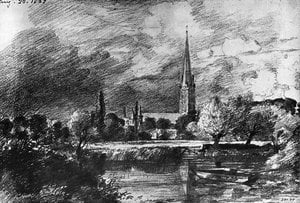
John Constable – Salisbury Cathedral from the Bishop’s Grounds: A Pastoral Vision of Faith and Light
John Constable's *Salisbury Cathedral from the Bishop’s Grounds* (1825) transcends mere depiction; it embodies a profound connection between the English countryside and spiritual contemplation. Currently housed in the Metropolitan Museum of Art in New York, this iconic landscape painting continues to inspire awe and admiration for its masterful blend of observation and emotion—a hallmark of Romantic art. Constable’s enduring legacy rests upon his ability to capture not just what he saw but how he felt about it, transforming a familiar architectural landmark into a symbol of serenity and timeless beauty.
Subject and Composition – Framing Divinity in Nature
The painting presents Salisbury Cathedral nestled within the verdant embrace of Wiltshire’s Bishop’s Grounds. Constable strategically positioned the cathedral spire amidst mature trees—specifically beech and elm—which soften its imposing Gothic structure, creating a harmonious juxtaposition between man-made grandeur and natural tranquility. A gentle stream meandering through the foreground draws the viewer's eye towards the cathedral, establishing a visual pathway that reinforces the painting’s central theme: the integration of faith and nature. Scattered figures strolling leisurely add a human scale to this picturesque vista—a subtle reminder of everyday life unfolding within this idealized landscape. Two horses further animate the composition, conveying movement and vitality, mirroring the dynamism inherent in the natural world. Constable's meticulous attention to detail ensures that every element contributes to the overall impression of contemplative grandeur.
Style and Technique – The Language of Impressionism Before Its Time
Constable’s artistic style is firmly rooted in Romanticism, prioritizing emotional response and an idealized portrayal of nature over strict topographical accuracy. He eschewed precise rendering in favor of expressive brushstrokes—a technique that distinguishes him from earlier generations of painters. These loose, visible strokes capture the fleeting effects of light and atmosphere with remarkable sensitivity, imbuing the painting with a palpable sense of immediacy. Constable employed oil paint on canvas, utilizing glazing techniques to build up layers of color and achieve subtle gradations – a method pioneered by artists like Claude Lorrain and Rembrandt—resulting in rich textures and luminous hues. The diffused glow emanating from the cathedral spire and foliage underscores Constable’s masterful handling of light, creating a mood of tranquil reflection and sublime beauty.
Historical Context & Commission – A Reflection of Victorian England
Completed in 1825, *Salisbury Cathedral from the Bishop’s Grounds* was commissioned by John Fisher, the Bishop of Salisbury—a prominent figure in Victorian society and Constable's close friend. This commission reflects the broader cultural preoccupation with landscape painting during the Romantic era, as artists sought to express spiritual values through depictions of the natural world. Notably, Fisher initially requested a second version with a brighter sky, demonstrating the personal connection between artist and patron and highlighting the symbolic importance of light within the artwork—a motif frequently employed by Romantic painters to convey divine illumination and transcendence. The painting’s creation coincided with a period of significant social and intellectual change in England, marked by burgeoning industrialization alongside an increasing appreciation for rural landscapes and artistic idealism.
Symbolism & Emotional Impact – Beyond Representation: An Expression of Soul
The cathedral itself symbolizes faith, history, and enduring human achievement—aspirations central to the Romantic worldview. Its placement within the Bishop’s Grounds suggests a harmonious relationship between humanity and nature—a concept championed by poets like Wordsworth and Coleridge—affirming the belief that beauty and spirituality coexist in the natural world. Constable's deliberate choice of an overcast sky contributes to the painting’s emotional complexity, evoking feelings of melancholy, contemplation, and awe at the sublime power of landscape. The figures strolling through the grounds represent human presence within this sacred space, reinforcing the idea that art can communicate profound spiritual truths—a legacy that continues to resonate with viewers today. *Salisbury Cathedral from the Bishop’s Grounds* remains a testament to Constable's artistic vision—a masterpiece that invites contemplation and celebrates the enduring beauty of the English countryside.
Owning a Piece of History – Bringing Constable’s Vision Home
- A Timeless Aesthetic: This painting offers a classic and sophisticated addition to any interior design scheme.
- Evocative Atmosphere: The serene mood and natural beauty create a calming and inspiring ambiance.
- Investment in Art History: A reproduction allows you to connect with the legacy of one of England’s most celebrated artists.
This artwork is an invitation to experience Constable's profound understanding of nature and faith—a timeless masterpiece that continues to captivate art lovers and collectors alike.
Otázky a odpovědi
V jakém roce bylo vytvořeno dílo „Salisbury Cathedral z pozorovacího nádvoří“ od John Constable?
Vznik díla „Salisbury Cathedral z pozorovacího nádvoří“ od John Constable se datuje do roku 1825.
Lze obraz díla „Salisbury Cathedral z pozorovacího nádvoří“ od John Constable volně reprodukovat?
Co se týče autorských práv, dílo "Salisbury Cathedral z pozorovacího nádvoří" spadá do patří do volného užití – autorská práva vypršela.
Lze dílo „Salisbury Cathedral z pozorovacího nádvoří“ od John Constable, které je uloženo v Metropolitní muzeum umění, legálně reprodukovat?
Autorskoprávní status díla „Salisbury Cathedral z pozorovacího nádvoří“ od John Constable je jasný: toto dílo spadá do patří do volného užití – autorská práva vypršela. Jeho umístění v instituci Metropolitní muzeum umění tento stav nemění.
Kdo vytvořil "Salisbury Cathedral z pozorovacího nádvoří"?
Dílo "Salisbury Cathedral z pozorovacího nádvoří" se připisuje autorovi John Constable.
Jakou saturaci a intenzitu vykazuje „Salisbury Cathedral z pozorovacího nádvoří“ od John Constable?
Barvy díla „Salisbury Cathedral z pozorovacího nádvoří“ od John Constable vykazují Jemné barvy saturaci s Monochromní intenzitou.
Je "Salisbury Cathedral z pozorovacího nádvoří" dobrým nápadem na dárek?
Dílo „Salisbury Cathedral z pozorovacího nádvoří“ od John Constable se doporučuje jako dárek pro Výročí. Jako dárek lze věnovat reprodukci tohoto uměleckého díla.
Kolik let bylo John Constable, když v roce 1825 vytvořil(a) dílo „Salisbury Cathedral z pozorovacího nádvoří"?
Když bylo dílo „Salisbury Cathedral z pozorovacího nádvoří“ vytvořeno v roce 1825, měl/a John Constable – narozen/a 1776 – 49 let.



 Zobrazit v interiéru
 Přepnout na tiskové verze
 Odeslat
 Sdílet
 Podrobnosti
 Průvodce

 Stáhnout obrázek
 Podobné kousky
 Rentgenové snímky
 Slideshow
 Statistiky


 Přečíst si více






































 Skleněná varianta je dostupná pouze u rozměrů menších než 110 cm