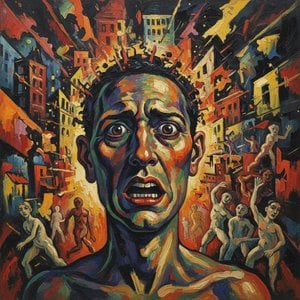
A Striking Encounter: Modigliani’s Portrait of Diego Rivera
This captivating portrait, painted in 1914 by Amedeo Modigliani, offers a compelling glimpse into the personality of fellow artist Diego Rivera. Housed at the Museu de Arte in São Paulo, Brazil, this oil on canvas is more than just a likeness; it’s an exploration of artistic kinship and a powerful statement within the burgeoning Expressionist movement. The painting immediately draws the viewer in with its intense gaze and unconventional aesthetic – a direct challenge to the prevailing norms of portraiture at the time. Rivera himself, already a rising star in the world of Mexican muralism, is presented not as a heroic figure of revolutionary zeal, but as a man wrestling with his own intellect and artistic ambitions.
Decoding Modigliani’s Style
Modigliani, a pivotal figure in early 20th-century art, developed a highly distinctive style characterized by elongated forms, simplified features, and an elegant linearity. Influenced profoundly by the African sculptures he encountered during his time in Morocco – particularly the stylized masks that seemed to capture the very essence of human emotion – Modigliani sought to strip away the superficial details of Western portraiture. His approach was deeply rooted in a desire to convey inner psychological states rather than simply replicating external appearances. The subtly stretched face of Rivera, with its almond-shaped eyes and carefully sculpted features, exemplifies this pursuit. It’s not merely a representation of Rivera's physical form; it’s an attempt to capture his spirit, his intensity, his very soul. The limited palette – dominated by oranges, greys, and whites – further contributes to the painting’s somber yet compelling mood, amplifying the sense of introspection.
Technique and Composition
Modigliani’s technique is marked by a confident application of paint, with visible brushstrokes adding texture and dynamism. He employed a layering process, building up color gradually and often scraping back areas to reveal underlying tones – a technique that adds depth and complexity to the image. The composition is relatively simple, focusing on Rivera's head and shoulders against an abstract background. This deliberate lack of detailed setting directs all attention to the subject’s face and expression. The off-center positioning adds a sense of unease and immediacy, as if we are encountering Rivera in a candid moment – a man lost in thought, perhaps contemplating his next great work. The use of impasto – thick layers of paint – creates a tactile quality, inviting closer inspection and emphasizing the physicality of the artist’s hand.
Historical Context: A Parisian Artistic Circle
Painted during Modigliani’s time in Paris, the portrait reflects the vibrant and experimental atmosphere of the city's artistic community. Modigliani and Rivera were part of a circle of artists – including Picasso and Brâncuși – who were challenging traditional artistic conventions. This period saw the rise of various avant-garde movements, with Expressionism seeking to convey subjective emotions and experiences rather than objective reality. The portrait can be seen as a testament to this spirit of innovation and artistic exchange. Rivera himself would soon become a leading figure in the Mexican Muralist movement, further solidifying his place in art history. The Parisian salon scene, with its constant flow of ideas and influences, undoubtedly played a crucial role in shaping Modigliani’s evolving style.
Symbolism and Emotional Resonance
While not overtly symbolic, the painting’s emotional impact is profound. The intensity of Rivera's gaze suggests a complex inner life – a sense of determination, perhaps even melancholy. Modigliani doesn’t simply *represent* Rivera; he attempts to capture his essence, his spirit. The portrait speaks to the power of artistic connection and the shared struggles of creative individuals. It is an intimate portrayal that transcends mere physical resemblance. The subtle tension between subject and viewer – a feeling of being both observed and observing – adds another layer of complexity to this enduring masterpiece.
- Consider pairing this reproduction with minimalist furnishings to allow the artwork’s intensity to shine.
- The portrait's somber tones work beautifully in studies or libraries, creating a contemplative atmosphere.
- Explore other works by Modigliani to create a cohesive and impactful art collection.
movement: Expressionism
topics: Portraiture, Expressionism, Diego Rivera, Italian Art, Bold Colors, Abstract Form, Intense Gaze, African Art, Gestural Abstraction, European Expressionism, Mexican Muralism, Social Commentary
creative_period: Mature Period
corpus_context: Key Rivera Portrait", Expressionist Style, Modigliani’s Signature, African Art, Gestural Abstraction, European Expressionism, Mexican Muralism, Social Commentary
Otázky a odpovědi
Nachází se dílo „Portrét Diega Rivera“ od Amedeo Modigliani v zemi původu umělce?
Ne – dílo se nachází v zahraničí. Rodimá země Amedeo Modigliani je Itálie, zatímco muzeum, které uchovává originál díla „Portrét Diega Rivera“, se nachází v zemi Brazílie.
Kde si mohu prohlédnout náhled díla "Portrét Diega Rivera"?
Náhled díla „Portrét Diega Rivera“ od Amedeo Modigliani si můžete prohlédnout na stránce Náhled v prostoru.
Je „Portrét Diega Rivera“ od Amedeo Modigliani portrét, krajina nebo čtvercová kompozice?
Dílo „Portrét Diega Rivera“ od Amedeo Modigliani má formát Portrétní orientace. Tento formát určuje poměry kompozice.