Early Life and Artistic Awakening in the Tyrolean Landscape
Franz von Defregger emerged from the rugged beauty of Tyrol, Austria, born on April 30, 1835, in the small hamlet of Strohn. His beginnings were deeply rooted in the realities of rural life; his parents, Michael and Maria Defregger, were farmers who instilled within him a profound connection to the land – a connection that would profoundly shape his artistic vision for decades to come. However, his early years were marked by hardship: a devastating typhoid epidemic tragically claimed the lives of his mother and two sisters when he was still a young boy, casting a long shadow over his childhood and shaping his understanding of loss and resilience. Despite these sorrows, a spark of creativity ignited within him – a desire to capture the world around him through observation and representation. He displayed an early aptitude for music, finding solace and expression in playing the flugelhorn with local bands, while simultaneously developing a natural talent for drawing and woodcarving as he worked alongside his father on the farm. These seemingly disparate pursuits—music and craftsmanship—laid the foundation for his future artistic endeavors, fostering both technical skill and an appreciation for detail. The decision to pursue art professionally came after his father’s death in 1858 – a pivotal moment that demanded courage and sacrifice. Defregger bravely sold the family farm, relinquishing financial security for the uncertain path of an artist, demonstrating a profound commitment to his burgeoning passion.
Formal Training and the Embrace of Munich
Defregger's artistic journey began in Innsbruck, where he apprenticed with the esteemed sculptor Michael Stolz, honing his skills in woodcarving – a craft that instilled within him a meticulous attention to form and texture. However, Stolz quickly recognized that Defregger’s true calling lay not in sculpture, but in painting. Recognizing this potential, Stolz facilitated an introduction to the influential Karl von Piloty at the Academy of Fine Arts in Munich – a move that proved transformative. From 1860 to 1861, he attended preparatory classes under Hermann Dyck, laying the groundwork for his formal artistic education and exposing him to the principles of academic painting. A period of study followed at the École des Beaux-Arts in Paris (1863-1865), where he encountered the Barbizon school – a movement characterized by its emphasis on plein air painting, naturalism, and a rejection of academic conventions. This exposure profoundly influenced his style, leading him to embrace a more direct and observational approach to landscape painting. The Barbizon painters’ focus on capturing the essence of nature and their celebration of rural life resonated deeply with Defregger, shaping his artistic sensibilities for years to come. Upon returning to Munich, he formally enrolled as a student at the Academy, immersing himself in the study of history painting under Karl von Piloty – a master known for his realistic depictions of historical events and figures.
A Style Rooted in Tyrolean Life and Historical Narrative
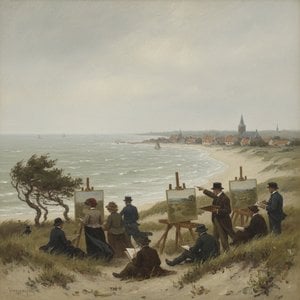
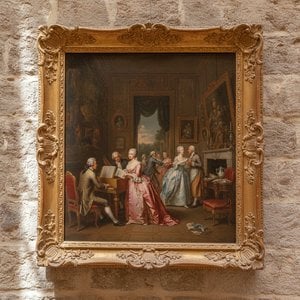
Franz von Defregger’s artistic style is instantly recognizable for its evocative portrayals of Tyrolean peasant life and significant historical moments. His paintings are imbued with a profound sense of nostalgia, sentimentality, and an almost palpable connection to the past – qualities that resonated deeply with audiences of his time and continue to captivate viewers today. He became closely associated with the Munich School, renowned for its meticulous realism, narrative focus, and ability to capture the spirit of everyday life. The influence of the Barbizon school is particularly evident in his landscape paintings, which masterfully depict the atmospheric beauty of the Tyrolean mountains and valleys – capturing not just their physical appearance but also the light, shadow, and mood of the region. However, Defreggger’s true mastery lay in his ability to portray the lives and stories of ordinary people—farmers, storytellers, musicians—with dignity, empathy, and a remarkable sensitivity to human emotion. Mother’s Pride (1872), for example, offers a touching glimpse into domestic life, while The Storyteller (1876) beautifully captures the warmth of family connection. He frequently returned to scenes from the Tyrolean national uprising of 1809 – a pivotal moment in Tyrolean history – and particularly focused on the heroic figure of Andreas Hofer, a subject that allowed him to explore themes of patriotism, resistance, and cultural identity. Andreas Hofer mit seinen Beratern in Innsbruck (1879) stands as a powerful depiction of this historical event, conveying both the drama of the conflict and the courage of its participants. Other notable works such as Beauty of the Tyrol (1880) and Der Zitherspieler (1876) further showcase his ability to celebrate the beauty of his homeland and capture the essence of traditional Tyrolean culture.
Recognition, Legacy, and Enduring Appeal
Defregger’s talent did not go unnoticed. In 1878, he achieved a significant milestone by becoming a professor of history painting at the Munich Art Academy – a position he held until 1910, profoundly influencing generations of aspiring artists. During this time, he fostered a new approach to historical painting, moving away from the rigid formality of academic tradition and embracing a more narrative and emotionally resonant style. He received numerous accolades throughout his career, including the Order of Merit of Bavaria (1883) and the Prussian Order of Merit for Science and the Arts – solidifying his reputation as one of Austria’s leading painters. His work was prominently displayed at the Century of German Art exhibition in Berlin (1906), further enhancing his national recognition. Beyond his artistic achievements, Defregger demonstrated a deep connection to his homeland by building both a private home in Munich (the Defregger House) and a residence in Bolzano (Villa Defregger). Streets were even named in his honor in Vienna, Bolzano, and Gries am Brenner – a testament to the esteem in which he was held. Franz von Defregger passed away on January 2, 1921, in Munich at the age of 85, leaving behind a rich artistic legacy that continues to inspire and captivate audiences today. His works remain cherished for their realism, emotional depth, and enduring celebration of the Tyrolean spirit – offering a valuable window into the cultural landscape of 19th-century Austria.
От редакционния екип на WahooArt.com
Квиз за изкуство
За всеки въпрос има само един верен отговор.
Въпрос 1:
В коя област на Австрия е роден Франц фон Дефрегер?
Въпрос 2:
Каква ранна умение демонстрира Дефрегер, докато работи на ферма?
Въпрос 3:
Коя школа на изкуството значително повлия на пейзажните картини на Дефрегер?
Въпрос 4:
Кой е основният тематичен фокус на творбите на Дефрегер, особено свързани с тиролската история?
Въпрос 5:
Каква позиция заема Дефрегер в Академията на изкуствата в Мюнхен от 1878 до 1910 г.?
Explore the ethereal beauty of the Hague School art movement. Discover how masters like Jan Weissenbruch captured the atmospheric grey light of the Dutch landscape through unparalleled technique and emotive, misty compositions.
Explore the profound beauty of genre painting. From Dutch Golden Age masters to global traditions, discover how artists capture the essence of everyday life through masterful realism and timeless storytelling.
Здравейте! Мога да ви помогна с избора на произведение на изкуството, проследяването на поръчка или отговори на въпроси относно гаранцията. С какво мога да ви бъда полезен?