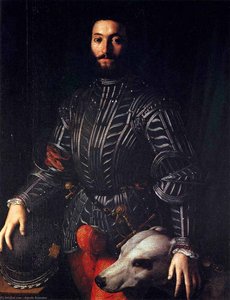
Аньоло Брондзино, 1503 – 1572

Картини на Аньоло Брондзино: 100-те най-известни произведения, подредени по рейтинг

Най-известната картина на Аньоло Брондзино е Венера, Купидон и Времето (Алегория на похотта) (1540), разположена в Национална галерия, Лондон. С Portrait of Eleonora da Toledo (1555) и Venus, Cupido and Satyr се допълват трите произведения, които всеки разпознава. Нашият каталог включва 189 произведения на Аньоло Брондзино; 100-те по-долу са най-гледаните от света, всяко от тях с годината си, музея, в който се съхранява, и причината за неговата значимост.

Класирани според нашия коефициент за популярност, който съчетава търсенията, посещенията и поръчките за всяко произведение. Обновено Октомври 2026. Всяко шедьовър на тази страница може да бъде поръчано като маслено репродукция на ръка с музейно качество или като художествен принт, в избран от Вас размер.

Портрет на Аньоло Брондзино
Аньоло Брондзино · 1503 – 1572
Роден · починал
1503 – 1572, Флоренция
Движение
Маниеризъм
Работи в нашия каталог
189
Най-известни
Венера, Купидон и Времето (Алегория на похотта) (1540)
Най-много творби в
Галерия Уфици

10-те най-известни картини на Аньоло Брондзино

Венера, Купидон и Времето (Алегория на похотта) (1540) на Аньоло Брондзино
1

Венера, Купидон и Времето (Алегория на похотта)

1540 · Масло върху платно · Национална галерия, Лондон

Потопете се в завладяващия свят на “Венера, Купидон и Времето (Алегория на похотта)” от Агноло Бронзино, шедьовър от 16-ти век, който безпроблемно съчетава митологична история с художествена иновация. Тази изискана творба ви кани да проучите богатата си символика, ярките цветове и динамичната си композиция, правейки я вечен акцент в колекцията на всеки любител на изкуството или елегантен декор за всяко пространство.

Portrait of Eleonora da Toledo (1555) на Аньоло Брондзино
2

Portrait of Eleonora da Toledo

1555 · Oil On Panel

To gaze upon Agnolo Bronzino's Portrait of Eleonora da Toledo is to step directly into the rarefied atmosphere of High Renaissance Florence. This painting, executed in 1555, transcends a mere likeness; it is a carefully constructed monument to status, power, and exquisite refinement. The subject, Eleonora da Toledo, radiates an almost palpable aura of aristocratic dignity. Bronzino captures her not just as a woman, but as a symbol of Medici…

Venus, Cupido and Satyr на Аньоло Брондзино
3

Venus, Cupido and Satyr

Oil

A pale, reclining figure occupies the center of the frame, her skin possessing the cool, polished sheen of marble. This is Venus, the goddess of love, draped in a way that emphasizes the tension between soft flesh and the hard edges of the composition. Beside her, Cupid clings to her form, a small, fleshy presence that embodies the sudden, sharp sting of passion. Their limbs are elongated, stretching toward one…

Portrait of Andrea Doria as Neptune (1550) на Аньоло Брондзино
4

Portrait of Andrea Doria as Neptune

1550 · Oil On Canvas · Pinacoteca di Brera, Милано

In the grand theater of the Italian Mannerist period, few images command the eye with such authoritative grace as Agnolo Bronzino’s Portrait of Andrea Doria as Neptune. This is not merely a portrait of a man, but a profound exercise in political allegory and divine projection. The subject, the legendary Genoese admiral Andrea Doria, is stripped of the heavy silks and velvet doublets typical of sixteenth-century aristocratic portraiture. Instead, Bronzino…

St. John the Baptist (1542) на Аньоло Брондзино
5

St. John the Baptist

1542 · Oil On Panel · Музей Джейн Пол Гети, Лос Анджелис

The figure of St. John the Baptist emerges from the shadows, rendered with a muscular intensity by the Florentine master Bronzino. This depiction captures the patron saint of Florence in a moment of profound spiritual tension. Created about 1542 - 1545, the work possesses a striking verticality that speaks to its original purpose. It does not exist in isolation but remains a fragment of a larger sacred narrative, having once…

Deposition (1565) на Аньоло Брондзино
6

Deposition

1565 · Oil On Canvas · Galleria dell'Accademia di Firenze, Флоренция

“Deposition,” painted in 1565 by the Florentine master Agnolo Bronzino, is not merely a religious scene; it's a meticulously crafted tableau of restrained emotion and profound psychological depth. Commissioned for the Observant Monastery in Cosmopoli, this work transcends simple narrative to become a meditation on grief, loss, and the delicate balance between earthly sorrow and divine grace. Bronzino, renowned for his “reserved elegance,” achieved this through an almost unnervingly controlled…

Portrait of a Young Man (1555) на Аньоло Брондзино
7

Portrait of a Young Man

1555 · Oil On Canvas · Nelson-Atkins Museum of Art, Канзас Сити

To gaze upon this portrait is to step directly into the rarefied atmosphere of mid-sixteenth-century Florence, a world governed by the subtle power plays and exquisite tastes of the Medici court. Agnolo Bronzino, the master chronicler of such elite circles, captured not merely a likeness, but an entire social stratum. The sitter, though anonymous to us today, embodies the controlled elegance expected of those who moved within the gilded cage…

Cosimo de Medici in Armour (1545) на Аньоло Брондзино
8

Cosimo de Medici in Armour

1545 · Oil On Panel · Музей Тисен-Борнемица, Мадрид

The gaze of the Grand Duke of Tuscany, Cosimo I de' Medici, meets the viewer through the work titled Cosimo de Medici in Armour. Created by the Florentine artist Bronzino, this portrait captures the ruler in a moment of poised authority. The image emerges from the mid-16th century, dated about 1545, and presents a commanding presence through its structured composition. It exists as a significant version of the painting held…

Portrait of Cosimo I de' Medici as Orpheus (1537) на Аньоло Брондзино
9

Portrait of Cosimo I de' Medici as Orpheus

1537 · Oil On Panel · Philadelphia Museum of Art, Филаделфия

In this portrait, we encounter Cosimo I de' Medici, not merely as a ruler, but as the mythological musician Orpheus. He is positioned in a three-quarter view from behind, turning his gaze back toward us with a sense of psychological alertness. His body, rendered with a polished, marble-like texture, possesses an idealized beauty that speaks to the High Mannerist style. A single splash of crimson red drapery provides a sharp…

Portrait of Eleonora of Toledo and Her Son, Francesco de'Medici (1549) на Аньоло Брондзино
10

Portrait of Eleonora of Toledo and Her Son, Francesco de'Medici

1549 · Oil On Panel · Cincinnati Art Museum, Цинсинати

In this vertical half-length portrait, we encounter the Duchess of Florence, Eleonora of Toledo, and her son, Francesco de' Medici. The composition is defined by a controlled, almost sculptural stillness. Eleonora stands slightly behind the young boy, her hand resting upon his shoulder in a gesture that is both protective and formal. There is a certain aristocratic detachment in their expressions, a cool composure that characterizes the Florentine Mannerist style.…

Аньоло Брондзино, картини от 11 до 100

Pope Leo X (1555) на Аньоло Брондзино
#22

Pope Leo X

1555 · Галерия Уфици

To gaze upon this portrait of Pope Leo X is to encounter a moment suspended in the opulent grandeur of the Italian Renaissance. Agnolo Bronzino, master chronicler of…

Купете го за дома си →
Miracle of the Brazen Serpent (1542) на Аньоло Брондзино
#30

Miracle of the Brazen Serpent

1542 · Palazzo Vecchio

In the heart of Florence’s Palazzo Vecchio, tucked within the sacred stillness of the Cappella di Eleonora, resides one of the most arresting spectacles of the Mannerist era:…

Portrait of a Young Man (1540) на Аньоло Брондзино
#32

Portrait of a Young Man

1540 · Метрополитън Музей на изкуствата

Agnolo Bronzino's “Portrait of a Young Man,” painted circa 1540, stands as an emblem of Florentine Mannerism—a stylistic movement that prioritized elegance and restraint over the exuberant naturalism…

Поръчайте репродукция →
Martyrdom of St Lawrence (1569) на Аньоло Брондзино
#33

Martyrdom of St Lawrence

1569 · Базилика Сан Лоренцо

Agnolo Bronzino’s “Martyrdom of St. Lawrence,” painted in 1569, isn't merely a depiction of a historical event; it’s a profound meditation on faith, suffering, and the enduring spirit…

Crossing of the Red Sea (1542) на Аньоло Брондзино
#42

Crossing of the Red Sea

1542 · Palazzo Vecchio

The fresco titled Crossing of the Red Sea was executed by the Florentine artist Agnolo Bronzino. This work, completed around 1542, utilizes the fresco technique to depict a…

View of the Chapel of Eleonora da Toledo (1440) на Аньоло Брондзино
#64

View of the Chapel of Eleonora da Toledo

1440 · Palazzo Vecchio

The painting presents a view of a chapel featuring a fresco that depicts the life of Christ. Within this sacred setting, the scene is populated by numerous figures,…

Moses strikes water from the wall rocks (1544) на Аньоло Брондзино
#75

Moses strikes water from the wall rocks

1544

The air feels heavy with anticipation as Moses raises his staff against the rugged, unyielding face of the rock. In this mid-sixteenth century fresco, a sudden, life-giving force…

Altarpiece (1540) на Аньоло Брондзино
#76

Altarpiece

1540 · Palazzo Vecchio

The year is 1540, and Florence pulses with the ambition of the Medici court. Within the private chapel of Eleonora di Toledo, Duchess of Florence, a masterpiece emerges…

Купете го за дома си →

Картини на Аньоло Брондзино по периоди

Обичаните сюжети на Аньоло Брондзино

Четирите най-често срещани сюжета сред тези шедьоври, с най-добрия пример за всеки от тях.

Къде могат да се видят картините на Аньоло Брондзино

8 музея, които притежават най-голям брой от картините на тази страница.

Музеи Град Творения на Аньоло Брондзино Картини от този списък
Галерия Уфици, ФлоренцияГалерия Уфици Флоренция 18 Holy Family, Portrait of Lucrezia Panciatichi, Pope Leo X
Palazzo Vecchio, ФлоренцияPalazzo Vecchio Флоренция 11 Miracle of the Brazen Serpent, The Miracle of the Spring, Gathering of the Manna
Музей на изкуствата (Будапеща), БудапещМузей на изкуствата (Будапеща) Будапещ 8 Venus, Cupid and Jealousy, Adoration of the Shepherds, Venus, Cupid and Envy
Национална галерия, ЛондонНационална галерия Лондон 5 Венера, Купидон и Времето (Алегория на похотта), Venus cupid time, Venus, Cupid and Time (detail)
Национална галерия на изкуствата, УокшънтънНационална галерия на изкуствата Уокшънтън 4 Eleonora di Toledo, Portrait of Eleanora di Toledo, A Young Woman and Her Little Boy
Детройтският институт за изкуства, ДетройтДетройтският институт за изкуства Детройт 2 Costanza da Sommaia, Madonna and Child with Saint John the Baptist
Walters Art Museum, БалтиморWalters Art Museum Балтимор 2 The Feast Given by Joseph for His Brothers, Portrait of a Baby Boy
Кралска колекция, ЛондонКралска колекция Лондон 2 Portrait of a Lady in Green, Portrait of a Lady in Green

Най-известната картина на Аньоло Брондзино за всяко десетилетие

  1. 1520s
    Virgin and Child with the Young Saint John the Baptist (1528) на Аньоло Брондзино
    #55 от 100

    Virgin and Child with the Young Saint John the Baptist

    Възраст 17 – 26 · Art Institute of Chicago

    In this Mannerist oil painting, three figures occupy a vertical, tightly cropped arrangement against a dark, near-black background. The Virgin Mary is positioned centrally, her form defined by…

  2. 1530s
    Portrait of Cosimo I de' Medici as Orpheus (1537) на Аньоло Брондзино
    Место 9 от 100

    Portrait of Cosimo I de' Medici as Orpheus

    Възраст 27 – 36 · Philadelphia Museum of Art

    In this portrait, we encounter Cosimo I de' Medici, not merely as a ruler, but as the mythological musician Orpheus. He is positioned in a three-quarter view from…

  3. 1540s
    Венера, Купидон и Времето (Алегория на похотта) (1540) на Аньоло Брондзино
    #1 от 100

    Венера, Купидон и Времето (Алегория на похотта)

    Възраст 37 – 46 · Национална галерия

    Потопете се в завладяващия свят на “Венера, Купидон и Времето (Алегория на похотта)” от Агноло Бронзино, шедьовър от 16-ти век, който безпроблемно съчетава митологична история с художествена иновация.…

  4. 1550s
    Portrait of Eleonora da Toledo (1555) на Аньоло Брондзино
    № 2 от 100

    Portrait of Eleonora da Toledo

    Възраст 47 – 56

    To gaze upon Agnolo Bronzino's Portrait of Eleonora da Toledo is to step directly into the rarefied atmosphere of High Renaissance Florence. This painting, executed in 1555, transcends…

  5. 1560s
    Deposition (1565) на Аньоло Брондзино
    #6 от 100

    Deposition

    Възраст 57 – 66 · Galleria dell'Accademia di Firenze

    “Deposition,” painted in 1565 by the Florentine master Agnolo Bronzino, is not merely a religious scene; it's a meticulously crafted tableau of restrained emotion and profound psychological depth.…

Въпроси относно картините на Аньоло Брондзино

Коя е най-известната картина на Аньоло Брондзино?Покажи отговора

Венера, Купидон и Времето (Алегория на похотта) (1540), Национална галерия, Лондон. Следват Portrait of Eleonora da Toledo (1555) и Venus, Cupido and Satyr.

На колко години е бил Аньоло Брондзино, когато е нарисувана Венера, Купидон и Времето (Алегория на похотта)?Покажи отговора

37 години: Венера, Купидон и Времето (Алегория на похотта) е от 1540 г., а Аньоло Брондзино е роден/а в 1503.

Кои са 10-те най-добри картини на Аньоло Брондзино?Покажи отговора

Венера, Купидон и Времето (Алегория на похотта), Portrait of Eleonora da Toledo, Venus, Cupido and Satyr, Portrait of Andrea Doria as Neptune, St. John the Baptist, Deposition, Portrait of a Young Man, Cosimo de Medici in Armour, Portrait of Cosimo I de' Medici as Orpheus и Portrait of Eleonora of Toledo and Her Son, Francesco de'Medici. Класацията по-горе посочва годината и музея на всяко от тях.

Колко картини е създал Аньоло Брондзино?Покажи отговора

В нашия каталог са изброени 189 произведения на Аньоло Брондзино, датирани от 1525 до 1569.

Къде се намират най-известните картини на Аньоло Брондзино?Покажи отговора

Повечето от тях се намират в Галерия Уфици (Флоренция), Palazzo Vecchio (Флоренция) и Музей на изкуствата (Будапеща) (Будапещ). В горната таблица музеите са изброени един по един.

Кога Аньоло Брондзино е създал най-известните си произведения?Покажи отговора

В 1540s: 36 от 100 произведенията на тази страница са от този период, като сред тях са Венера, Купидон и Времето (Алегория на похотта).

Кои са най-ранните и най-късните известни картини на Аньоло Брондзино?Покажи отговора

Най-старата творба на тази страница е от St Matthew (1525), а най-новата е от Martyrdom of St Lawrence (1569).

Какво най-често е рисувал Аньоло Брондзино?Покажи отговора

Renaissance (35), Portrait (17) и Woman (13), сред 100 произведения на тази страница.

Коя техника използва най-често Аньоло Брондзино?Покажи отговора

Oil On Panel: 28 от общо 100 произведения на тази страница.

Към коهто художествено направление принадлежи Аньоло Брондзино?Покажи отговора

Маниеризъм, както показват картините на тази страница.

Кои картини на Аньоло Брондзино мога да видя в Галерия Уфици?Покажи отговора

Holy Family, Portrait of Lucrezia Panciatichi и Pope Leo X са сред 8-те произведения на тази страница, съхранявани в Галерия Уфици, Флоренция.

Мога ли да купя репродукция на картина на Аньоло Брондзино?Покажи отговора

Да. Всяка картина на тази страница може да бъде поръчана като ръчно рисувано маслено репродукция музейно качество или като художествен принт в избран от Вас размер, директно от страницата на съответната картина.

За Аньоло Брондзино

Agnolo Bronzino: The Silent Elegance of Florentine Mannerism

Agnolo di Cosimo, known to history as Bronzino, emerged from the vibrant artistic landscape of Renaissance Florence in 1503, a period already brimming with genius. Born the son of a butcher, his path diverged sharply from familial trade, guided instead by an innate talent that would see him become one of the most sought-after portraitists of his era and a defining figure of Mannerism. His early training began with Raffaellino del Garbo, but it was under the tutelage of Jacopo da Pontormo that Bronzino’s artistic sensibilities truly took shape. While absorbing Pontormo's innovative style—characterized by expressive distortions and unsettling perspectives—he ultimately forged his own distinct voice—one characterized by a cool composure and refined detail markedly different from his teacher’s often emotionally charged works. This early period was also influenced by studies with Andrea del Sarto, exposing him to the legacies of Michelangelo and Leonardo da Vinci, foundational influences that would subtly permeate his mature style. The young Bronzino quickly demonstrated an aptitude for capturing not just physical likeness but a certain psychological depth, even in his earliest commissions.

Early Influences and Artistic Formation

Bronzino’s formative years were marked by exposure to the artistic currents of Florence under Pontormo's guidance. Pontormo’s distinctive style—a deliberate departure from classical ideals—challenged conventional notions of beauty and realism. Bronzino skillfully adapted Pontormo’s expressive distortions, incorporating them into his own compositions with remarkable subtlety. Simultaneously, he absorbed lessons from Andrea del Sarto, mastering the techniques of sfumato and chiaroscuro—methods pioneered by Leonardo da Vinci—which would become hallmarks of his later work. These influences instilled in Bronzino a profound appreciation for intellectual rigor alongside artistic virtuosity. His early portraits reveal an uncanny ability to convey inner states through carefully crafted poses and expressions, demonstrating a sensitivity that transcended mere visual representation. Vasari famously described Bronzino as “a boy who had been apprenticed to Pontormo,” highlighting the pivotal role played by his teacher in shaping his artistic vision.

The Medici Patronage and Florentine Court Style

Bronzino’s career ascended dramatically with the patronage of Cosimo I de’ Medici, Duke of Tuscany. Recognizing Bronzino's exceptional talent, Cosimo appointed him as the official court painter—a position he held until his death in 1572—solidifying his influence on Florentine art and culture. This relationship fostered a flourishing artistic environment where Bronzino could hone his skills and explore innovative stylistic approaches. The portraits emanating from this period are not merely likenesses; they are meticulously constructed statements of power, status, and dynastic ambition. Cosimo and Eleonora di Toledo—his wife—became frequent subjects, immortalized in paintings that exude an aristocratic aloofness and polished elegance. These works weren’t simply about capturing physical resemblance but crafting enduring symbols of Medici authority—a deliberate effort to project an image of regal grandeur and intellectual refinement. The commissioning of monumental frescoes for the Villa Imperiale further cemented Bronzino's reputation as a master craftsman, demonstrating his ability to execute ambitious projects with unwavering precision.

The Mannerist Aesthetic: Cool Composure and Stylized Form

Bronzino’s artistic style is quintessentially Mannerist—a movement that emerged in Florence during the mid-16th century as a reaction against the High Renaissance's emphasis on naturalism and harmonious balance. Unlike his predecessors, Bronzino rejected the idealized beauty of classical art, favoring instead a deliberately stylized aesthetic characterized by elongated figures, attenuated drapery, and subtle distortions of perspective. This approach—often described as “frozen emotion”—contrasted sharply with the expressive dynamism of Renaissance painting. Bronzino’s figures are rarely caught in moments of spontaneous action; rather, they appear posed with an almost sculptural stillness—a deliberate departure from the naturalistic conventions of earlier artists. His masterful use of sfumato—the blurring of contours to create a hazy effect—and chiaroscuro—the dramatic interplay of light and shadow—further enhanced this sense of detachment and refinement. As exemplified in *Venus, Cupid, Folly and Time*, Bronzino’s paintings are imbued with complex symbolism—a deliberate effort to convey intellectual ideas alongside visual beauty. He skillfully manipulated color palettes—often favoring muted tones—to achieve a harmonious balance between elegance and restraint.

Legacy and Enduring Influence

Bronzino's contribution to Florentine art history is undeniable, shaping the visual language of aristocratic representation for decades to come. His meticulous technique and stylistic innovation established him as one of the foremost Mannerist painters—a master of cool composure and refined detail whose portraits continue to captivate audiences today. Despite criticisms leveled against Mannerism during the Romantic era—characterized by a preference for emotional expression—Bronzino’s work has experienced a resurgence in appreciation in recent decades, scholars recognizing the intellectual depth and stylistic sophistication inherent in his art. His legacy extends beyond individual masterpieces; he profoundly influenced subsequent generations of artists, establishing standards of excellence that continue to inspire creativity. Bronzino's enduring influence is evident not only in the stylistic conventions of portraiture but also in his pioneering role as a court painter—a position that demanded both artistic virtuosity and diplomatic sensitivity. He remains a testament to the power of art to convey complex ideas and emotions with unparalleled elegance and precision.

Всички 189 произведения на Аньоло Брондзино →