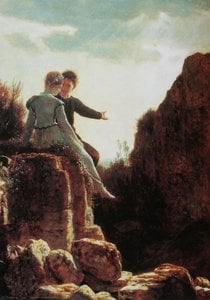
Арнолд Бьоклин, 1827 – 1901

Картини на Арнолд Бьоклин: 100-те най-известни произведения, подредени по рейтинг

Най-известната картина на Арнолд Бьоклин е Островът на мъртвите (Първа версия) (1880), разположена в Öffentliche Kunstsammlung, Базел. С Автопортрет със смъртта, свиреща на цигулка и Война (1896) се допълват трите произведения, които всеки разпознава. Нашият каталог включва 233 произведения на Арнолд Бьоклин; 100-те по-долу са най-гледаните от света, всяко от тях с годината си, музея, в който се съхранява, и причината за неговата значимост.

Класирани според нашия коефициент за популярност, който съчетава търсенията, посещенията и поръчките за всяко произведение. Обновено Октомври 2026. Всяко шедьовър на тази страница може да бъде поръчано като маслено репродукция на ръка с музейно качество или като художествен принт, в избран от Вас размер.

Портрет на Арнолд Бьоклин
Арнолд Бьоклин · 1827 – 1901
Роден · починал
1827 – 1901, Базел
Движение
Symbolist expressionism
Работи в нашия каталог
233
Най-известни
Островът на мъртвите (Първа версия) (1880)
Най-много творби в
Alte Nationalgalerie

10-те най-известни картини на Арнолд Бьоклин

Островът на мъртвите (Първа версия) (1880) на Арнолд Бьоклин
1

Островът на мъртвите (Първа версия)

1880 · Масло върху платно · Öffentliche Kunstsammlung, Базел

В тихите, сенчести коридори на историята на изкуството, малко образи притежават призрачния магнетизъм на Арнолд Бьоклин и неговата Островът на мъртвите (Първа версия). Завършен в началото на 1880-те години, този шедьовър служи като дълбок портал към символизма, където четката на художника не се стреми да отразява реалността, а да събуди нефизическите шепоти на душата. Докато човек взира този монументален холст, той е незабавно пренасян в царство на дълбока тишина и…

Автопортрет със смъртта, свиреща на цигулка на Арнолд Бьоклин
2

Автопортрет със смъртта, свиреща на цигулка

Масло · Alte Nationalgalerie, Берлин

Въздухът в стаята се усеща тежък, наситен с миризма на стара дървесина и тежестта на наближаваща тишина. Мъжът седи в официално облекло, като костюмът и вратовръзката му придават усещане за тъжна достойнство на присъствието му. Той държи цигулка, но не той води мелодията. Зад него от сенките се изплъзва скелетна фигура, чиито костни пръсти танцуват върху струните. Това е среща между живия свят и неизбежното, тихо противостояние, в което музиката…

Война (1896) на Арнолд Бьоклин
3

Война

1896 · Масло върху платно · Kunsthaus Zürich, Цюрих

Силата на конфликта: „La Guerre“ на Арнолд Бьоклин Субект и композиция „La Guerre“ (1896) на Арнолд Бьоклин е драматично изследване на конфликта и хаоса. Този мощен символистски шедьовър изобразява насилствена сцена, изпълнена с човешки и вероятно свръхестествени фигури, ангажирани в борба. Композицията е гъста и слоеста, включваща централен кластер от фигури в интензивни действия. Мъж в червено повдига брадва над главата си, готов да удари, докато жена с развяваща се…

The isle of the dead (Version 3) (1883) на Арнолд Бьоклин
4

The isle of the dead (Version 3)

1883 · Oil On Panel · Alte Nationalgalerie, Берлин

In the quietude of the late nineteenth century, few images captured the collective psyche of Europe as profoundly as Arnold Böcklin’s The Isle of the Dead. This particular version, a haunting masterpiece from 1883, serves as more than a mere landscape; it is a portal into the subconscious. As the viewer's eye meets the dark, mirror-like waters, there is an immediate sense of profound stillness, a hush that commands reverence.…

Island of the Dead (Version 5) (1886) на Арнолд Бьоклин
5

Island of the Dead (Version 5)

1886 · Acrylic On Canvas · Museum der bildenden Künste, Лайпциг

The Haunting Beauty of Böcklin’s ‘Island of the Dead’ A Timeless Vision Arnold Böcklin's 'Island of the Dead (Version 5)' is more than just a painting; it’s an immersion into a realm of profound melancholy and enduring mystery. Completed in 1886, this iconic Symbolist work continues to captivate viewers with its stark beauty and unsettling serenity. Böcklin masterfully blends naturalistic elements – the rugged coastline, the imposing cypress trees –…

Island of the Dead (1880) на Арнолд Бьоклин
6

Island of the Dead

Introduction Arnold Böcklin's painting "Island of the Dead" is one of his most famous works, and it has been widely reproduced in prints. The painting depicts a desolate and rocky islet seen across an expanse of dark water, with a small rowboat carrying a shrouded figure approaching the shore. Size and Media The original painting measures 73.7 x 121.9 cm (29 x 48 in.) and is painted in oil on…

L'Îlle des morts на Арнолд Бьоклин
8

L'Îlle des morts

Oil On Canvas · Museum der bildenden Künste, Лайпциг

A rocky islet rises from a still, dark sea, its jagged silhouette defined by the presence of cypress trees. The composition centers on a small boat approaching the shore, carrying figures toward the silent, stony terrain. This scene, rendered in oil, captures a moment of profound stillness where the boundary between the physical world and the afterlife becomes porous. The atmosphere is heavy with the weight of transition, suggesting a…

Pont dans un paysage de montagne на Арнолд Бьоклин
9

Pont dans un paysage de montagne

Oil On Canvas · Alte Nationalgalerie, Берлин

Arnold Böcklin’s Pont dans un paysage de montagne is not merely a depiction of stone and foliage; it is an invitation—a sublime passage into a realm where the tangible world dissolves into myth and profound contemplation. This masterpiece, steeped in the evocative atmosphere of Symbolism, immediately draws the viewer across its painted threshold. One gazes upon a bridge, elegantly spanning a valley carved by time, set against a backdrop of…

Арнолд Бьоклин, картини от 11 до 100

Diana's Hunt на Арнолд Бьоклин
#18

Diana's Hunt

In Diana's Hunt, Arnold Böcklin employs a horizontally oriented composition to organize a complex mythological landscape. A large hill dominates the background, creating a sweeping diagonal line that…

Купете го за дома си →
La peste на Арнолд Бьоклин
#19

La peste

In this unsettling scene, we find ourselves witnessing a moment of profound, inevitable decay. A monstrous, winged creature, reminiscent of a bat, moves through the narrow streets of…

Купете го за дома си →
Veritas (1881) на Арнолд Бьоклин
#21

Veritas

1881 · Баварски държавни списъци с произведения на изкуството

In this somber monochrome portrait, the figure of Veritas emerges from a deep, undifferentiated void. Painted by Arnold Böcklin about 1881, the work presents a female personification of…

Купете го за дома си →
Roman May Day (1872) на Арнолд Бьоклин
#25

Roman May Day

1872 · Баварски държавни списъци с произведения на изкуството

In this 1872 oil painting, we find ourselves drawn into a somber, twilight landscape that feels heavy with the weight of antiquity. The scene is set within a…

Купете го за дома си →
The hermit (1863) на Арнолд Бьоклин
#45

The hermit

1863 · Баварски държавни списъци с произведения на изкуството

A single figure sits perched upon a jagged rocky outcrop, hunched in a pose of heavy reflection. The landscape is a vertical struggle between a towering, dark cliff…

Поръчайте репродукция →
Honeymoon (1890) на Арнолд Бьоклин
#46

Honeymoon

1890 · Städel Museum

Arnold Böcklin's "Honeymoon," painted in 1890, is more than just a picturesque landscape; it’s a carefully constructed meditation on love, aspiration, and the profound connection between humanity and…

Поръчайте репродукция →
Sappho (1862) на Арнолд Бьоклин
#52

Sappho

1862 · Philadelphia Museum of Art

In this 1862 oil painting, a solitary female figure is positioned on a rocky ledge within a dense, dark woodland. The subject, identified as the poet Sappho, is…

Поръчайте репродукция →
A Sacred Grove (1871) на Арнолд Бьоклин
#53

A Sacred Grove

1871 · Баварски държавни списъци с произведения на изкуството

is an oil on canvas painting by the artist Arnold Böcklin. The work was created about 1871. This piece is part of the collections held by the Kunstmuseum…

Купете го за дома си →
A Cliff Face (1852) на Арнолд Бьоклин
#57

A Cliff Face

1852 · Национална галерия

In A Cliff Face, Arnold Böcklin presents a somber landscape study of rugged geological formations. The composition is dominated by a large, diagonal mass of rock that slopes…

Поръчайте репродукция →

Картини на Арнолд Бьоклин по периоди

Обичаните сюжети на Арнолд Бьоклин

Четирите най-често срещани сюжета сред тези шедьоври, с най-добрия пример за всеки от тях.

Къде могат да се видят картините на Арнолд Бьоклин

8 музея, които притежават най-голям брой от картините на тази страница.

Музеи Град Творения на Арнолд Бьоклин Картини от този списък
Alte Nationalgalerie, БерлинAlte Nationalgalerie Берлин 20 Автопортрет със смъртта, свиреща на цигулка, The isle of the dead (Version 3), Pont dans un paysage de montagne
Баварски държавни списъци с произведения на изкуството, МюнхенБаварски държавни списъци с произведения на изкуството Мюнхен 25 Veritas, Nymph at a Spring, Roman May Day
Staatliche Kunsthalle Karlsruhe, КарлсруеStaatliche Kunsthalle Karlsruhe Карлсруе 4 Poverty and Sorrow, Roman wine tavern, Landscape in the Roman Campagna
Kunsthaus Zürich, ЦюрихKunsthaus Zürich Цюрих 5 Война, Centaur Watching Fish, Le Réveil du printemps
Städel Museum, ФранкфуртStädel Museum Франкфурт 4 Le Voyage de noces, Honeymoon, Villa by the Sea III
Museum der bildenden Künste, ЛайпцигMuseum der bildenden Künste Лайпциг 2 Island of the Dead (Version 5), L'Îlle des morts
Philadelphia Museum of Art, ФиладелфияPhiladelphia Museum of Art Филаделфия 2 Nymph and Satyr, Sappho
Schloss Weimar, WeimarSchloss Weimar Weimar 2 At Krazenbach in Unterwalden, Rocky landscape with a hunting centaur

Най-известната картина на Арнолд Бьоклин за всяко десетилетие

  1. 1840s
  2. 1850s
    Nymph at a Spring (1855) на Арнолд Бьоклин
    № 24 от 100

    Nymph at a Spring

    Възраст 23 – 32 · Баварски държавни списъци с произведения на изкуството

    In Nymph at a Spring, we encounter the early hand of Arnold Böcklin. Painted about 1855, this work captures the Swiss artist during a formative period of his…

  3. 1860s
    The Artist and his Wife (1863) на Арнолд Бьоклин
    № 27 от 100

    The Artist and his Wife

    Възраст 33 – 42 · Alte Nationalgalerie

    The painting titled The Artist and his Wife was executed by the artist Arnold Böcklin. This work dates to 1863. It is an oil painting that depicts two…

  4. 1870s
    Weeping at the Cross (1876) на Арнолд Бьоклин
    № 11 от 100

    Weeping at the Cross

    Възраст 43 – 52 · Alte Nationalgalerie

    Arnold Böcklin's 1876 work, Weeping at the Cross, presents a somber scene of profound grief following the crucifixion. The subject matter is religious and tragic, centering on the…

  5. 1880s
    Островът на мъртвите (Първа версия) (1880) на Арнолд Бьоклин
    Место 1 от 100

    Островът на мъртвите (Първа версия)

    Възраст 53 – 62 · Öffentliche Kunstsammlung

    В тихите, сенчести коридори на историята на изкуството, малко образи притежават призрачния магнетизъм на Арнолд Бьоклин и неговата Островът на мъртвите (Първа версия). Завършен в началото на 1880-те…

  6. 1890s
    Война (1896) на Арнолд Бьоклин
    № 3 от 100

    Война

    Възраст 63 – 72 · Kunsthaus Zürich

    Силата на конфликта: „La Guerre“ на Арнолд Бьоклин Субект и композиция „La Guerre“ (1896) на Арнолд Бьоклин е драматично изследване на конфликта и хаоса. Този мощен символистски шедьовър…

  7. 1900s
    Playing in the Waves (1900) (1900) на Арнолд Бьоклин
    #44 от 100

    Playing in the Waves (1900)

    Възраст 73 – 74 · Баварски държавни списъци с произведения на изкуството

Въпроси относно картините на Арнолд Бьоклин

Коя е най-известната картина на Арнолд Бьоклин?Покажи отговора

Островът на мъртвите (Първа версия) (1880), Öffentliche Kunstsammlung, Базел. Следват Автопортрет със смъртта, свиреща на цигулка и Война (1896).

На колко години е бил Арнолд Бьоклин, когато е нарисувана Островът на мъртвите (Първа версия)?Покажи отговора

53 години: Островът на мъртвите (Първа версия) е от 1880 г., а Арнолд Бьоклин е роден/а в 1827.

Кои са 10-те най-добри картини на Арнолд Бьоклин?Покажи отговора

Островът на мъртвите (Първа версия), Автопортрет със смъртта, свиреща на цигулка, Война, The isle of the dead (Version 3), Island of the Dead (Version 5), Island of the Dead, The Isle of the Dead (Version 2), L'Îlle des morts, Pont dans un paysage de montagne и L'Îlle des morts 1. Класацията по-горе посочва годината и музея на всяко от тях.

Колко картини е създал Арнолд Бьоклин?Покажи отговора

В нашия каталог са изброени 233 произведения на Арнолд Бьоклин, датирани от 1847 до 1900.

Къде се намират най-известните картини на Арнолд Бьоклин?Покажи отговора

Повечето от тях се намират в Alte Nationalgalerie (Берлин), Баварски държавни списъци с произведения на изкуството (Мюнхен) и Staatliche Kunsthalle Karlsruhe (Карлсруе). В горната таблица музеите са изброени един по един.

Кога Арнолд Бьоклин е създал най-известните си произведения?Покажи отговора

В 1870s: 20 от 100 произведенията на тази страница са от този период, като сред тях са Weeping at the Cross.

Кои са най-ранните и най-късните известни картини на Арнолд Бьоклин?Покажи отговора

Най-старата творба на тази страница е от At Krazenbach in Unterwalden (1847), а най-новата е от Playing in the Waves (1900) (1900).

Какво най-често е рисувал Арнолд Бьоклин?Покажи отговора

Trees (15), Sky (12) и Rocks (11), сред 100 произведения на тази страница.

Коя техника използва най-често Арнолд Бьоклин?Покажи отговора

Oil On Canvas: 25 от общо 100 произведения на тази страница.

Към коهто художествено направление принадлежи Арнолд Бьоклин?Покажи отговора

Symbolist expressionism, както показват картините на тази страница.

Кои картини на Арнолд Бьоклин мога да видя в Alte Nationalgalerie?Покажи отговора

Автопортрет със смъртта, свиреща на цигулка, The isle of the dead (Version 3) и Pont dans un paysage de montagne са сред 13-те произведения на тази страница, съхранявани в Alte Nationalgalerie, Берлин.

Мога ли да купя репродукция на картина на Арнолд Бьоклин?Покажи отговора

Да. Всяка картина на тази страница може да бъде поръчана като ръчно рисувано маслено репродукция музейно качество или като художествен принт в избран от Вас размер, директно от страницата на съответната картина.

За Арнолд Бьоклин

The Shadow of the Isle

Basel, Switzerland, provides the starting point for a life defined by the tension between the tangible and the spectral. Born on October 16, 1827, to Christian Frederick Böcklin and Ursula Lippe, the young man would eventually move beyond the silk trade of his father to the rigorous halls of the Düsseldorf Academy. Under the guidance of Schirmer, he began to absorb the language of landscape, a skill that would later be used to map the geography of the human soul. He did not merely paint scenery; he constructed realms where the classical and the macabre collide.

The movement from the academic discipline of Düsseldorf to the light of Paris and the ancient weight of Rome marks a fundamental shift in his vision. In the Louvre, he absorbed the history of the masters, but it was the atmosphere of Italy that truly shaped his hand. He returned to Rome between 1862 and 1866, a period where his palette began to favor more violent, expressive colors. This was not the bright, sun-drenched Italy of the Renaissance, but a place of deep shadows and mythological weight. His work began to lean into the allegorical, using figures from antiquity to explore the heavy, inescapable presence of mortality.

The Architecture of Dreams

By the late 19th century, his reputation was anchored by a specific, haunting preoccupation. Between 1880 and 1886, he produced five versions of The Isle of the Dead. This work, inspired by the English cemetery in Florence where his daughter was buried, became a focal point for the Symbolist movement. It is a scene of profound stillness: a rocky islet, dark cypress trees, and a rowboat approaching a silent shore. The painting does not merely depict a place; it depicts a state of being. This ability to render the intangible—the whispers of dreams and the weight of the afterlife—placed him at the center of a new European sensibility.

His technical approach often utilized a thick, expressive impasto, particularly in works like La Guerre (1896). In this piece, the canvas trembles with the chaos of conflict. He avoids the clean lines of traditionalism, opting instead for a dense, layered composition where figures clash amidst crumbling architecture. It is a visceral manifestation of destruction, where the veil between myth and reality dissolves into a storm of shadows. His style overlapped with the Pre-Raphaelites, yet he remained distinct, focused on a mysticism that felt both ancient and unsettlingly modern.

A Legacy of Influence

The impact of his imagery extended far beyond the canvas, reaching into the auditory realm of late-Romantic music. His paintings provided a visual stimulus for composers, most notably influencing the atmosphere of Gustav Mahler’s work. His ability to bridge the gap between the visual and the psychological meant that his influence was felt by those who sought to represent the subconscious. His reach touched several generations of artists:

  • Hans Thoma, a younger artist influenced by his symbolic depth.
  • Giorgio de Chirico, who found a profound connection in the isolation of Böcklin's compositions.
  • Salvador Dalí and Max Ernst, who drew from his ability to blend the comic with the nightmarish.
  • Marcel Duchamp, who noted the artist's significant influence on his own development.

He died in Fiesole, Italy, leaving behind a body of work that refused to be easily categorized. He was a painter of the Swiss landscape, the Roman tavern, and the mythological grove, yet his true subject remained the silent, enduring presence of the unknown. His works remain held in significant collections, including the Kunstmuseum Basel and the Kunsthaus Zürich, serving as anchors for those exploring the intersection of myth and mortality.

Всички 233 произведения на Арнолд Бьоклин →