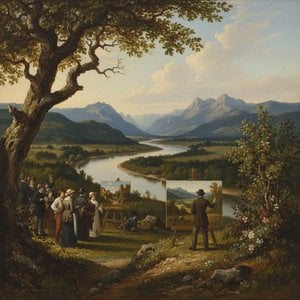
A Life Dedicated to Likeness: The Portraits of May Bridges Lee
May Bridges Lee, born in 1884 and passing away in 1977, was a quietly prolific British portrait artist whose work offers a fascinating glimpse into the social fabric of early 20th-century Britain. While not a household name today, her extensive body of work – particularly her commissions for the Royal Masonic Hospital – provides a valuable record of prominent figures and a compelling example of Victorian and Edwardian portraiture traditions continuing into the modern era. Her story is one of dedication to craft, keen observation, and a subtle ability to capture not just appearance but also character within her subjects. Often referred to as Lady Stott through marriage, she navigated a professional life that balanced artistic ambition with societal expectations for women of her time.Early Life and Artistic Training
Details regarding Bridges Lee’s early life remain somewhat scarce, typical for many female artists of the period whose personal histories were often overshadowed by their male counterparts. However, it is known she received a solid artistic education, likely through private tuition – common for women of her social standing who aspired to be professional artists but lacked access to formal art school training available primarily to men. This early grounding instilled in her a mastery of traditional techniques, particularly oil painting and drawing. Her style demonstrates a clear understanding of light and shadow, anatomical accuracy, and the meticulous rendering of textures – skills that would become hallmarks of her mature work. The influence of established portrait painters of the late 19th century is evident in her early pieces; she absorbed the lessons of artists like John Singer Sargent and George Watts, adapting their approaches to suit her own sensibilities.The Royal Masonic Hospital Commissions: A Defining Project
Bridges Lee’s most significant contribution lies in her decades-long association with the Royal Masonic Hospital (now the Freemasons' Hospital). Beginning in the 1930s, she undertook an extraordinary series of portraits depicting hospital officials, benefactors, and medical staff. These were not merely formal representations; they served as a visual chronicle of the institution’s history and its commitment to charitable work. Over two hundred portraits were created for the Hospital, transforming its corridors into a gallery of distinguished faces. This sustained project allowed Bridges Lee to hone her skills and develop a distinctive approach to portraiture – one that emphasized dignity, respect, and a subtle psychological depth. She wasn’t simply painting *who* these people were, but also conveying their dedication to the hospital's mission. The portraits are remarkable for their consistency in quality and their ability to capture the individual personalities of her sitters.Style and Technique: A Legacy of Realism
Bridges Lee’s artistic style is firmly rooted in realism, though not without a touch of sensitivity and refinement. She favored a traditional oil painting technique, building up layers of color to create rich textures and luminous skin tones. Her compositions are typically straightforward – often depicting her sitters in three-quarter profile against neutral backgrounds – allowing the focus to remain squarely on their faces and expressions. She possessed an exceptional eye for detail, meticulously rendering clothing, jewelry, and other accessories with remarkable precision. However, her portraits are not simply photographic reproductions; she skillfully used light and shadow to sculpt form and create a sense of volume. More importantly, she imbued her subjects with a quiet dignity and psychological presence, suggesting their inner lives beyond the surface appearance. Her work reflects an understanding of Victorian ideals of portraiture – emphasizing moral character and social standing – but also demonstrates a modern sensibility in its subtle exploration of individual personality.Historical Significance and Enduring Appeal
May Bridges Lee’s historical significance lies not in groundbreaking innovation, but in her steadfast commitment to a traditional art form during a period of rapid change. She represents a generation of artists who continued to uphold the values of realism and craftsmanship while navigating the challenges of modernity. Her extensive series of portraits for the Royal Masonic Hospital provides an invaluable visual record of a significant charitable institution and its supporters.- Her work offers insights into the social hierarchies and philanthropic endeavors of early 20th-century Britain.
- The portraits serve as compelling examples of Victorian and Edwardian portraiture traditions continuing into the modern era.
- Bridges Lee’s dedication to her craft and her ability to capture both likeness and character make her a noteworthy figure in British art history.
Въпроси и отговори
Мога ли да разгледам творбите на May Bridges Lee според цветния спектър?
Страницата Спектрален индекс организира творбите на May Bridges Lee по цвят.
Има ли преглед на всички теми, които May Bridges Lee е изобразявал?
Страницата Атлас по теми представя творбите на May Bridges Lee по теми.
С какви псевдоними или алтернативни имена е известен May Bridges Lee?
May Bridges Lee се появява и под алтернативните имена Lady Stott.