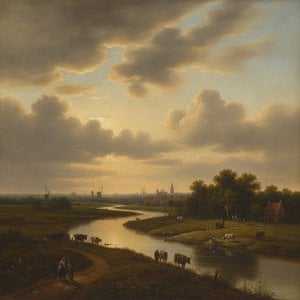
The Maritime World of Ludolf Backhuysen: A Life Painted in Waves
Ludolf Backhuysen, born in Hamburg in 1630 and passing away there in 1708, was not merely a painter; he was a chronicler of the sea. His life unfolded against the backdrop of a burgeoning maritime power, a city intimately connected to trade, exploration, and the unpredictable temperament of the North Sea. While biographical details remain somewhat sparse – Backhuysen’s art speaks far more eloquently than documented accounts – we know he came from a family of artists; his father, Hans Backhuysen, was also a painter, though less renowned. This familial influence undoubtedly sparked Ludolf's early interest in capturing the drama and beauty of ships and harbors. He initially trained as an accountant, a practical profession for the time, but his passion for painting proved too strong to ignore. By 1659, he had abandoned bookkeeping entirely, dedicating himself fully to depicting the vessels that defined Hamburg’s prosperity.From Detailed Records to Atmospheric Seascapes
Backhuysen's early works are characterized by a remarkable precision and attention to detail. He meticulously rendered each ship – its rigging, sails, flags, and hull – with an almost topographical accuracy. These paintings weren’t simply artistic representations; they served as valuable records for merchants and ship owners, documenting their fleets and individual vessels. However, Backhuysen wasn't content to remain a mere technical draftsman. Over time, his style evolved, moving beyond strict documentation towards a more expressive and atmospheric approach. He began to focus on the interplay of light and shadow, capturing the turbulent energy of storms, the serene calmness of sunlit waters, and the subtle nuances of weather conditions. This shift reflects a growing interest in the Romantic ideals that were beginning to take hold across Europe, emphasizing emotion and subjective experience over purely objective representation. His palette broadened, incorporating richer tones and more dynamic brushwork.Influences and Artistic Kinship
Identifying direct influences on Backhuysen is complex. He largely developed his unique style independently, rooted in the specific maritime environment of Hamburg. However, scholars point to similarities with Dutch marine painters like Simon de Vlieger and Jan van Kessel, particularly in their shared focus on ship detail and harbor scenes. The influence of Dutch masters is evident in Backhuysen’s use of light and composition, but he distinguished himself through his distinctly Northern aesthetic – a cooler palette, more dramatic skies, and a greater emphasis on the raw power of nature. He also absorbed elements from Italianate landscape painting, incorporating classical compositional principles into his seascapes. Backhuysen’s work stands as a fascinating synthesis of Dutch precision, Italian grandeur, and a uniquely Hamburgian sensibility.A Legacy Forged in Paint and Water
Throughout his career, Backhuysen produced an astonishing number of paintings – estimates range upwards of 150 known works. He became the official painter to the Hamburg Admiralty, further solidifying his reputation as the city’s preeminent marine artist. His paintings were highly sought after by merchants, ship owners, and collectors alike, not only for their accuracy but also for their artistic merit.- Backhuysen's depictions of ships in distress – battling fierce storms or navigating treacherous ice floes – are particularly compelling.
- He masterfully captured the bustling activity of Hamburg harbor, portraying a vibrant microcosm of 17th-century life.
- His later works demonstrate a remarkable ability to convey atmosphere and emotion through subtle variations in light and color.
Historical Significance: A Window into a Maritime Age
Ludolf Backhuysen’s historical significance extends far beyond his artistic achievements. His paintings offer invaluable insights into the maritime world of the 17th century – the types of ships used, the methods of navigation, and the daily lives of sailors and merchants. They serve as visual documents of a pivotal era in European history, when trade and exploration were transforming global economies and cultures. More than just paintings, Backhuysen’s works are portals to another time, allowing us to experience the sights, sounds, and emotions of a bustling port city and the vast, unpredictable ocean that sustained it. His legacy continues to inspire artists and captivate audiences today, reminding us of the enduring power of art to capture both the beauty and the drama of the natural world.Въпроси и отговори
Има ли хронологическа история на Ludolf Backhuysen?
Кариерата на Ludolf Backhuysen се разгръща период по период на страницата Хронология: хоризонтална хронология от произведения, групирани в глави според различните етапи от кариерата му.
Как да намеря творби на Ludolf Backhuysen в специфична цветова палитра?
За да намерите творби на Ludolf Backhuysen в определена цветова палитра, посетете страницата на художника: По палитра.
Къде мога да разгледам всички произведения на Ludolf Backhuysen?
Всички произведения на Ludolf Backhuysen в ето този уебсайт могат да бъдат разгледани на неговата страница с всички творби: Всички произведения на изкуството.