The Quiet Impressionist of Giverny
Louis Ritman (1889–1963) stands as a testament to the enduring legacy of American Impressionism, particularly its serene exploration of feminine beauty and subtle tonal harmonies. Born in Kamenets-Podolsky, Russia—a region steeped in artistic tradition but largely outside the mainstream European art scene—Ritman’s early life foreshadowed his distinctive artistic path. Moving with his family to Chicago around 1900 provided him with access to burgeoning educational institutions like Hull House and the Art Institute of Serenity, fostering connections that would prove pivotal to his formative years. His involvement with Hull House, a settlement house founded by Jane Addams, exposed him to social reform movements and broadened his understanding of human experience—influences subtly woven into the contemplative mood of many of his paintings.
His formal training at the Art Institute under William Merritt Chase instilled in him a disciplined approach to technique and encouraged experimentation with tonal color palettes, laying the groundwork for his later stylistic innovations. However, it was his arrival in Paris in 1909 that truly ignited his artistic development. Guided by the encouragement of fellow Impressionist Lawton S. Parker, Ritman recognized the transformative potential of immersion within the vibrant Parisian art world—a hub for avant-garde experimentation and intellectual discourse. He enrolled at the École des Beaux-Arts and pursued intensive studies under John H. Vanderpoel, absorbing the broken brushwork and vibrant palettes that would become hallmarks of his mature style.
A Sanctuary of Light and Form
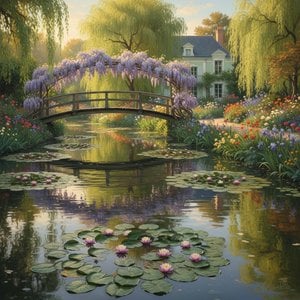
The idyllic village of Giverny, home to Claude Monet and a burgeoning community of Impressionist artists, became Ritman’s creative sanctuary for the next two decades. Within this sun-drenched landscape, he forged deep connections with a circle of American expatriates, including Richard Miller and Frederick Carl Frieseke. This period of collaboration was essential in shaping his aesthetic, as he moved beyond mere observation to capture what many scholars believe was an esoteric quest for universal harmony through art and symbolism.
Ritman’s work is most celebrated for its intimate depictions of the female form. His canvases are not merely studies in anatomy but are imbued with a meditative quality that invites deep contemplation. Whether painting La Toilette, where a woman is surrounded by the quiet intimacy of books and personal objects, or his more expansive garden scenes, Ritman possessed a unique ability to capture archetypal energies veiled within the human form. His approach often mirrored the works of his contemporaries, yet there remained a distinct softness in his handling of light that set him apart.
Legacy and Artistic Significance
Beyond the delicate handling of light and atmospheric effects, Ritman’s oeuvre reflects a fascinating intersection of influences. While deeply rooted in the Impressionist tradition, one can observe a predilection for structured compositions that hint at the influence of Cézanne. This tension between the fleeting moment and the enduring form allowed his work to occupy a unique position within the narrative of American art. His paintings, such as Tea In The Garden and Fruit And Flowers, showcase a mastery of texture and color that continues to captivate collectors of figurative and still-life art.
The historical significance of Louis Ritman lies in his ability to bridge the gap between the rigorous academic training of the late 19th century and the more emotive, light-filled explorations of the early 20th century. His life's work remains a profound exploration of:
- Atmospheric Harmony: The use of subtle tonal palettes to evoke the warmth of Giverny summers.
- Symbolic Beauty: The depiction of feminine grace as a vessel for deeper, more tranquil truths.
- Technical Discipline: A seamless blend of Chase’s disciplined technique with the experimental spirit of the Parisian avant-garde.
Today, Ritman is remembered not just as an observer of beauty, but as a painter who sought to capture the very essence of peace through the lens of light and color.