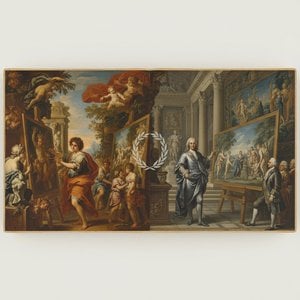
Laurent Pécheux (1729–1821): A Roman Neoclassical Master
Laurent Pécheux (1729–1821) stands as a pivotal figure in the artistic landscape of late 18th-century Rome and Northern Italy, embodying the spirit of Neoclassicism while simultaneously absorbing Romantic naturalism’s burgeoning influence. Born in Lyon, France, Pécheux embarked on an artistic journey marked by rigorous training at the Jesuit College before being propelled towards Paris where he honed his skills under luminaries like Charles-Joseph Natoire, Jean-Baptiste Pillement, and Jean-Antoine Morand – artists who championed a revival of classical ideals amidst the turbulent currents of Enlightenment thought.
The decisive turning point arrived in 1751 when influential Roman painters Gabriel-François Deyon and Augustin Pajou, winners of the Prix de Rome, persuaded him to relocate to Rome, securing substantial patronage from his father. This move cemented Pécheux’s connection with the artistic epicenter of Europe and initiated a prolific period characterized by collaboration with celebrated masters such as Antonio Raphael Mengs and Pompeo Batoni – figures who shaped the aesthetic sensibilities of their time. Pécheux's studio quickly became a hub for aspiring artists, attracting students eager to absorb the lessons of Roman tradition.
A commission from Princess Maria Luisa of Bourbon-Parmas in 1777 brought Pécheux into direct contact with the royal court and propelled him towards Turin where he served as professor of painting at the Accademia Albertina. This role fostered an environment conducive to experimentation and innovation, allowing Pécheux to explore diverse artistic styles while maintaining a steadfast commitment to anatomical accuracy and expressive realism—traits that would define his oeuvre. His final years were spent in Turin, leaving behind a legacy of impactful artwork and teaching experience.
- Notable Works: “Narcisse,” “La mort d’Epaminondas,” “Sacrifice au Dieu Mars” exemplify Pécheux's masterful command of Baroque techniques combined with Romantic naturalism.
- Influences: Mengs, Batoni and Natoire profoundly impacted Pécheux’s artistic vision, fostering a deep appreciation for classical sculpture and painting principles.
- Technique: Pécheux excelled in oil painting, utilizing meticulous layering and vibrant color palettes to convey emotion and detail with unparalleled precision.
Laurent Pécheux's contribution to the artistic canon extends beyond individual masterpieces; he served as a conduit for disseminating classical ideals into the Romantic era. His influence can be discerned in subsequent generations of painters who embraced anatomical realism and sought inspiration from Roman art history—solidifying his position as an enduring symbol of Neoclassical excellence and a cornerstone of Italian Baroque heritage.