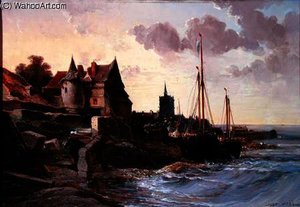
Constant Troyon: Bridging Porcelain and Pastoral
Constant Troyon, born in Sèvres in 1810, was an artist whose journey spanned a remarkable range of artistic pursuits – from the meticulous detail of porcelain decoration to the expansive landscapes and captivating animal studies that would ultimately define his legacy. His early life, steeped in the traditions of the renowned Sevres factory, instilled within him a profound appreciation for craftsmanship and precision, skills he initially honed through years of dedicated work on delicate ceramic surfaces. This formative period, demanding an exacting eye and steady hand, subtly shaped his artistic sensibilities, laying the groundwork for his later mastery of observation and technique. It’s a fascinating paradox – a life beginning with such intricate miniature detail ultimately leading to grand depictions of nature's vastness.
Early Influences and Artistic Development
Troyon’s artistic trajectory began as a wanderer, seeking inspiration across France. He initially pursued landscape painting, capturing fleeting moments of beauty with a nascent talent. However, it was his encounter with the Barbizon school – Camille Roqueplan, Jules Dupré, and others – that proved pivotal. Roqueplan, an older artist known for his evocative depictions of rural life, recognized Troyon’s potential and introduced him to the core principles of this movement: a commitment to painting *en plein air*, direct observation of nature, and a rejection of academic conventions. This immersion in the Barbizon style profoundly impacted Troyon's approach, shifting his focus from idealized representations to a more realistic portrayal of the natural world. The influence of artists like Cuyp and Rembrandt, whose works he studied intently, further refined his understanding of light, composition, and emotional resonance within landscape painting.
The Rise of the Animal Painter
A turning point in Troyon’s career arrived with a visit to the Netherlands in 1846, where he encountered Paulus Potter's iconic “Young Bull.” This encounter ignited a passion for animal painting that would become his defining characteristic. Potter’s masterful depiction of bovine anatomy and behavior captivated Troyon, inspiring him to dedicate himself to capturing the essence of animals – their strength, vulnerability, and inherent dignity – with unprecedented realism. He spent years observing cattle in various settings, meticulously studying their movements, expressions, and interactions. This dedication culminated in a series of celebrated paintings that showcased his remarkable ability to convey both the physical presence and psychological depth of these creatures. His work wasn’t merely about accurate representation; it was an attempt to capture the spirit of the animal, its connection to the land, and its place within the natural order.
Royal Patronage and International Recognition
Troyon's talent quickly gained recognition, attracting the attention of influential patrons like Queen Charlotte and ultimately securing commissions from European royalty and wealthy collectors. His paintings were exhibited widely, garnering critical acclaim and establishing him as a leading figure in the Barbizon school. The American art critic Albert Wolff famously described Troyon’s later work as “a new method of painting,” highlighting his innovative approach to capturing light, atmosphere, and animal behavior. This international success cemented his place within the broader European artistic landscape, bridging the gap between French tradition and burgeoning modernism.
Legacy and Historical Significance
Constant Troyon’s legacy extends beyond his individual paintings. He represents a crucial link between the meticulous craftsmanship of porcelain decoration and the expressive power of landscape and animal painting. His dedication to *en plein air* observation, combined with his profound understanding of anatomy and behavior, established him as a pioneer in capturing the essence of nature. His works continue to be admired for their realism, emotional depth, and evocative portrayal of the natural world, solidifying his position as one of the most significant artists of the Barbizon school and a key figure in 19th-century French art. His paintings offer a valuable window into a bygone era, reflecting both the artistic trends of his time and the enduring fascination with the beauty and power of the animal kingdom.