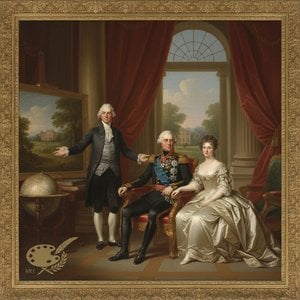
A Life Dedicated to Likeness: The World of John Hayter
John Hayter RA (1800-1895) occupies a fascinating, if sometimes understated, position within the pantheon of 19th-century British portraiture. While perhaps not possessing the household name recognition of contemporaries like Lawrence or Gainsborough, Hayter’s career was remarkably prolific and deeply interwoven with the fabric of Victorian society. Born into an artistic family in St James's, United Kingdom, his path seemed predetermined – a destiny he embraced wholeheartedly, ultimately becoming Painter-in-Ordinary to Queen Victoria herself. This appointment wasn’t merely a title; it signified Hayter’s ability to capture not just physical resemblance, but also the essence of character and social standing within an era defined by rigid hierarchies and evolving sensibilities. His story is one of diligent craftsmanship, astute observation, and a keen understanding of the power inherent in portraying those who shaped their age.Early Influences and Artistic Formation
The artistic lineage surrounding Hayter was undeniably formative. As the second son of miniaturist Charles Hayter and brother to Sir George Hayter – both successful portraitists in their own right – he grew up immersed in a world of pigments, brushes, and discerning clientele. This familial influence instilled within him not only technical skill but also an appreciation for the nuances of capturing likeness. He formally began his training at the Royal Academy Schools in 1815, quickly demonstrating both aptitude and ambition by exhibiting work there in the same year. The early years were a period of absorbing established techniques and developing his own artistic voice within the prevailing neoclassical style. However, Hayter wasn’t simply a mimic; he possessed an innate sensitivity that allowed him to move beyond mere replication towards portraits imbued with personality and psychological depth. His brother George also played a role in shaping his career, as both artists navigated the competitive landscape of London's art world.Mastering the Art of Portraiture: Technique and Style
Hayter’s artistic style evolved within the conventions of Victorian portraiture, prioritizing realism and meticulous attention to detail. While proficient in oil painting, he became particularly celebrated for his portraits executed in chalk or crayon – a medium that allowed for remarkable subtlety and nuance. These drawings weren't merely preparatory sketches; they were highly sought-after works in their own right, often engraved and widely disseminated through publications like *The Court Album*. This album, featuring portraits of female aristocracy, became a significant platform for Hayter’s work, showcasing his ability to capture elegance, refinement, and social status. He skillfully balanced formal composition with an approachable quality, making his portraits appealing to a broad audience. His technique wasn't about flamboyant brushwork or dramatic lighting; it was about quiet observation, precise rendering, and a delicate touch that brought his subjects to life on paper or canvas.A Royal Appointment and Lasting Legacy
The pinnacle of Hayter’s career arrived with his appointment as Painter-in-Ordinary to Queen Victoria. This prestigious position provided him with unparalleled access to the royal family, allowing him to paint the Queen herself on numerous occasions – beginning when she was just twelve years old. These portraits are invaluable historical documents, offering glimpses into the young queen's evolving personality and reign. Beyond his royal commissions, Hayter continued to portray prominent figures of the era, including the Duke of Wellington and opera singer Giuditta Pasta, solidifying his reputation as a leading portraitist. While not always achieving the same level of critical acclaim as some of his contemporaries, John Hayter played a crucial role in documenting Victorian society through his art. His work provides valuable insights into the fashion, social customs, and personalities of the era, serving as an important visual record of a transformative period in British history. He left behind a legacy not of radical innovation, but of consistent quality, skillful execution, and a dedication to capturing the likenesses of those who defined his time. His skill in chalk portraiture remains particularly noteworthy, showcasing a delicate technique that captured both physical resemblance and inner character with remarkable finesse.Въпроси и отговори
Как се развива изкуството на John Hayter с течение на времето?
Хронологичен преглед на творчеството на John Hayter може да бъде открит на страницата Хроника, където произведенията следват реда на създаване им, разделени по периоди.
Къде мога да видя цветовата палитра на творчеството на John Hayter?
Използването на цвят от John Hayter в произведенията, изброени в този уебсайт, може да бъде проучено на страницата за Геном на палитрата на художника.
Къде могат да бъдат намерени произведенията на John Hayter, групирани по ключови думи?
Работите на John Hayter могат да бъдат разгледани по ключови думи на страницата за произведения на John Hayter чрез По ключови думи. Всяка ключова дума групира съответните произведения на изкуството.