The Emergence of a Glasgow Master
Born in the industrial heart of Kelvinhaugh, Glasgow, in 1846, James Lawton Wingate’s journey into the world of fine art was one of profound transformation. Before he was a celebrated painter, he labored as a commercial clerk, yet his true vocation revealed itself in the quiet, early morning hours dedicated to the study of drawing. This period of disciplined self-instruction laid the foundation for a career that would eventually bridge the gap between the structured traditions of the Victorian era and the burgeoning light of Impressionism. His early exposure to the teachings of Ruskin and the Pre-Raphaelite movement instilled in him a reverence for detail, a trait that would later harmonize with his more fluid, atmospheric explorations of the natural world. A pivotal moment arrived during his travels through Italy between 1867 and 1868, where the Mediterranean light and classical landscapes inspired the creation of over one hundred and fifty watercolours, forever altering his perception of color and composition.A Symphony of Light and Atmosphere
As Wingate’s style matured, he moved beyond mere representation to capture the very soul of the British landscape. His work is characterized by a delicate tension between the grandeur of Romanticism and the soft, ephemeral qualities of Impressionistic technique. In masterpieces such as Veiled Moonlight, one can witness his ability to manipulate light, creating an ethereal glow that seems to dance across the Scottish Highlands. He did not merely paint scenery; he painted the feeling of a moment—the weight of the mist, the warmth of a setting sun, and the profound solitude found in nature. This mastery of atmosphere is perhaps best seen through his most evocative subjects:- A Quiet Evening at Fairlie, where the sunset beach scene evokes the rhythmic peace of the coast;
- Veiled Moonlight, a study in melancholic beauty and soft, luminous brushwork;
- His various woodland scenes, which showcase his skill in capturing the intricate interplay of shadow and leaf.
The Poetic Realism of Rural Life
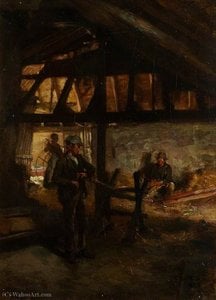
Beyond the sweeping vistas of the Highlands, Wingate possessed a remarkable gift for finding the extraordinary within the ordinary. He turned his gaze toward the rustic textures of everyday existence, imbuing humble settings with a sense of historical weight and dignity. In works like Interior, Carpenter’s Shop, he demonstrates a profound respect for the tactile reality of craftsmanship, using rich textures to bring the dust, wood, and tools of a working studio to life. This facet of his oeuvre reveals an artist deeply rooted in the observation of truth, where every stroke serves to honor the quiet, enduring rhythms of rural life. Through his eyes, the simple act of making straw ropes or the stillness of a barn becomes a subject of high art, cementing his legacy as a painter who could find the sublime in the most modest of corners.Въпроси и отговори
Има ли хронологическа история на James Lawton Wingate?
Хроника на James Lawton Wingate е хронологична линия с функция за превъртане, която представя творбите на художника в хронологичен ред, групирани по периоди от кариерата му.
Мога ли да посетя виртуален музей с творбите на James Lawton Wingate?
3D Музей на James Lawton Wingate е страница, която представя произведенията на художника в една виртуална триизмерна галерия.
От коя държава е James Lawton Wingate?
James Lawton Wingate е роден в United Kingdom.