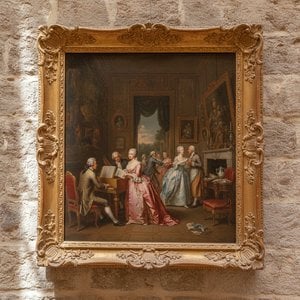
Constance Charpentier: A Life in Portraiture
Early Life and Training
Constance Marie Charpentier was born in Paris, France, on April 4, 1767, and passed away in 1849. Her early life remains somewhat shrouded in mystery, particularly regarding her formal artistic training. Records are unclear, but it is widely believed she studied under several prominent artists of the time.
- She is often associated with Jacques-Louis David, a leading figure of Neoclassicism, though this remains debated.
- Other potential instructors include François Gérard, Pierre Bouillon, Louis Lafitte, and members of the Wille family – Johann Georg Wille or his son, Pierre-Alexandre Wille.
Artistic Development and Style
Charpentier specialized in genre scenes and portraits, with a particular focus on depicting women and children. Her style reflects the influence of Neoclassicism, characterized by clarity, precision, and a restrained emotional palette. However, she also infused her work with a sensitivity to character and an intimate portrayal of domestic life.
- Her paintings often capture moments of quiet contemplation or everyday activity.
- She demonstrated skill in rendering textures and details, particularly in fabrics and facial expressions.
Career and Recognition
Charpentier began exhibiting her work at the Salons – prestigious art exhibitions – from 1795 to 1819. Over this period, she presented approximately thirty paintings to the public.
- In 1814, she received a gold medal at the Paris Salon, marking a significant achievement in her career.
- She was also awarded a silver medal at the Salon in Douai in 1821.
Challenges and Misattributions
Charpentier’s artistic legacy has been complicated by instances of misattribution. Some of her works were initially credited to her teacher, Jacques-Louis David.
- The painting Young Woman Drawing (1801), for example, was first attributed to David, then to Charpentier, but is now believed to be the work of Marie-Denise Villers.
- This highlights the challenges faced by female artists in gaining recognition during this period and the tendency for their contributions to be overlooked or overshadowed.
Legacy and Historical Significance
Despite these challenges, Constance Charpentier is now recognized as one of the finest portrait painters of her era. Based on surviving works positively identified as hers, she demonstrated a remarkable talent for capturing the likenesses and personalities of her subjects.
- Her paintings offer valuable insights into the lives of women and children in late 18th and early 19th-century France.
- She represents an important figure in the history of French art, demonstrating the skill and creativity of female artists during a time when their opportunities were limited.
Въпроси и отговори
От коя държава е Constance Charpentier?
Constance Charpentier е роден в France.
Мога ли да разглеждам творбите на Constance Charpentier по техника?
За да намерите всички творби на Constance Charpentier в определена техника, посетете страницата на художника за Всички техники.
Как да намеря творби на Constance Charpentier в специфична цветова палитра?
За да намерите творби на Constance Charpentier в определена цветова палитра, посетете страницата на художника: По палитра.