The Artistic Journey of Carlos Bernardo Bracher
Born in Juiz de Fora, Brazil, Carlos Bernardo Bracher has cultivated a profound and multifaceted career as a painter, draftsman, sculptor, and engraver. His artistic foundations were laid in his hometown at the Sociedade de Belas Artes Antônio Parreiras around 1959, marking the beginning of a lifelong devotion to visual expression. Seeking to expand his technical horizons, he moved to Belo Horizonte, where between 1965 and 1966, he studied under the esteemed Fayga Ostrower at the Federal University of Minas Gerais. This period of academic rigor was further enriched by his studies in mural and mosaic techniques with Inimá de Paula at the Municipal School of Fine Arts, providing him with a versatile toolkit that would later allow him to navigate between the delicate precision of printmaking and the grand scale of architectural art.
In 1967, Bracher’s burgeoning talent was recognized by the National Salon of Fine Arts in Rio de Janeiro, which awarded him a travel grant for studies abroad. This pivotal opportunity led him to Europe, where he settled primarily in Paris and Lisbon. Immersed in the vibrant artistic currents of these historic cities, he refined his painting techniques and began exhibiting in local galleries, absorbing the diverse influences of the international art scene. Upon returning to Brazil in the mid-1970s, he found a spiritual and creative home in Ouro Preto, Minas Gerais. This setting, rich with colonial history and architectural splendor, became a central theme in his work, as he often explored the interplay between the domestic and the divine through depictions of Baroque churches and Colonial Mineiro houses.
Mastery of Form and Symbolism
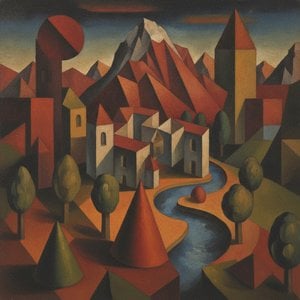
The work of Carlos Bernardo Bracher is characterized by a sophisticated balance between modern abstraction and representational charm. His technique often utilizes a structured approach to form, where buildings and landscapes are not merely subjects but rhythmic elements that guide the viewer's eye. In masterpieces such as Street, Houses and Churches, he creates a serene vision of architectural harmony, presenting hillside vistas that suggest a deep-rooted connection between human habitation and spiritual summits. His ability to capture an atmospheric stillness allows his scenes to feel like cherished memories frozen in light, where the permanence of stone meets the fleeting nature of time.
Beyond his landscapes, Bracher’s versatility is evident in his diverse range of media and thematic explorations:
- Printmaking and Sculpture: His mastery extends into the realms of engraving and sculpture, demonstrating a command over texture and three-dimensional space.
- Tributes and Series: He has demonstrated great depth through dedicated series, such as his poignant paintings created in honor of the centenary of Vincent van Gogh's death, which were exhibited in various galleries and museums across Brazil and abroad.
- Retrospective Milestones: His long-standing career was celebrated in 1989 with a major retrospective exhibition titled Pintura Sempre, which traveled through prominent Brazilian cities including São Paulo, Curitiba, Rio de Janeiro, Brasília, and Belo Horizonte.
Through decades of dedicated practice, Bracher has remained a significant figure in the Brazilian art landscape. His work continues to resonate through its ability to bridge the gap between geometric precision and emotional warmth, offering viewers a window into both the historical soul of Minas Gerais and the universal language of modern art.
Въпроси и отговори
Как мога да разгледам всички произведения на Carlos Bernardo Bracher?
Всяка творба на Carlos Bernardo Bracher в този уебсайт може да бъде разгледана на страницата за всички произведения на Carlos Bernardo Bracher: Всички произведения.
Колко произведения на Carlos Bernardo Bracher са налични за разглеждане?
Можете да разгледате 1 произведения на изкуството творби на Carlos Bernardo Bracher на страницата Всички произведения.
Как се развива изкуството на Carlos Bernardo Bracher с течение на времето?
Хронологичен преглед на творчеството на Carlos Bernardo Bracher може да бъде открит на страницата Хроника, където произведенията следват реда на създаване им, разделени по периоди.